Draft for consultation
Shared Homelessness and Rough Sleeping Strategy 2026-31
Last updated March 2026
DRAFT VERSION
- Bromsgrove District Council
- Malvern Hills District Council
- Redditch Borough Council
- Wychavon District Council
- Wyre Forest District Council
Our Vision - to end homelessness and rough sleeping and where it has not been possible to prevent it from occurring, ensure that it is rare, brief and non-recurring.
Contents
- Introduction
- Pillar 1: Universal prevention – tacking the root causes of homelessness
- Pillar 2: Targeted prevention – targeted support for people at risk of homelessness
- Pillar 3: Preventing crisis – helping people stay in their homes
- Pillar 4: Improving emergency responses – improving temporary accommodation and making people’s experiences better if they do become homeless
- Pillar 5: Recovery and preventing repeat homelessness – ensuring people don’t experience homelessness more than once and halving long term rough sleeping
- Governance arrangements
- Partnerships
Appendix 1 – Action Plan
Appendix 2 - Funding the strategy
Appendix 3 - Glossary of terms
See also Shared Homelessness Review 2025 - draft for consultation
Foreword - Chair of Worcestershire Housing Board
I am proud to introduce this shared Homelessness and Rough Sleeping Strategy 2026-31 for Bromsgrove District Council, Malvern Hills District Council, Redditch Borough Council, Wychavon District Council and Wyre Forest District Council.
Homelessness and rough sleeping remain among the most visible and urgent challenges facing our communities today. They are stark reminders of inequality, vulnerability, and the need for collective action. It is not simply the absence of a home, but the absence of security, dignity, and opportunity. Every child should grow up with the security of a home, and every adult deserves a safe place to live that provides stability and where they have a chance to thrive.
Tackling homelessness and rough sleeping continues to be of utmost importance for each of the councils involved in developing and delivering on this strategy.
Our vision, aligned with the Government’s national strategy, will focus on 5 pillars to end homelessness:
Universal prevention: tackling the root causes of homelessness across the whole population.
Targeted prevention: providing tailored support to people who are more likely to face homelessness.
Preventing crisis: early identification of people who need help and putting in place personalised interventions that meet their needs.
Improving emergency responses: to ensure that if people do become homeless, they receive high quality support and that homelessness is brief.
Recovery and preventing repeat homelessness: helping people rebuild their lives with the right support.
This strategy will also take a renewed approach to the support and intervention for families with children in temporary accommodation to minimise the associated risk and long-term impact this has on them.
We recognise that homelessness is not simply a housing issue, but a complex social challenge shaped by health, employment, family breakdown, and wider economic pressures. Tackling homelessness requires collaboration across government, local authorities, health and social care, the voluntary sector, and communities themselves. That is why we have developed this strategy in collaboration with a range of stakeholders, which is essential to the successful implementation of our vision, as well as with the voice of those with lived experience of homelessness.
I would like to take this opportunity to thank all the organisations and individuals who have contributed towards the development of this strategy.
Governance will sit with the Worcestershire Housing Board- recognising that tackling homelessness not only benefits the individual but also benefits the economy, the health of our population, reduces crime and disorder and reduces costs for the taxpayer.
This strategy will govern our approach for five years and will see us beyond Local Government Reorganisation (LGR). However, given our experiences over recent years in tackling homelessness and the ever-changing landscape, it is vital that it remains responsive and will be kept under constant review.
Vic Allison, Chief Executive of Malvern Hills and Wychavon District Councils and Chair of the Worcestershire Housing Board
1. Introduction
Our vision is to end homelessness and rough sleeping and where it isn’t possible to prevent it from occurring, ensure it is rare, brief and non-recurring.
We will tackle homelessness and rough sleeping through our work on the 5 pillars to end homelessness in line with the Government’s National Plan to End Homelessness: universal prevention, targeted prevention, preventing crisis, improving emergency responses and recovery.
The district councils collaborating on the development and implementation of this strategy have a proven track record of working closely together to prevent and tackle homelessness across our districts. This is the third shared homelessness strategy to be developed, and the achievements of our last strategy are highlighted below.
1.1 Achievements of the last strategy
The previous Homelessness and Rough Sleeping Strategy 2022 – 2025 was developed by all six Local Housing Authorities (LHAs) in Worcestershire and focused on the then three main tenets of the national strategy: prevention, intervention and recovery as well as increasing the supply of temporary and permanent accommodation.
- Established a countywide Homelessness and Rough Sleeping Strategy Group.
- Developed a Prison Leavers Protocol and the pre-release homeless panel.
- Developed stakeholder involvement and People With Lived Experience (PWLE) in reviewing services through regular countywide meetings, bespoke focus groups, and questionnaires.
- Quarterly reviews of data collection and deep dives into client groups to inform decision making and share learning.
- Joint training in homelessness, Mental Capacity Act, psychologically informed environments, Care Act 2014, Complex Adults Risk Management framework, self-neglect etc.
- Support for those with mental health illnesses through development of Mental Health Link Worker posts and non-medical interventions
- Delivery of the Rough Sleeper initiative (target 563 p.a):
- 2024/25 – 637 people supported
- 2023/24 – 837 people supported
- 2022/23 – 713 people supported
- Housing and support plans developed for the Target Priority Group (TPG) (the most complex rough sleepers)
- Cost of living plans, welfare assistance and bespoke support to reduce homelessness developed across the county
- Safe accommodation units set up for survivors of domestic abuse
- Supported provision of domestic abuse support services including through the Domestic Abuse Support Service (West Mercia Women’s Aid), Sanctuary Scheme and Domestic Abuse Coordinator and specialist Housing Officers (all councils)
There are also some actions from the previous strategy that are still underway at the time of writing this strategy including:
- Undertaking a review of peer support models in place in some areas of the county to share learning and best practice and explore whether the models could be expanded.
- Explore opportunities for a greater range of supported and step-down accommodation available following the supported housing needs assessment and strategy. The Supported Housing (Regulatory Oversight) Act 2023 has yet to be implemented so this action was deferred.
1.2 The current situation: homelessness review
To inform and provide the evidence base for the strategic objectives and actions within this strategy, a homelessness review was undertaken.
The review includes a compilation of homelessness data and trends, mapping of services and analysis of gaps in provision, service provider feedback and the feedback of People With Lived Experience (PWLE). We also held a stakeholder engagement event in September 2025 to gather the views of statutory and voluntary sector organisations and co design the strategy.
1.3 The plan to prevent and tackle homelessness in our districts: long-term vision and short-term priorities
In line with the Government’s national strategy, our long-term vision is to end homelessness and rough sleeping and where it isn’t possible to prevent it from occurring, that it is rare, brief and non-recurring.
Our strategy and action plan are centred around the 5 pillars to end homelessness as set out in the national strategy:
- Universal prevention: tackling the root causes of homelessness across the whole population.
- Targeted prevention: providing tailored support to people who are more likely to face homelessness.
- Preventing crisis: early identification of people who need help and putting in place personalised interventions that meet their needs.
- Improving emergency responses: to ensure that if people do become homeless, they receive high quality support and that homelessness is brief.
- Recovery and preventing repeat homelessness: helping people rebuild their lives with the right support.
The action plan defines our priorities over the next 5 years to achieve our vision, and contains short-, medium- and long-term priorities.
1.4 Strategy structure
The strategy firstly explores the local issues that need to be addressed against each of the five pillars in the national strategy, based on the Homelessness Review undertaken in 2025.
Secondly it defines how we will take action to address local issues through the Strategy Action Plan, the Homelessness and Rough Sleeping Strategy Group and local homelessness partnerships, and comprehensive governance arrangements under the Worcestershire Housing Board.
Finally, it outlines the funding and resource available to implement the strategy and deliver services.
1.5 Partnership working to codesign the strategy
The LHAs recognise the role our statutory and voluntary sector partners play in supporting the work we do, and how they go beyond the delivery of our statutory services through providing complimentary statutory and non-statutory services. However, this strategy is focused primarily on the role of LHAs and in meeting their legal responsibilities. It is a legal obligation of the LHAs to have a strategy in place and for it to be compliant with the Homelessness Act 2002. In developing the strategy, we have followed the legislative and good practice guidance and reviewed homelessness strategies from across the country.
2. Pillar 1: Universal prevention – tacking the root causes of homelessness
2.1 Increasing the supply of social and affordable housing
The Worcestershire Housing Strategy 2023-40, developed by the six Worcestershire LHAs and partners provides a long-term housing strategy for Worcestershire centred around four priority areas:
- Economic growth and jobs
- Quality and standards
- Health and wellbeing
- Net zero carbon and climate change
Specifically in relation to housing growth, the focus is on developing a 5+ year public sector pipeline of development sites, and the development of housing delivery capacity e.g. the exploration of direct delivery housing models for those LHAs who do not currently have this capacity.
There are two established delivery groups working to implement Housing Strategy actions and these are overseen by the Worcestershire Housing Board, which also oversees the implementation of this Homelessness and Rough Sleeping Strategy. This arrangement will ensure synergy between the two strategies.
In terms of permanent housing all the councils collaborate with developers and registered providers to deliver market and affordable housing across the county. This work is underpinned by the councils Local Plans which identify a wide range of tenures and types of housing including low-cost home ownership and social/ affordable rent properties.
There is a shortage in the supply of housing, particularly in the provision of affordable housing with an annual requirement of all housing tenures of approximately 1,911 per annum across the districts that share this strategy.
Local Plan numbers are informed by a combination of the standard methodology requirement, Housing Market Assessments and Housing Needs Surveys to determine the required mix of housing.
2.2 Making the best use of existing housing and that it is allocated to those who need it most
All LHAs sharing this strategy have their own allocations policies to ensure that much needed affordable housing is allocated to those who need it most. In each LHA area, the demand for affordable housing far outstrips supply. At the time of writing, Local Government Reorganisation could see the abolition of all six district councils in Worcestershire and the introduction of one or two unitary authorities and with it the requirement to develop new allocations policies for the new organisation(s).
Feedback from the Homelessness and Rough Sleeping Strategy Stakeholder Event indicated that partners felt that the “managed move” process whereby Registered Providers (RPs) move households within their own stock and therefore negating the need for a homelessness approach could be an area to try to seek consistency on. This would mean less upheaval for households and reduced service demand on local authority housing teams.
The councils also collaborate with registered providers to ensure best use is made of existing stock including tackling under occupation and low demand schemes.
Whilst evictions from social housing are relatively low locally as they are nationally, there are more opportunities to prevent homelessness from social housing tenancies at an earlier stage through the establishment of pre-eviction panels and improved collaborative working. The government references a new toolkit in the National Plan to End Homelessness to provide advice for providers and councils on strengthening tenant engagement to reduce homelessness risks.
2.3 Supported housing
As with general needs affordable housing, the demand for supported housing is far higher than the supply locally and nationally. People need supported accommodation for a range of reasons e.g. young people needing support with life skills, people with mental health needs, people with substance misuse needs, survivors of domestic abuse. Some cohorts of homeless households will need more than just a housing solution to lift them out of homelessness and will require a sustainable, supported, and appropriate environment.
The Government’s new Social and Affordable Homes Programme includes new flexibility for accommodation where the level of design and adaptation results in higher costs and calls on providers to produce ambitious bids for new supported housing.
The Worcestershire Housing Strategy delivery groups are exploring opportunities with RPs to deliver supported housing.
To improve standards across existing supported accommodation and tackle rogue landlords the government is introducing a new licensing regime following the consultation on the Supported Housing (Regulatory Oversight) Act 2023. As part of the implementation of this Act, the councils will be required to develop a Supported Housing Strategy by 31st March 2027.
2.4 Private rented sector accommodation
The Renters Rights Act seeks to give more security to tenants by abolishing section 21 ‘no fault’ evictions which has been a significant cause of homelessness across the districts. The Act also brings with it a range of other measures to strengthen tenants’ rights e.g. empowering tenants to challenge unreasonable rent increases, bringing an end to rental bidding and reducing barriers to accessing private rented accommodation such as outlawing discrimination against prospective tenants with children or who receive benefits, and preventing landlords from charging high rent in advance payments.
Making sure both tenants and landlords understand their rights under the Act will play an important part in reducing the risk of homelessness.
For the first time, the Act also includes the provision for councils to issue civil penalties against landlords who evict their tenants illegally.
Whilst the local authorities sharing this strategy welcome the intention of this legislation, there remains concern that the Act will lead to private landlords exiting the market prior the major implementation milestones e.g.no-fault evictions being removed in May 2026, which may lead to a spike in homelessness. Measures to mitigate this situation are considered within the strategy action plan.
As there is not enough social housing to meet demand, helping people to access private rented accommodation remains a priority across the districts – through rent deposits, bonds and private sector leasing schemes.
The councils will also be considering as part of this strategy how they can build relationships with private landlords to both improve access to private rented accommodation and prevent homelessness from private rented accommodation e.g. by encouraging landlords to work with the councils if they have a tenant who is at risk of homelessness.
Work with private sector landlords and letting agents also enables councils to meet some housing needs in parts of the county, although local housing allowance rates do make this challenging. The councils have been innovative in attracting landlords to provide accommodation through landlord forums, the use of rent bonds and deposits, social letting agencies and private sector leasing schemes, and this will continue during the lifetime of the strategy.
It should be noted that in some areas of the county, there are particular pressures on private sector accommodation with both Home Office and criminal justice providers looking to purchase/lease private rented sector accommodation for asylum seekers and prison leavers. In some cases, this has led to homelessness situations as existing tenants are served with notice and has led to reducing private sector accommodation available to homeless households.
2.5 Maximising income, financial inclusion and welfare assistance
Supporting low-income households to be able to pay their rent and other essential living costs to sustain their accommodation is critical to preventing homelessness. Recent years funding from the Household Support Fund, and Discretionary Housing Payments have led to some positive outcomes locally in the face of the cost-of-living crisis. It is expected that the new Crisis Resilience Fund will build on this bespoke approach.
Some councils involved in this strategy also have specialist Financial Inclusion Officers who work directly with people making homeless approaches due to rent arrears who are struggling with the cost of living. Their role is to ensure that their income is maximised through ensuring they are receiving correct benefit entitlements, assistance to apply for benefit back payments and working with local services to increase their income through quality employment. Help is also provided by tenancy sustainment or support workers on issues like budgeting and maximising benefit entitlement,
Continuing to provide discretionary welfare support to ensure low-income households do not become homelessness is a key priority for this strategy and action plan.
3. Pillar 2: Targeted prevention – targeted support for people at risk of homelessness
3.1 Collaboration to prevent homelessness
The LHAs and partner agencies have a proven record of working collaboratively to prevent homelessness. The Worcestershire Housing Board comprises of senior officers from across sectors who oversee the implementation of housing and homelessness strategies. A countywide Homelessness and Rough Sleeper Strategy Group has been in existence for many years comprising of LHAs, MHCLG, statutory and voluntary sector parters.
Feeding into the countywide group, each LHA has a local homelessness partnership. This arrangement will continue to provide assurance that the strategy action plan is implemented, outcomes are achieved against the strategy targets – and that people that are at risk of homelessness are identified early and linked into the right housing and support services.
The government intends to introduce a new ‘duty to collaborate’ requiring public services to work together to prevent homelessness and support those at crisis point. Locally we developed a ‘commitment to refer’ which goes beyond the existing ‘duty to refer’ which requires certain public bodies to notify the LHA should they identify a household who may become homeless within 56 days. This is in recognition that there are many partners who will identify a potential homelessness situation and not just those included in the legislation.
It is the intention of this strategy to scrutinise adherence to the duty to refer locally and prepare for the new ‘duty to collaborate’.
3.2 Addressing barriers to accessing services
Some groups of people face barriers to accessing services because they may not be delivered in a way that meets their needs. For example, an action in the previous homelessness strategy was to understand the barriers for women rough sleepers in accessing services that are often communal provisions for both male and female rough sleepers. This work is ongoing at the time of writing this strategy. We also know that young people, care leavers, people from ethnic minority backgrounds, disabled people and LGBT+ people also face barriers.
For young people and care leavers the LHAs and Children’s Services work closely together and have developed a longstanding Care Leavers Protocol and a 16/17-year-old Protocol to clarify joint working arrangements. Each district has supported accommodation for young people, which in recent years has been at risk due to a change in funding structures and has meant LHAs have needed to meet the shortfall in County Council funding. It is a priority for supported accommodation to be in place for homeless young people in order for them to have a safe and supported environment for them to develop the necessary life skills needed to live a successful future life. In 2021 Wychavon District Council bought and refurbished a 10-room property to provide supported accommodation for young people and have also committed to purchasing a further property in its latest council plan.
Locally we also know that people with a physical disability can find it hard to access adapted temporary accommodation due to the lack of availability. This can then lead to extended stays in hospital and a delay in discharge. Wyre Forest District Council opened a new temporary accommodation facility in 2025 which includes a small number of fully adapted rooms. Our intention is to explore opportunities to work with colleagues across the health system to increase the availability of adapted temporary accommodation.
We also know locally that people with multiple and complex needs face barriers to accessing accommodation, for example those that are using drugs and alcohol and with mental health support needs. Worcestershire Public Health have developed a Memorandum of Understanding between services to address this issue.
Working with People With Lived Experience (PWLE) of homelessness and accessing services is also a priority for this strategy as it is critical that we design accessible, inclusive and culturally sensitive, trauma informed services.
We already regularly undertake lived experience engagement with certain groups, for example survivors of domestic abuse and rough sleepers. However, we are seeking to go further with this strategy
and ensure PWLE are contributing to, and overseeing, the strategy actions and performance via the Countywide Homelessness and Rough Sleeping Group.
3.3 Interventions to prevent homelessness for higher risk groups
There are many challenges that affect the higher risk groups and these include a severe housing shortage, silting up or undersupply of supported accommodation especially for those with complex needs and some poor-quality supported accommodation.
3.3.1 Single people
Single homeless households make up 57% of all housing register applicants across the districts, with the largest group being single adults aged 35–65 (26%).
Between 2022–2025, 54% of applicants owed a homeless duty were single adults:
65% were already homeless (relief duty)
37% were threatened with homelessness (prevention duty)
Single homeless people often face multiple needs: mental ill health, substance misuse, social isolation, and barriers to employment. Many do not qualify as having a priority need under legislation, limiting access to settled housing and statutory support. They are overrepresented among rough sleepers and those in insecure arrangements (e.g.sofa surfing), leading to poor health, social exclusion, and instability. Even those without vulnerabilities struggle due to unaffordable rents and precarious finances.
This homelessness strategy aims for early intervention, clear routes to housing, and multi-agency collaboration (local authorities, housing providers, health, probation, voluntary sector).
The LHAs use national homelessness funding to provide both accommodation-based and floating support, rent deposits and rent in advance to help access accommodation and No First Night Out/No Second Night Out provision and access to furniture.
3.3.2 Prison leavers
A small but significant number of homeless applications are from those leaving prison. We hold fortnightly prison meetings to ensure that where a Duty to Refer has been made, individuals are provided with a homelessness assessment prior to release wherever possible.
However, housing options are often limited due to the individual not meeting the priority need threshold under homelessness legislation. With limited supported accommodation available, Community Accommodation Service(CAS3) accommodation has provided a much-needed lifeline for those who otherwise might be released without an accommodation offer which may result in rough sleeping.
Recalls from this accommodation remain a concern (circa 50%) and a positive housing pathway from CAS 3 accommodation needs to be explored.
3.3.3 Rough sleepers/those at risk of rough sleeping
Rough sleeping can be a dangerous and isolating experience. People who sleep rough are more likely to be victims of crime and violence. The longer a person remains on the streets, or actively engages in street life culture, the more likely it will have significant implications on their physical and mental health. Female rough sleepers are particularly at risk and may require specialist or women only services to address their needs. Safeguarding is therefore particularly relevant to these groups.
The Worcestershire official street count held each year shows fluctuating levels of rough sleeping across the county, with numbers in recent years remaining fairly static.
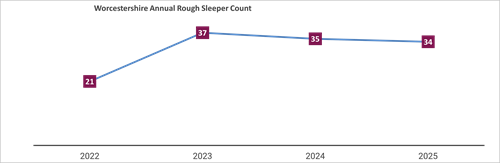
Rough sleeper data is collated each week improving our local intelligence of the flow, return, and stock of individuals and the reason behind their homelessness. Regular rough sleeper/prevention meetings and multi-agency meetings are held at a local level enables the co-ordination of services and information sharing to develop partnerships with all organisations and individuals committed to ending rough sleeping and homelessness. This includes a consideration of any safeguarding issues that need to be flagged with partners or referred to the Adult Safeguarding Team. All five councils have rough sleeper outreach teams providing intensive support and routes into accommodation such as No First / No Second Night Out, Housing First/Led and other services.
Progress has been made in tackling health inequalities with increased access to health services and countywide drug and alcohol support, including harm reduction teams. Outreach teams have strengthened their practice by signing up to Homeless Link’s outreach principles and undertaking learning and development.
Although Supported Housing providers in Worcestershire work within a trauma informed, person centred approach, those clients with substance misuse, serious mental health conditions and/or a history of arson may find themselves waiting for a suitable placement due to stringent accessibility criteria. There is also limited availability of rapid access supported accommodation resulting in an individual’s only accommodation option being outside of the county.
We will also expand the multi-agency work on Target Priority Group rough sleepers and expand the Mental health and Homelessness Group so that multi-agency working is consistent across all districts and there is effective cross boundary working.
Therefore, the strategy will continue to promote collaborative working with health partners, housing providers and other organisations to improve access to services for rough sleepers including early intervention for those at risk and accommodation for those with complex needs.
3.3.4 Young people and care leavers
Homelessness for young people remains significant issue. This includes from people aged 16-17, Care Leavers and young parents. Many young people will have support as well as accommodation needs as they leave home for the first time.
Changes to the benefits system together with the impact of the cost-of-living crisis, and the number of young people in low paid work, has seen a rise in the number of those at risk of homelessness.
For young people the data indicates that the most common causes of homelessness in Worcestershire are family or friends being no longer willing to accommodate, the loss of private rented accommodation and relationship breakdown with partner (non- violent breakdown).
Whilst services do work closely together, there is still more to be done to prevent young people from becoming homeless. It is a focus of this strategy to enable more upstream homelessness prevention through family mediation and identifying potential homelessness situations at the earliest stage e.g. via schools and other relevant sectors/organisations.
3.3.5 Families with children
Worcestershire continues to be an attractive place to live and work, inevitably leading to high rents and house prices. This means some families are unable to afford to own or privately rent a home. Changes to the benefits system together with the impact of the cost-of-living crisis and the number of people in low paid work has seen a rise in the number of families at risk of homelessness.
We want to prevent homelessness by identifying the key risk factors/triggers in families lives that can lead to a family being at risk of homelessness at the earliest possible stage.
Families in Worcestershire access social housing registers for a variety of reasons, often reflecting both long-term housing challenges and immediate triggers that place them at risk of homelessness. The key reasons include:
- Relationship Breakdown
Non-violent relationship breakdowns, particularly involving partners, remain a significant factor. Families in this situation often require alternative accommodation to prevent homelessness or unsafe living conditions. - Domestic Abuse
Domestic abuse is a major reason families seek housing support. Increased awareness of available services and support pathways has led to earlier reporting and engagement with housing services. - Loss of Private Rented Accommodation
The end of an assured shorthold tenancy in the private rented sector, whether due to eviction, rent increases, or landlord decisions, continues to trigger housing register applications. - Financial Hardship and Housing Affordability
Rising rents, high house prices, low wages, and changes to the benefits system contribute to families’ inability to secure or sustain accommodation. - Other Factors
Other, less frequent reasons include overcrowding, unsuitability of current accommodation (e.g., health/accessibility needs), and the need to move closer to education, employment or support networks.
As of June 2025, there were 4,955 families on the housing registers across the councils’ areas which equates to 43% of all applications.
Analysis of trends shows that relationship breakdown, domestic abuse and the loss of private rented tenancies remain the leading immediate triggers for applications, emphasising the importance of early intervention and targeted prevention support.
3.3.6 Survivors of domestic abuse
Domestic Abuse continues to be one of the primary drivers of homelessness across Worcestershire, with a profound and lasting impact on victim/survivors, families, and communities. Since the introduction of the Domestic Abuse Act 2021, LHAs and Worcestershire County Council have worked collaboratively to strengthen housing pathways, deliver on new statutory duties, and create a coordinated, trauma-informed response using a whole family approach for those fleeing abuse.
The establishment of the Worcestershire Domestic Abuse Partnership Board, a domestic abuse and housing coordinator, specialised domestic abuse housing officers and the provision of safe accommodation has led to more consistent standards of support across the county. Housing teams, alongside commissioned domestic abuse providers, now play a critical role in early identification, prevention, and sustaining safe accommodation for survivors.
Data and Trends
Data highlights that domestic abuse remains a significant cause of homelessness presentations across Worcestershire over the last three years. Of those owed a homelessness duty in 2024/25, 30.8% of households presented due to domestic abuse.
| Year | Prevention | Relief | Total |
|---|---|---|---|
| 2022/23 | 8.3% | 18.4% | 26.7% |
| 2023/24 | 9.7% | 18.8% | 28.5% |
| 2024/25 | 7.1% | 23.7% | 30.8% |
In 2024/25 over 10,000 domestic abuse–related incidents and crimes were recorded by police in Worcestershire. This total includes both crimes and non-crime incidents. According to Worcestershire County Council’s Operation Encompass page, which summarises West Mercia Police’s Q4 2024/25 Performance Monitoring Report, around 25% of all recorded crimes in the county were classified as domestic abuse related.
While West Mercia Police data for the same period indicates a statistical decrease in domestic abuse incidents across the force area, the figures for Worcestershire demonstrate that domestic abuse remains a significant issue locally.
Despite improved reporting, local insight suggests that many survivors still do not disclose abuse, indicating ongoing unmet need. Across the county, domestic abuse-related approaches accounted for a significant proportion of homelessness applications. The majority were women with dependent children, though a growing number of single survivors, male victims, and individuals with complex needs have been identified.
Sanctuary Schemes and Safe Accommodation
LHAs across Worcestershire, work in partnership to deliver safe accommodation, including, refuge spaces, dispersed units, and sanctuary schemes to enable survivors to remain safely in their homes where appropriate.
Sanctuary Scheme Referrals (September 2024 – August 2025):
|
District |
2024/25 |
|---|---|
|
Bromsgrove |
3 |
|
Malvern Hills |
15 |
|
Redditch |
8 |
|
Wychavon |
32 |
|
Wyre Forest |
47 |
Between 2024-2025 a total of 105 referrals were made to sanctuary schemes across all 5 local authorities. Overall referrals have decreased across most districts, with some localised increases, highlighting variation in demand and referral pathways.
There has been much progress across the LHAs since the implementation of the Domestic Abuse Act 2021 statutory duty across LHAs including the expansion of the Domestic Abuse Community Champions network through Worcester Community Trust and West Mercia Women’s Aid, delivery of trauma-informed housing training to frontline staff, specialist Domestic Abuse Housing in each council (who have received positive feedback from service users) and strengthened partnership working between housing, police, and support providers through regular MARAC coordination and attendance at DRIVE meetings.
All the housing teams work in partnership with Sanctuary Schemes to help victim-survivors of domestic abuse stay safely in their homes by providing tailored security measures, reducing the need to move.
The introduction of the Domestic Abuse Housing Coordinator role to work closely with Domestic Abuse Housing Officers has ensured training and knowledge remain up to date.
3.3.7 Veterans
Instances of homelessness amongst veterans are low locally, however there is action to be taken to further tackle this. LHAs are currently working with the Worcestershire Armed Forces Covenant team to ensure that there is a good understanding of the Armed Forces Covenant in housing services and ensure that organisational policies reflect the needs of the Covenant e.g. that local connection rights (for the purposes of social housing allocation) are embedded in policy.
3.3.8 Refugees and migrant homelessness
Worcestershire has provided a sanctuary to refugees from Ukraine, Syria and Afghanistan through the government’s resettlement schemes, including Homes for Ukraine, the Afghan Citizens Resettlement Scheme(ACRS) and Afghan Relocations and Assistance Policy(ARAP), as well as a small number of arrivals through the Community Sponsorship Scheme. Accommodation has been provided by a combination of private hosts, the private rented sector and, where appropriate, social housing.
The Home Office is responsible for providing accommodation for asylum seekers, whilst their asylum claims are being processed. Home Office accommodation is provided in Worcestershire in both contingency hotels and dispersal accommodation (usually self-contained family accommodation or houses of multiple occupation). However, asylum seeker numbers in Worcestershire are currently relatively low in comparison to other areas of the UK.
Once asylum has been granted, a refugee is required to leave their Home Office accommodation, with notice to quit currently at 42 days from the date of decision. A process is in place for information to be shared with the local housing authority of notice to quit local Home Office accommodation, to ensure housing advice can be provided.
Homelessness amongst this cohort is relatively low locally due to fewer asylum seeker numbers than other areas of the country and the fact that those placed in Worcestershire often look to relocate to areas where cultural or religious needs are better met or nearer to family members once asylum has been granted. However, it still remains a challenge to be able to respond to the needs of refugees and migrants. In particular, we are seeing an increase in approaches for those with No Recourse To Public Funds, where options for support are extremely limited, and LHAs need to work closely with our partner VCSE organisations to respond to this.
3.3.9 Hospital discharge, substance use and Adult Social Care support
“Discharge from hospital into poor quality, insecure housing or, in the worst cases, onto the streets is a deeply harmful outcome. When combined with unmet mental health needs and substance use needs, it can severely undermine people’s recovery and increase the risk that their health deteriorates further and makes them even more vulnerable.” A National Plan to End Homelessness, MHCLG, 2025.
The government is committed to a target that no one eligible for assistance is discharged to the street after a hospital stay and will be working with the NHS and councils to implement the Discharging people at risk of or experiencing homelessness guidance published in 2024.
In preparation for this, our strategy will commit to exploring local opportunities with colleagues across the health system to promote early identification of housing issues and planning from admission both for accommodation needs but also any ongoing health and care needs.
The LHAs do not provide any supported temporary accommodation and therefore it is essential that if people do need to access temporary accommodation that the necessary support and care package is provided to reduce the risk of a harmful outcome.
Sadly, district councils have seen a rise in the number of homeless people harming themselves, and others, in temporary accommodation and an increase in the number of deaths in temporary accommodation through people dying by suicide or overdose. Although the numbers are small, they are increasing and this desperately needs to be addressed to safeguard people and prevent this from happening.
At the time of writing this strategy a roundtable event was being organised to bring together senior officers from housing, health, social care, registered housing providers, and safeguarding to focus on the issue of supporting people with complex needs in unsupported accommodation. It is expected that the recommendations from that event will feed into this strategy and the action plan.
3.3.10 Neurodivergence and homelessness
People with a range of neurodivergent needs, including autism, ADHD, dyslexia, dyspraxia, learning disabilities and other cognitive differences, may face additional barriers and challenges when navigating housing services or experiencing homelessness. These barriers often relate to communication differences, difficulties with unfamiliar and changing environments, sensory needs, and the cumulative impact of unmet support needs.
To better support local residents with neurodiverse needs, Local Housing Authorities have introduced training for housing officers to improve understanding of neurodivergence and to help staff recognise when individuals may require tailored approaches, including those who do not have a formal diagnosis. This training aims to ensure that interactions are accessible, supportive, and responsive to individual needs rather than relying on assumptions or labels.
LHAs are also reporting increasing numbers of households requesting additional bedrooms where, for example, children with neurodivergent needs are unable to share bedrooms with siblings. This often reflects genuine challenges relating to sleep, safety, behaviour regulation, or sensory differences. These pressures contribute to growing demand for larger family homes within an already limited social housing stock.
4 Pillar 3: Preventing crisis – helping people stay in their homes
Identifying and preventing homelessness at the earliest possible stage is the best outcome for households, LHAs and the public purse. However, where it has not been possible to prevent homelessness, services need to work together quickly and effectively to ensure that it is a brief as possible.
4.1 Preventing homelessness at the earliest stage
‘Too often, households are known to one service, such as a voluntary or community organisation, without that information being shared with the council or other relevant partners. To deliver truly coordinated and preventative support, everyone must work together, with clear referral pathways and shared responsibility for identifying and responding to risk early.’
A National Plan to End Homelessness, MHCLG, 2025
Locally as well as nationally, we want to increase the proportion of households who are supported to stay in their own homes or helped to find alternative accommodation – to prevent homelessness and the need for temporary accommodation.
Details of the Government’s new Homelessness, Rough Sleeping and Domestic Abuse Grant were announced in December 2025 as part of a provisional multi-year settlement. The intent of this grant is to simplify homelessness funding and allow for greater flexibility in spend according to local need.
The provisional 3-year allocations will allow for longer term strategic planning to commission or directly provide homelessness services/initiatives on a longer-term basis, rather than annual allocations in recent years.
To inform this strategy, a mapping exercise was carried out as part of the homelessness review which identified what services are available across Worcestershire and what gaps in provision there might be. A summary of this is contained within the homelessness review and an action within the plan is to explore what services are required to be commissioned or directly provided by LHAs based on the findings of the review.
The LHAs already provide a number of services to help prevent homelessness or to ensure suitable alternative accommodation is available at the prevention stage. This includes access to funding for rent deposits/bonds and rent in advance, welfare assistance, working with landlords and families to resolve issues and mediation for young people and their families.
4.2 Accessing the right support at the right time
It is vital that people get the support that they need, when they need it, to prevent homelessness. Housing and homelessness systems can be complex by the very nature of legislation, geographical location, differences in funding and associated criteria, whether they are provided by statutory of voluntary services and as such it can be challenging for people to navigate them or understand what support is available.
The need to raise awareness of what services are already available was a key theme arising from partners who attended the strategy stakeholder event held in September 2025. The mapping exercise outlined in the previous section will be useful in raising awareness but the LHAs are keen to work with partners to build further on this through improved communication and joint training across organisations and sectors. Joint work with the Adult Front Door and the Community Directory are actions within the strategy action plan.
To proactively identify and predict where households may be at risk of homelessness, we want to improve our use of data to enable us to target high-risk households 3-6 months before they potentially reach crisis point. To address this, we want to explore using a predictive analytics model utilising a range of different data to target our homelessness prevention work.
4.3 Person-centred support to prevent rough sleeping
The councils have worked closely together for many years to tackle rough sleeping and have developed a range of initiatives such as No First Night Out (emergency bed spaces for those that are new to the street), Housing First/Led models (intensive support linked to accommodation), outreach support, bespoke funding and person-centred packages of support. A Rough Sleeper Coordinator has also been in post for several years to oversee the councils’ strategic approach to tackling rough sleeping and unblock barriers to accommodation for those with a poor tenancy or offending history.
We will aim continue providing bespoke funding for outreach teams and the Rough Sleeper Coordinator to find a housing solution for those at risk of rough sleeping and rough sleepers.
5. Pillar 4: Improving emergency responses – improving temporary accommodation and making people’s experiences better if they do become homeless
Whilst the aim is to prevent homelessness at the earliest possible stage and negate the need for temporary accommodation, it will always be needed as a safety net for households at crisis point.
LHAs have a duty to provide temporary accommodation in certain circumstances to homeless households. They can also utilise a discretionary duty to accommodate others, where no duty is owed but they are accommodated under wider policy initiatives such as No First Night Out/No Second Night Out to prevent rough sleeping or to support rough sleepers coming off the streets.
If temporary accommodation is required then it must be safe, affordable, of a decent standard and stable. B&B accommodation is not suitable for families with children, but we recognise that it may be the only option at crisis point.
Over the previous three years the number of placements ending has steadily declined from 1121 to 734 and the same for placements with children 339 to 235. Which means that households are spending longer in temporary accommodation. This is due to increasing pressure on housing availability impacting on the ability to house people into permanent accommodation. Correspondingly in the five districts the length of stay in temporary accommodation over 12 weeks has risen from 18% in 2022/23 to 26% in 2024/25 and a corresponding increase of length of placements for the longer timescales (or static numbers over the last three years).
For all the councils the most used type of temporary accommodation is Bed and Breakfast but the amount this is used varies from 46% of all placements in Redditch to 59% in Wyre Forest in 2024/25.There has been a decrease in use of Bed and Breakfast between 2023/24 and 2024/25 in all of the councils except Bromsgrove where the percentage of placements in B&B have increased from 42% to 48%.
This shows positive work undertaken by many councils to bring other forms of temporary accommodation into use including from Registered Providers and councils’ own stock. When considering the use of temporary accommodation for households with dependent children, WFDC and MHDC still mainly use Bed and Breakfast (53% and 72% respectively). However, both WDC and BDC use more temporary accommodation provided by Registered Providers than B&B (39% and 56% respectively) and RBC mainly use their own housing stock (61%).
The availability of different types and numbers of temporary accommodation differs across the county and can range from ad hoc used of emergency accommodation such as Bed and Breakfast to accommodation owned and managed by the Councils directly. See the table below for more information on temporary accommodation across the districts.
|
Placements into: |
22/23 |
23/24 |
24/25 |
|---|---|---|---|
|
TA within RP Stock |
89 |
89 |
72 |
|
TA within your own stock |
113 |
115 |
98 |
|
Any other type of TA |
27 |
28 |
76 |
|
Made own arrangements for TA |
36 |
13 |
3 |
|
Other nightly paid, privately managed accommodation |
165 |
92 |
69 |
|
Private sector TA leased council / Registered Provider |
29 |
43 |
12 |
|
Bed & Breakfast |
633 |
578 |
395 |
|
Temporarily remains in property |
5 |
3 |
3 |
|
Other: e.g refuge |
24 |
13 |
6 |
The new government strategy has a strong focus on households in temporary accommodation and particularly those with dependent children. There is now a body of research around the health impacts of temporary accommodation on people’s health including infant mortality and councils are expected to reduce the use of Bed and Breakfast style accommodation for families over the lifetime of this parliament.
All the LHAs have support workers who can provide additional support to households in need, but the resource is limited and it is critical that the councils utilise other support and care providers where relevant.
LHAs want to increase the amount of good quality self-contained accommodation, which will provide a better experience for homeless households but is also better value for money and less expensive than nightly paid accommodation.
We will work with education providers and GPs to ensure they are aware and can support those households in Temporary Accommodation where appropriate.
6. Pillar 5: Recovery and preventing repeat homelessness – ensuring people don’t experience homelessness more than once and halving long term rough sleeping
With the right support people can rebuild their lives after experiencing the trauma of homelessness and break the cycle of repeat homelessness.
6.1 Ensuring people don’t experience homelessness more than once
Preventing repeat homelessness is achieved through a variety of ways depending in part on the client group. Ensuring households are supported through the transition from temporary into permanent accommodation and working with households to make them tenancy ready whilst in temporary and supported accommodation has proved beneficial.
Some repeat homeless can arise through households not being able to access health interventions when needed. Locally some LHAs have funded Mental Health Link workers to work with housing teams and households approaching for homelessness assistance. This has proved a valuable resource to enable homeless households to access mental health support and assisting them to access existing mental health services at the right time.
Through regular meetings, agencies collaborate on policy development, share data and good practice, and coordinate funding opportunities. This joined‑up approach strengthens the county’s ability to deliver sustainable solutions and improve outcomes for those at risk of, or experiencing, homelessness.
Further work needs to be done to better understand why repeat homelessness for survivors of domestic abuse and larger families with complex needs is high and we will work with those with lived experience to see if we can develop workstreams to tackle this.
6.2 Tackling long term rough sleeping
The Government’s funding programmes have enabled LHAs to implement a number of service offers for rough sleepers including Housing First/Led, No First/Second Night Out, outreach workers and access to personalised budgets. This approach has supported the most entrenched rough sleepers, some of whom had previously been on the streets for many years, to maintain social housing/private rented tenancies. Through the use of personalised budgets for meaningful activities and engagement opportunities councils have been able to help rough sleepers and former rough sleepers to sustain their accommodation, make their property a home, build positive routines and strengthen community connections.
By offering bespoke interventions, the personalisation budget helps to break the cycle of homelessness and reduce the likelihood of individuals returning to the streets. It empowers frontline staff to respond quickly and creatively to barriers faced by rough sleepers, ensuring that support is not only practical but also person-centred.
This strategy is committed to maintaining this robust approach to tackling and reducing rough sleeping.
6.3 Access to specialist health services: mental health, physical health & substance use
“What needs to be considered is the traumatic experience of being homeless. And that doesn’t stop the moment you come out of homelessness… Even if you didn’t have mental health issues going into homelessness, you are guaranteed 100 million percent [to have mental health issues after experiencing homelessness]. I have no doubt in my mind at all that everybody goes through a homelessness journey will experience trauma if being homeless and that needs to be considered because even if you’ve got no recovery to deal with, no official mental health diagnosis or any compound need, you are going to have an adjustment and, you know, adjustment from that trauma”
MHCLG (2025) Lived Experience Forum Report, recommendations from people with lived experience for the cross-Government homelessness strategy, Revolving Doors, Groundswell, Justlife Foundation
Project Bright Path supports people who are rough sleeping or at risk of rough sleeping and experiencing mental health challenges, both diagnosed and undiagnosed. The programme provides rapid, relational and trauma-informed support through short-term, focused interventions and better connection into mainstream services. Its purpose is to help people stabilise at times of crisis and access the right mental health and housing support at the right time. A key development during the year was the appointment of two Band 7 mental health practitioners, one based in Herefordshire and one in Worcestershire. Their specialist clinical input has already made a difference, supporting people with complex needs, helping unlock access to formal mental health assessments and diagnosis, and strengthening the ability of frontline workers to navigate mental health systems.
The project also delivers a training programme which is delivered in partnership with a wide range of organisations, including LHAs, housing providers, rehabilitation centres and voluntary sector partners. Content has continued to evolve, with additions including trauma-informed approaches, neurodiversity awareness and clearer pathways for mental health and homelessness support.
In developing this strategy, housing and health colleagues have been engaging in more detailed discussions around the links between mental health, physical health and homelessness and what could be done locally to address poor health and inequalities via the countywide Homelessness and Rough Sleeping Strategy group, the Worcestershire Housing Board, the Housing and Health Group, the district health collaboratives, and the Health Inequalities Prevention Personalisation Care Board. This strategy is committed to ensuring access to specialist services for homeless households and specific actions will be defined in conjunction with housing and health.
6.4 Community support and services
The LHAs recognise that peer support can be invaluable in tackling and preventing homelessness. Those that have lived experience will often be able to engage complex homeless households more effectively as they know first hand what it is like to experience homelessness and disadvantage.
Homelessness peer support models are in place in some areas of the county and there remains a commitment from the previous strategy to review peer support models and identify good practice with a view to potentially increasing or upscaling peer support.
The Homelessness and Rough Sleeper Strategy Group continues to learn from those with lived experience of homelessness through ongoing feedback, workshops and questionnaires.
The service mapping exercise carried out as part of the Homelessness Review and the Community Services Directory are also useful to highlight the community support services available. Ongoing discussions on how to harness community support continue to take place at local homelessness forums.
We will continue to engage with other services that can support households into education, employment and training and those that assist people with managing finances such as the Citizens Advice Bureau.
7. Governance arrangements
7.1 Oversight, delivery and monitoring
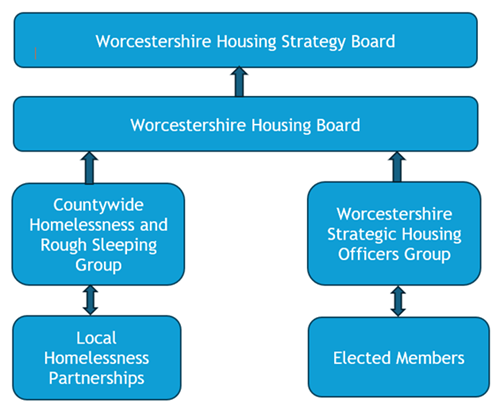
Worcestershire Housing Board is responsible for ensuring that the commitments within the Homelessness and Rough Sleeping Strategy are realised. The partnership is a multi-agency and cross-sector partnership, ensuring delivery of the strategy is supported across relevant organisations. The Housing Board reports to the Housing Strategy Board comprised of Chief Executive or senior officers from LHAs, Registered Providers, NHS and Public Health.
The Strategy will be overseen by the Countywide Homelessness and Rough Sleeping Group, a public and voluntary sector partnership that brings together statutory agencies, housing teams, health services, and community partners to ensure a coordinated response to homelessness across the county. The chair of that group will attend the Housing Board regularly to report on outcomes achieved and progress against actions.
Each LHA has its own local homelessness partnership, consisting of local statutory and voluntary partners which will oversee and deliver on homelessness services and the strategy at a local level and feed into the Countywide Homelessness and Rough Sleeping Group.
The LHAs are responsible for meeting their own statutory duties in relation to preventing homelessness. The Worcestershire Strategic Housing Officers Group (WSHOG) will be responsible for the operational delivery of the LHA elements of the strategy. Each LHA will have their own separate mechanism for reporting back to elected members on outcomes and progress including committees and member briefings to ensure there is political oversight on the delivery of the strategy and services.
8. Partnerships
Partnerships are essential to the delivery of the strategy as many organisations have a role to play in tackling homelessness and rough sleeping in the wider context.
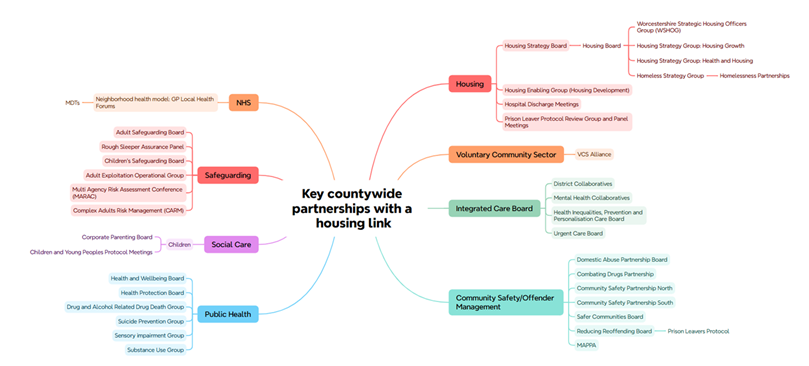
This is not a definitive or exhaustive list of all partnerships but highlights some key groups and inter-relationships. There are also localised partnership and strategic groups within each LHA that are not included in this section.
ICB and health partnerships
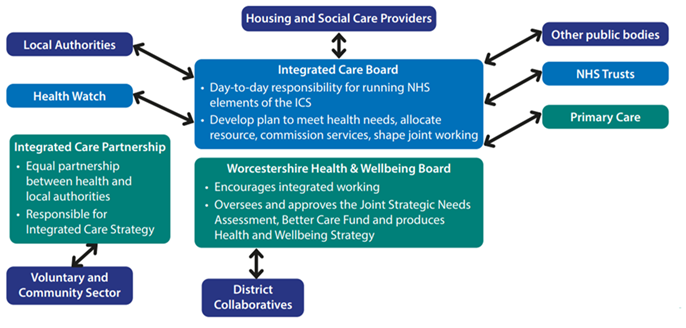
The advent of the Integrated Care Boards and review of the role of the Health and Wellbeing Board has led to a new way of working within the health, social care and wider partnerships including greater district level working with Primary Care Networks.
Integrated Care System - Taking collective action to tackle health inequalities.
Reducing Re-offending Group & MAPPA Strategic Management Board
The Reducing Re-offending Board oversees the development and delivery of the criminal justice pathway and protocol across the county, following on from work commissioned by Public Health and the LHAs. Multi-Agency Public Protection Arrangements (MAPPA) were introduced in 2001 under the Criminal Justice and Court Services Act 2000 and subsequently strengthened by the Criminal Justice Act 2003 as the statutory arrangement for managing sexual and violent offenders. It provides a mechanism whereby the agencies involved can better discharge their responsibilities and protect the public in a coordinated way. The responsible authority for MAPPA in each criminal justice area consists of the police, probation, and prisons. LHAs have a duty to cooperate with MAPPA arrangements in assessing and managing the risks posed by MAPPA-eligible offenders and the Board oversees the process.
Adult Safeguarding Board and the Assurance Panel
The main purpose of Worcestershire Safeguarding Adults Board (WSAB) is to promote wellbeing and reduce the risk of harm for people with care and support needs. Rough sleepers specifically are overseen by an Assurance Panel. The LHAs are represented on the Board and Panel at Senior Officer level.
Corporate Parenting Board (CPB)
The CPB provides leadership and a governance structure for corporate parenting to drive forward the outcomes for looked after children and care leavers. It oversees the Board’s strategy and promotes the voice of children and young people. It also provides challenge and scrutiny to ensure the best outcomes are achieved for children in care and care leavers. LHAs are represented at CPB by officers from WSHOG.
Domestic Abuse Partnership Board (DAPB)
The DAPB consists of key partners with an interest in tackling domestic abuse and supporting victims, including their children. The DAPB has been created to support Worcestershire County Council in meeting its duty under Part IV of the Domestic Abuse Act 2021 and to expand upon the wider community-focused work of the Worcestershire Forum against Domestic Abuse.
Appendix 1 – Action Plan
Pillar 1: Universal Prevention – tackling the root causes of homelessness
|
Action |
Measure |
Lead |
Timescale |
|---|---|---|---|
|
1.1 Prevent homelessness from private rented sector tenancies by building relations with landlords to identify those at risk of homelessness at an earlier stage, utilising funding where appropriate and available and take action to sustain tenancies. |
- Countywide landlord forum established. - “Help to Stay” scheme established. - Tenancy Sustainment Officers in place (funding dependent). - Decrease in households becoming homeless due to end of a private sector tenancy for a negative reason. - Prevention panel established with landlords - Utilise funding such as the Crisis Resilience Fund and homeless funding to sustain tenancies |
Housing Advice Team Leaders/Housing Strategy Officers/Private Sector Housing Teams |
March 2027 |
|
1.2 Ensure more legal support is available for tenants facing eviction by expanding partnerships with organisations who already undertake this work so that services have sufficient resource, knowledge, expertise and capacity to robustly defend evictions based on grounds under Renters Rights Act. |
- Training on Renters’ Rights Act undertaken for LHA staff. - Established referral mechanisms are in place with the Housing Loss Prevention Advice Service - Decrease in households becoming homeless due to end of a private sector tenancy for a negative reason. - Increase in tenancies sustained in the private rented sector following intervention. |
Housing Advice Team Leaders/Housing Strategy Officers/Private Sector Housing Teams Registered Housing Providers |
December 2026 |
|
1.3 Develop an integrated tenancy sustainment approach, bringing together housing, community organisations/hubs, employment and financial inclusion partners and develop stronger links to online support, to identify tenancies at risk and deliver coordinated support. |
- “Tenancy at Risk” protocol with Registered Providers is explored. - Coordinated support packages in place including income maximisation, debt advice, financial literacy training, and flexible crisis prevention/ discretionary welfare funding. - Decrease in households becoming homeless due to end of a tenancy for a negative reason. |
Housing Advice Team Leaders/Housing Strategy Officers and Community Services |
March 2028 |
|
1.4 Review the Duty to Refer data and prepare for the new Duty to Collaborate to ensure that any potential homeless cases are referred to the local housing teams by partner agencies at the earliest opportunity. |
- Duty to refer data is reviewed. - Increase in the number of Duty to Refer referrals - Increase in the proportion of cases approaching for homelessness assistance at prevention stage, or earlier. |
Housing Strategy Officers/All statutory agencies required to refer |
March 2027 |
|
1.5 Use data and lived experience to track and evaluate progress against the strategy (and inform service delivery) using key performance indicators and regular reviews. Consider how we can implement “big picture” reporting to demonstrate and understand homelessness prevention activity across all sectors/organisations. |
- Data dashboard and baseline statistics developed and monitored at countywide homelessness strategy meetings. - Summary reporting mechanism developed to show homelessness prevention work across all sectors/organisations. - PWLE attending/providing feedback to the Homelessness Strategy Group. |
Research and Intelligence Officer/Housing Strategy Officers |
September 2028 |
|
1.6 Improve shared understanding of the work of all partner agencies in preventing homelessness through promoting the Community Services Directory, and joint training and awareness sessions. |
- Joint training undertaken and increased awareness of roles and responsibilities. - All homelessness prevention services are signed up to the community services directory. |
County Council, Housing Advice Team Leaders/Housing Strategy Officers, Homelessness Partnerships |
September 2027 |
|
1.7 Develop and implement clear referral guidance and processes between agencies (housing, health, education, social care) for early identification of at-risk individuals. |
- Referral guidance and process defined and promoted. - Individuals are not released from institutions into homelessness. |
Housing Strategy Officers, Health, Education and Social Care Leads |
March 2029 |
|
1.8 Explore opportunities to develop and deliver homelessness education programmes in schools |
- Review service offered by Nightstop in WF and roll out across other district (funding dependent) |
Housing Strategy Teams |
March 2029 |
|
1.9 Make better use of existing social housing by exploring opportunities to better match disabled households with adapted housing and by tackling under occupation of larger properties |
-Current demand for adapted housing and best practice in maximising use of existing stock reviewed |
Housing Strategy Teams |
March 2028 |
Pillar 2: Targeted Prevention - targeted support for people at risk of homelessness
|
Action |
Measure |
Lead |
Timescale |
|---|---|---|---|
|
2.1 Explore the feasibility of a predictive homelessness risk model that pulls data from a range of sources to identify and target support to people at greatest risk of becoming homeless before they reach crisis point. |
- Predictive analytics system developed and implemented. - Data driven services/provision are developed. - Increase in homelessness prevention. - Decrease in TA placements. |
Research and Intelligence Officer |
March 2029 |
|
Action |
Measure |
Lead |
Timescale |
|---|---|---|---|
|
2.2 Review and strengthen the rough sleeper support/accommodation options (All services and interventions that tackle rough sleeping) and commission or directly deliver services required utilising the new multi-year homelessness funding arrangements. |
- Carry out a needs assessment and develop a Supported Housing Strategy - Number of services newly commissioned or expanded (if required) - Map unmet needs identified through outreach |
- WSHOG - Housing Advice/strategy Teams, - Outreach Services, - Rough Sleeper Co-Ordinator |
July 2027 |
|
2.3 Investigate the ability to provide bespoke funding Outreach teams and the Rough Sleeper Coordinator to develop tailored solutions for individuals who have previously been unable to secure or maintain accommodation, subject to funding. |
- Reduction in rough sleeping. - Number of individuals housed through the funding - Tenancy sustainment 6 months + - Number of individuals supported through the funding to address unmet needs - Reduction in repeat presentations to outreach services - Building relationships with Registered Providers to overcome barriers into accommodation |
- Rough Sleeper Co-ordinator - Outreach Services - Housing Advice/Strategy Teams |
March 2029 (pending funds) |
|
2.4 Expand the online multi-agency work on Target Priority Group rough sleepers Implement outreach and support services TPG online group across all districts to improve cross-boundary coordination and case management. Learning from good practice and promoting joined up working. |
- Online multi-agency TPG group working effectively across boundaries+. - Reduction in the number of TPG rough sleepers. - Increase in TPG rough sleepers accessing services and accommodation - Number of districts consistently using the TPG platform - Number of cross-boundary cases successfully resolved |
- Rough Sleeper Co-Ordinator/Housing Advice Teams |
September 2026 |
|
2.5 Extend the Mental Health & Homelessness Group to all districts to enable discussion/referrals into mental health services for those at risk of or experiencing rough sleeping |
- Mental Health and Homelessness group expanded across all districts to ensure consistent access to mental health services. - Increased number of districts participating - Number of rough sleeping cases discussed - Increased access to mental health support for rough sleepers |
- Housing Advice/Strategy Team Leaders - Rough Sleeper Co-Ordinator |
March 2027 |
|
2.6 Understand factors leading to returns to rough sleeping |
- Enhanced support offer in place for those who return to rough sleeping. - Work undertaken with Registered Providers to reduce the no. of people refused housing due to poor tenancy history - Reduction in recurring rough sleeping - Number of individuals enrolled in enhanced support - Tenancy sustainment following re-engagement |
- Rough Sleeper Co-Ordinator - Outreach Services - Housing Advice/Housing Strategy Teams |
April 2027 |
|
2.7 Set up a Lived Experience involvement process to ensure people who have experienced rough sleeping or homelessness are able to put forward ideas or feedback. Use this feedback to make changes to services and improve everyday practice, subject to funding. |
- People with lived experience involved in service development and improvement - Number of people with lived experience taking part in a way that meets their needs - Feedback collected and recorded - Number of service changes or improvements made because of the group’s feedback |
- Rough Sleeper Co-Ordinator - Outreach Services |
October 2026 |
|
Action |
Measure |
Lead |
Timescale |
|---|---|---|---|
|
2.8 Pilot the “Upstream” model in partnership with schools, specialist youth and family support services e.g. Centrepoint model (should funding be available). This would include a review of family intervention and mediation services. |
- Prevention initiatives developed across the Councils leading to a reduction in youth homelessness. - The causes of youth homelessness and what interventions can be made to sustain accommodation and positive relationships with family/friends are better understood. |
- Housing Advice/Strategy Team Leaders - Children’s Services -Youth Services -Schools |
December 2027 |
|
2.9 Review the Care Leavers Protocol in light of new legislative requirements that state that care leavers will no longer be deemed intentionally homeless in the case of accommodation breakdown. |
- Care leavers protocol updated to be compliant with the legislation. |
- Housing Advice/Strategy Team Leaders - Children’s Services |
December 2026 |
|
2.10 Agree a Memorandum of Understanding with providers of young persons supported accommodation to facilitate movements to alternative supported accommodation where relationships between residents have broken down |
- Memorandum of Understanding in place across providers to respond to potential homelessness situations where the relationship between residents has broken down. - Fewer crisis situations in which a suitable move cannot be found |
- Housing Advice/Strategy Team Leaders - Supported Housing Providers |
December 2027 |
|
2.11 Work with partner organisations (e.g. DWP) to explore services provided to address youth unemployment and ensure they can be connected with prevention/mediation/budgeting/debt advice services. |
- Reduction in youth homelessness - More young people managing their money and able to live independently |
- Housing Advice Team Leaders - DWP |
March 2027 |
|
2.12 Work with partners to understand the links between homelessness and neurodiversity in young people and how homelessness prevention services can meet their needs. |
- Reduction in youth homelessness. - Officers trained to ensure that neurodivergence is recognised and services are adapted to meet needs. |
- Housing Advice Team Leaders -County Council |
March 2027 |
|
Action |
Measure |
Lead |
Timescale |
|---|---|---|---|
|
2.13 Identify the key risk factors in families that lead to homelessness to ensure targeted intervention at the earliest stage |
- Review best practise around early intervention and prevention for families including risk factor identification. - Increase in homeless prevention for families with children |
- Housing Advice Team Leaders and Housing Strategy Officers - Research and Intelligence Officer |
Ongoing |
|
Action |
Measure |
Lead |
Timescale |
|---|---|---|---|
|
2.14 Commission a homelessness and health audit to understand the health needs of homeless households, reduce health inequalities for rough sleepers and improve life expectancy. |
- The health needs of homeless households are understood and services commissioned or adapted to meet need and prevent homelessness. - Health inequalities experienced by rough sleepers are reduce and life expectancy is increased. |
- WSHOG |
September 2026 |
|
2.15 Improve joint working across housing, health and social care to: (i) Prevent unnecessary hospital admissions for those who are homeless/at risk of homelessness (ii) remove barriers to hospital discharge for those who cannot return to their home or who are homeless (iii) Develop and implement the Duty to Collaborate for hospital admission, discharge, and step-down care that ensure a housing plan is in place before discharge. |
- Improved pathway into accommodation to ensure that discharges are planned in partnership with housing options services and that appropriate support is in place. - Reduced unnecessary hospital admissions for homeless households - Reduced delays in hospital discharge for homeless households |
-WSHOG -Integrated Care Board -NHS |
September 2027 |
|
2.16 Explore opportunities to provide a flexible approach to medical appointments to meet the needs of those with complex needs/chaotic lives and ensure follow up care is provided– example of health care worker in local day centres. |
- Health Bus service locations are near rough sleeper locations wherever possible. - All rough sleepers have access to a GP and substance use services where appropriate. |
-WSHOG -Integrated Care Board -NHS |
December 2026 |
|
2.17 Enhance the collaborative approach with partners to effectively manage the risk to those with complex and multiple needs in temporary accommodation. |
- Existing support and ongoing care and support processes are reviewed. - Reduction in serious incidents in unsupported TA/housing. |
- Worcestershire Housing Board - WSHOG |
April 2027 |
|
2.18 Integrate mental health services more deeply into homelessness prevention and intervention strategies. E.g. outreach teams should have improved access to mental health professionals to provide immediate support to those in crisis, and ongoing support is provided for those in unsupported temporary accommodation. |
- Current mental health services (and their capacity) are mapped, gaps are identified. - Those in TA can access appropriate mental health support |
- Outreach Teams - Mental Health Services |
June 2028 |
|
2.19 Develop more fully accessible permanent and temporary housing through Disabled Facilities Grant and Homes England Funding (dependent on funding) |
- Increase in the number of accessible/healthy homes delivered by Developers and RPs - Increase in the number of accessible temporary accommodation units. |
-WSHOG -Worcestershire Housing Adaptations Service |
June 2030 |
|
2.20 Investigate the ability to provide flexible budgets to prevent homelessness especially for non-priority/intentional cases or individuals facing severe mental health issues. This could be used to help cover emergency needs. |
- Funding identified - Data captured on “what works” to prevent homelessness for this cohort to inform future service delivery |
-Housing Advice Team Leaders/Housing Strategy Teams |
December 2026 |
|
Action |
Measure |
Lead |
Timescale |
|---|---|---|---|
|
2.21 Sustain and expand safe accommodation options (funding dependent) to minimise the use of B&B for DA survivors. |
- Increase in the number of safe accommodation options |
-DA Coordinator -Public Health -Housing Providers |
September 2027 |
|
2.22 Review best practice in preventing homelessness due to domestic abuse at an earlier stage through early interventions with households at risk of homelessness due to DA. |
- Those are risk of homelessness and experiencing domestic abuse approach for homelessness assistance at an earlier stage e.g. prevention stage, not relief/crisis stage - Decrease in homelessness approaches due to DA - Greater awareness and take up of Sanctuary Scheme options |
- DA Coordinator - DA Housing Officers - Research and Intelligence Officer |
March 2027 |
|
2.23 Develop a protocol for Registered Providers to access relevant survivor information (with consent) to deliver trauma-informed housing offers and minimise re-traumatisation. |
- Improved accommodation offers due to greater understanding of needs and risk - Reduced repeat homelessness for DA survivors |
- DA Coordinator - Registered Housing Providers - DA Housing Officers |
June 2027 |
|
2.24 Develop dedicated housing pathways for survivors with multiple needs and those with No Recourse to Public Funds (NRPF) |
- Reduced homelessness levels due to DA - Improved partnership working with schools and health and holistic support available to whole family. |
- DA Coordinator - DA Housing Officers |
June 2027 |
|
2.25 Strengthen communication and engagement with schools and health professionals to support early identification and safeguarding and ensure children affected by domestic abuse are linked to appropriate support services to prevent future victimisation or perpetration. |
-Processes are defined and embedded |
- DA Coordinator - DA Housing Officers |
July 2027 |
|
Action |
Measure |
Lead |
Timescale |
|---|---|---|---|
|
2.26 Review supported and transitional accommodation capacity and barriers to accommodation to ensure that there are pathways into accommodation prior to release. |
- Reduced homelessness due to leaving prison |
- Housing Advice/Strategy Team Leaders - Prison and Probation Service |
September 2027 |
|
2.27 Improve data capture: referrals to Prison Release meetings, homeless assessments before release, and accommodation pathways including CAS3 accommodation. |
- Improved understanding of housing needs - Increased accommodation options and improved process for prison leavers |
- Housing Advice/Strategy Team Leaders - Prison and Probation Service |
December 2026 |
|
2.28 Increase the number of housing assessments undertaken within prisons to identify a housing solution before release. |
- Increased accommodation options and improved process for prison leavers |
- Housing Advice/Strategy Team Leaders - Prison and Probation Service |
June 2027 |
|
2.29 Work with partner housing providers to develop a positive pathway from CAS3 accommodation |
- More individuals moving on from CAS3 into settled or supported accommodation |
- Strategic Housing Senior Officers |
March 2027 |
|
2.30 Review Worcestershire Criminal Justice Housing and Support Protocol |
- Protocol is updated to reflect current legislation and service provision |
- Strategic Housing Lead |
March 2028 |
|
Action |
Measure |
Lead |
Timescale |
|---|---|---|---|
|
2.31 Collaborate with community, voluntary, and faith organisations to develop tailored, culturally appropriate information and guidance for asylum seekers, refugees and those with No Recourse to Public Funds, enabling them to access necessary support. |
- Comprehensive and culturally appropriate guidance developed. |
-Homelessness Partnerships |
September 2027 |
|
Action |
Measure |
Lead |
Timescale |
|---|---|---|---|
|
2.32 Continue to work with the Worcestershire Armed Forces Covenant Partnership to ensure that there is a good understanding of the Armed Forces Covenant in housing and that organisational policies reflect the needs of the Covenant |
- Armed Forces Covenant embedded in housing services (where relevant) - Housing staff received training on the Armed Forces Covenant. |
-WSHOG |
Ongoing |
Pillar 3: Preventing crisis – helping people stay in their homes
|
Action |
Measure |
Lead |
Timescale |
|
3.1 Use the findings of the Homelessness Review Service Mapping to explore funding services required to be commissioned or directly provided by LHAs to sustain accommodation. |
- Gaps are defined, business case developed. - More homelessness cases are prevented |
Housing Advice Team Leaders and Housing Strategy Officers |
December 2026 |
|
3.2 Ensure that homelessness services are well connected to services offering support through the new Crisis and Resilience Fund. |
- CRF fund outcomes analysed to inform “what works” - Report on outcomes that have prevented homelessness without the need for a homeless approach to housing services. - Homelessness Services are aligned with the local delivery of the Crisis and Resilience Fund and support is available to those in crisis and facing homelessness. |
WSHOG |
March 2027 |
|
3.3 Utilise funding to ensure services such as accommodation and floating support, and help with housing costs are targeted to reduce homelessness through prevention |
-Number of households prevented from becoming homeless increases |
Housing Advice Team Leaders and Housing Strategy Officers |
December 2026 |
|
3.4 Make use of the government toolkits to aid prevention of homelessness (when available) |
-Number of households prevented from becoming homeless increases |
Housing Advice Team Leaders and Housing Strategy Officers |
March 2028 |
Pillar 4: Improving Emergency Responses – improving temporary accommodation and making people’s experiences better
|
Action |
Measure |
Lead |
Timescale |
|
4.1 Increase the number of high-quality, self-contained, TA units for families with children through working with Registered Housing Providers and considering options such as leasing or purchasing accommodation (funding dependent). Minimise the use of B&B, and other forms of shared accommodation and out of area placements for families with children. 4.2 Improve the transition of households moving out of TA and into settled accommodation by providing an assessment of support needs and referring families into the appropriate support. This would include sharing the needs assessment with housing providers (with consent) so they can provide a trauma informed housing offer. 4.3 Create family-centred TA solutions: re-evaluate the model for families in TA, ensuring that placements consider the impact on children’s schooling, health, and support networks and help children, families and young people in TA to maintain connections to services and support networks. 4.4 Jointly review social housing allocations policies once government’s new guidance is available to try to prevent the need for TA or move people on into settled accommodation more quickly if they do need to access TA. 4.5 Develop a resilience plan to address the impacts of rising temporary accommodation use, accommodation costs, and the anticipated loss of grant funding. This will include a review of block booking contracts, introduce dynamic purchasing and reduce the use of spot purchasing 4.6 Work with PWLE to analyse the barriers to accessing temporary accommodation and implement solutions e.g. increased security measures, provisions for pets. 4.7 Explore opportunities to work with colleagues across the health economy to increase the availability of adapted temporary accommodation. |
- Increase in the number of suitable TA units - Reduction in the average length of stay in temporary accommodation - Reduction of the number of households with children in temporary accommodation - Reduction in the number of families with children in B&B over 6 weeks - Reduction in temporary accommodation costs - Increase in successful move-ons per quarter - PWLE feedback from families who have experienced TA is gathered and analysis on a regular basis - Barriers to TA are understood and action taken to overcome barriers |
Housing Advice Team Leaders and Housing Strategy Officers |
March 2028 |
Pillar 5: Recovery and Preventing Repeat Homelessness – ensuring people don’t experience homelessness more than once and having long term rough sleeping
|
Action |
Measure |
Lead |
Timescale |
|
5.1 Take action to tackling long term rough sleeping through reviewing: Accommodation-based and floating support/Rough sleeper outreach and intensive support/Rent deposits and rent in advance/No First Night Out Accommodation/Furniture projects |
- All activities to prevent and tackle rough sleeping locally are reviewed and defined, gaps identified and services commissioned. - Reduction in rough sleeping |
- Housing Advice/Strategy Team Leaders - Rough Sleeper Co-Ordinator |
March 2027 |
|
5.2 Review opportunities to develop and implement community and peer support models |
-Increase in tenancy sustainment - increase in engagement of service users |
- Housing Advice/Strategy Team Leaders - Rough Sleeper Co-Ordinator |
March 2028 |
|
5.3 Review opportunities to strengthen advocacy services: increase the availability of independent advocates, particularly for vulnerable groups like young people, those with mental health issues, and DA survivors. |
- Advocacy services are defined and strengthened |
- Housing Advice/Strategy Team Leaders - Outreach Services - Housing Advice |
December 2027 |
|
5.4 Investigate with PWLE why there is a high level of repeat homelessness in certain homeless cohorts e.g. DA survivors, rough sleepers, families with complex support needs. |
- Repeat homelessness is minimised - Drivers of repeat homelessness are understood and minimised |
- Research and Intelligence Officer |
March 2028 |
|
5.5 Develop mechanisms for referring temporarily accommodated households (with consent) to medical professionals, schools etc (subject to Government guidance) |
-Repeat homelessness is minimised and households are safeguarded |
- WSHOG |
December 2028 |
Stakeholders identified a number of suggestions that are business as usual and as such do not feature in the action plan but will still be delivered. The strategy action plan will be reviewed on an annual basis, and this will include a review of current actions and identification of any new actions required for future years.
Appendix 2 - Funding the strategy
Homelessness Prevention Grant
Homelessness services across the districts have previously been funded through a combination of district council general fund budgets and targeted grant funding from the Ministry of Housing, Communities and Local Government (MHCLG), most notably the Homelessness Prevention Grant (HPG).
The HPG was a ringfenced funding stream required to be deployed in line with national policy objectives. Its strategic purpose was to strengthen early intervention and prevention activity, ensuring full and consistent implementation of the Homelessness Reduction Act, while contributing to the ambition of ending rough sleeping through increased prevention of single homelessness.
The HPG also intended to reduce reliance on temporary accommodation, particularly for families. This included maximising opportunities for family homelessness prevention, reducing the overall number of families placed in temporary accommodation, and eliminating the use of bed and breakfast accommodation for families beyond the statutory six-week limit.
Strategic deployment of HPG focussed on targeted prevention, effective use of temporary accommodation alternatives, and system-wide approaches that delivered sustainable housing outcomes while reducing financial and operational pressures on local authorities.
The allocations in 2025/26 were as follows;
|
Housing Authority |
Grant (£) |
|---|---|
|
Bromsgrove District Council |
£383,917 |
|
Malvern Hills District Council |
£402,595 |
|
Redditch Borough Council |
£776,429 |
|
Wychavon District Council |
£811,670 |
|
Wyre Forest District Council |
£664,560 |
This funding supported the delivery of a range of coordinated interventions across the county aimed at preventing and reducing rough sleeping. These included No First Night Out and No Second Night Out emergency accommodation, designed to minimise the number of nights individuals spend sleeping rough; housing pathways, intervention and transition worker roles that provided targeted support to secure and sustain accommodation; a countywide Rough Sleeping Coordinator role operating across the districts to ensure strategic oversight of rough sleeping interventions, partnership working and system alignment; and the delivery of Housing-Led and Housing First accommodation to provide settled housing with appropriate wraparound support for individuals with complex needs.
At the time of writing this strategy the Government had recently announced the new homelessness and rough sleeping funding arrangements for 2026/7-2029/30. This section will be updated in due course.
Domestic Abuse Act Funding for Domestic Abuse Housing Officers 2025/6
|
Housing Authority |
Grant (£) |
|
Bromsgrove District Council |
£33,666 |
|
Malvern Hills District Council |
£33,666 |
|
Redditch Borough Council |
£33,666 |
|
Wychavon District Council |
£33,666 |
|
Wyre Forest District Council |
£33,666 |
Funding for domestic abuse services is essential to ensure the provision of dedicated, specialist officers who can effectively respond to victims and survivors. These officers play a critical role in early intervention, risk assessment, safeguarding, and multi-agency coordination. Sustained investment will allow for improved response times, consistent victim support, enhanced offender management, and better outcomes for families affected by domestic abuse. Funding will support recruitment, specialist training, and retention of officers, ensuring victims receive trauma-informed, timely, and effective protection while reducing repeat incidents and long-term harm within communities.
Domestic Abuse Act Funding 2025/6 (to implement the requirements of the Domestic Abuse Act 2021)
|
Housing Authority |
Grant (£) |
|
Bromsgrove District Council |
£35,774 |
|
Malvern Hills District Council |
£34,742 |
|
Redditch Borough Council |
£35,697 |
|
Wychavon District Council |
£34,855 |
|
Wyre Forest District Council |
£33,835 |
Household Support Fund (2025/26)
HSF 7 Allocation April 25 – March 26
|
District Council 12 month allocation |
General allocation |
Food/warm space allocation |
Total |
|---|---|---|---|
|
Bromsgrove |
£171,321.39 |
£18,000.00 |
£189,321.39 |
|
Malvern Hills |
£235,312.23 |
£18,000.00 |
£253,312.23 |
|
Redditch |
£329,900.14 |
£18,000.00 |
£347,900.14 |
|
Wychavon |
£230,918.03 |
£18,000.00 |
£248,918.03 |
|
Wyre Forest |
£328,625.52 |
£18,000.00 |
£346,625.52 |
|
Total |
£1,296,076 |
£90,000 |
£1,386,076 |
The Household Support Fund (HSF) is intended to provide targeted financial assistance to vulnerable households who are struggling to meet the cost of essential living expenses. The fund aims to prevent crisis, reduce hardship, and support households to maintain stability.
Discretionary Housing Payments (2025/6)
|
Housing Authority |
Grant (£) |
|
Bromsgrove District Council |
£62,332 |
|
Malvern Hills District Council |
£75,651 |
|
Redditch Borough Council |
£79,296 |
|
Wychavon District Council |
£112,099 |
|
Wyre Forest District Council |
£110,242 |
Discretionary Housing Payments (DHPs) provide short-term financial assistance to households who require additional help with housing costs and are in receipt of Housing Benefit or the housing element of Universal Credit. The fund aims to prevent homelessness, sustain tenancies, and support households during periods of financial difficulty.
Homelessness Rough Sleeping and Domestic Abuse Grant, & New Burdens Funding for Renters Rights Act
Our targets are based on national targets to create a step change in our approach to work upstream and prevent homelessness wherever possible. These are to:
- increase the proportion of people who are supported to stay in their own home or helped to find alternative accommodation when they approach their local council for support
- eliminate the use of B&B accommodation for families, other than very short-term use in emergencies
- halve the number of people sleeping rough long-term
|
Local Authority |
Homelessness Rough Sleeping and Domestic Abuse Grant |
Of which, funding for Homelessness and Rough Sleeping |
Funding for Renters Rights Act 2025 New Burdens |
Funding for Domestic Abuse Safe Accommodation Grant |
|---|---|---|---|---|
|
Bromsgrove |
£1,636,130.00 |
£1,474,318.00 |
£50,497.00 |
£111,315.00 |
|
Malvern Hills |
£1,414,759.00 |
£1,310,533.00 |
£42,799.00 |
£104,226.00 |
|
Redditch |
£2,477,421.00 |
£2,294,301.00 |
£72,088.00 |
£111,032.00 |
|
Wychavon |
£2,627,008.00 |
£2,552,442.00 |
£76,082.00 |
£104,565.00 |
|
Wyre Forest |
£2,485,740.00 |
£2,307,923.00 |
£70,660.00 |
£107,157.00 |
Appendix 3 - Glossary of terms
CAS3 : Community Accommodation Service
DAPB: Domestic Abuse Partnership Board
DRIVE: A domestic abuse partnership that protects victims by disrupting, challenging and changing the behaviour of those who are causing harm
LGR: Local Government Reorganisation
LHAs: Local Housing Authorities
MHCLG: Ministry of Housing Communities and Local Government
MARAC: Multi agency risk assessment conference
PWLE: People with Lived Experience
RPs: Registered Housing Providers
TPG: Target Priority Group (most complex rough sleepers)
WHSOG: Worcestershire Strategic Housing Officers Group.
Text alternatives to diagrams
Governance arrangements hierarchy chart
4 level hierarchy chart.
Level 1 - Worcestershire Housing Strategy Board
Level 2 - Worcestershire Housing Board
Level 3 - Countrywide Homelessness and Rough Sleeping Group linked to level 4 Local Homelessness Partnerships
Level 3 - Worcestershire Strategic Housing Officers Group linked to level 4 Elected Members
Key countywide partnerships with a housing link
Housing
- Housing Strategy Board
- Housing Board
- Worcestershire Strategic Housing Officers Group (WSHOG)
- Housing Strategy Group: Housing Growth
- Housing Strategy Group: Health and Housing
- Homeless Strategy Group
- Homelessness Partnerships
- Housing Board
- Housing Enabling Group (Housing Development)
- Hospital Discharge Meetings
- Prison Leaver Protocol Review Group and Panel Meetings
NHS
- Neighbourhood health model: GP Local Health Forums
- MDTs
Safeguarding
- Adult Safeguarding Board
- Rough Sleeper Assurance Panel
- Children’s Safeguarding Board
- Adult Exploitation Operational Group
- Multi Agency Risk Assessment Conference (MARAC)
- Complex Adults Risk Management (CARM)
Social Care
- Children
- Corporate Parenting Board
- Children and Young Peoples Protocol Meetings
Public Health
- Health and Wellbeing Board
- Health Protection Board
- Drug and Alcohol Related Drug Death Group
- Suicide Prevention Group
- Sensory impairment Group
- Substance Use Group
Voluntary Community Sector
- VCS Alliance
Integrated Care Board
- District Collaboratives
- Mental Health Collaboratives
- Health Inequalities, Prevention and Personalisation Care Board
- Urgent Care Board
Community Safety / Offender Management
- Domestic Abuse Partnership Board
- Combating Drugs Partnership
- Community Safety Partnership North
- Community Safety Partnership South
- Safer Communities Board
- Reducing Reoffending Board
- Prison Leavers Protocol
- MAPPA
Flow chart style diagram showing connections between partnerships.
Multiple boxes are organised into 3 columns
On the left
Box 1 - Local authorities a two way arrow links to box 6
Box 2 - Health watch a two way arrow links to box 6
Box 3 - Integrated Care Partnership
- Equal partnership between health and local authorities
- Responsible for integrated car strategy
Links to
box 4 - voluntary and community sector a two way arrow links to box 3
In the centre
Box 5 - housing and social care providers a two way arrow links to box 6
Box 6 - integrated care board
- day to day responsibility for running NHS elements of the ICS
- Develop plan to meet health needs, allocate resource, commission services, shape joint working
box 7 Worcestershire Health and wellbeing board
- Encourages integrated working
- oversees and approves the Joint Strategic Needs Assessment, Better Care Fund, and produces Health and Wellbeing Strategy
Box 8 District Collaboratives a two way arrow links this to box 7
Right hand side all three boxes have a two way arrow between each of them and box 6
Box 9 Other public bodies
Box 10 NHS Trusts
Box 11 Primary Care