Wyre Forest District Council
Debt management policy
Last updated July 2025
Next review due July 2027
Contents
1. Introduction
2. Background and scope
3. Income collection principles
4. Summary Debt Collection process
5. Fraud Prevention Privacy Notice
6. Complaints procedure
7. Equality Statement
Appendix 1A Delivering the policy - Revenues Debt Types
Appendix 1B Delivering the policy - Sundry Debt Types
Appendix 2 Debt write-off proforma
INTRODUCTION
This policy applies to the collection and recovery of all billed charges.
This document sets out how Wyre Forest District Council will collect and recover income due to the council. It identifies the principles to be applied to debt management across the council and aims to ensure that all monies due are collected and that debt owed is kept to a minimum. This is because the council has both a legal duty and a responsibility to its residents and tax payers to ensure that income due is paid promptly. The council is committed to using the most effective recovery methods available and this policy ensures that the council complies with relevant legislation, official guidance and best practice in meeting the following objectives:
- all debtors, taxpayers and ratepayers are treated fairly
- action taken is fair and open, and that no debtor receives less favourable treatment because of their race, nationality, colour, ethnic or national origin, religious belief, gender, marital status, sexual orientation, age or disability
- a co-ordinated and consistent approach to manage debt is followed
- appropriate support which may be required is identified and individual circumstances are considered
BACKGROUND AND SCOPE
The Council is funded through a combination of Government grants, retained Business Rates and Council Tax. Residents and businesses have a responsibility to pay these charges to fund statutory and non-statutory services that the Local Authority provides to them. While these revenue sources fund universal services the Local Authority provides, there are also services provided direct to residents and customers which are individually chargeable.
This policy document applies to all debts and income due to the Council including but not limited to:
Revenue Debts
- Council Tax
- Business Rates
- Overpaid Housing Benefit
Sundry Debts
- Sundry Debt (including licensing, statutory notices, sundry rents, subscriptions, etc)
- Commercial Property Rent and Service Charges
- Leaseholder payments
- Commercial and Garden Waste Collection
- Car parking excess charges
- Recovery of enforcement costs following works in default
- Charging for discretionary services or any money due to the Council under terms of an agreement to pay for goods, services or property
The council will ensure that when recovering debt it will take account of the guidance issued by the Local Government Ombudsman, https://www.lgo.org.uk/information-centre/reports/focus-reports . The council will pause all recovery action recommended in this policy whilst a debtor is in debt respite, also known as “breathing space” in accordance with The Debt Respite Scheme (Breathing Space Moratorium and Mental Health Crisis Moratorium) (England and Wales) Regulations 2020. All cases will be considered for discounts and reliefs that may be appropriate before taking debt recovery action.
The relevant legislation includes:
Council Tax
Local Government Finance Act 1992
Local Government Finance Act 2012
The Council Tax (Administration and Enforcement) Regulations 1992 (as amended)
Business Rates
Local Government Finance Act 1988
Local Government Finance Act 2012
The Non Domestic Rating (Collection and Enforcement) (Local Lists) Regulations 1989 (as amended)
Housing Benefit
Housing Benefit Regulations 2006
Overpayments Housing Benefit (Pension Credit) Regulations
Sundry and Other Debtors
The Late Payment of Commercial Debts Regulations 2002
The Late Payment of Commercial Debts Regulations 2013
The Late Payment of Commercial Debts (Interest) Act 1998
INCOME COLLECTION PRINCIPLES
Different types of debt attract different collection treatment, this is detailed in Appendix A. Every demand and invoice issued must be correctly addressed to the person who is liable to pay it and should wherever possible include a title, fore name or initial.
The general principles adopted in this policy are as follows:
- All demands will be issued as soon as practicable taking into account any legislative requirements.
- Invoices for services delivered by or on behalf of the council will be raised prior to the service being received or as soon as possible thereafter. Where feasible, payment in advance of the service will be obtained. Recurring charges invoices will be issued in a timely manner to enable payment to be made ahead of the due date. For debts, paid periodically, such as trade or garden waste, periodic rents, or licensing the preferred method of payment is by direct debit, where this is not possible an alternative electronic means should be selected.
- For all monies owed the council will use the most appropriate and effective method of debt recovery in order to maximise income collection and minimise costs.
- The council recognises that prompt recovery action is a key element for managing debt and maximising income and will:
- regularly monitor the level and age of debt
- set clear targets for the recovery of debt
- follow the recovery procedures in this policy, the Revenues Recovery Policy and the Housing Benefit Overpayment Policy
- set priorities for specific areas of debt and assess recovery methods to ensure maximum recovery
- review irrecoverable and debts over six months old on a regular basis – sundry debts to be reviewed monthly
- Where the potential for a statutory benefit, discount or exemption exists in relation to the debt, efforts will be made to make the debtor aware of such opportunities and they will be assisted and encouraged to apply for these.
- The council will seek to work with welfare organisations where the debtor recognises the benefits that these organisations can offer both the debtor and the council in prioritising repayments to creditors and in maximising the income available to the debtor.
- The council will use every opportunity to engage with debtors and make ‘bespoke’ payment arrangements with individual customers based on the circumstances and debt outstanding. Dependent upon their overall financial position customers may be signposted to the council’s Financial Inclusion Officers and/or an independent debt advice service.
- For business customers the council will consider ability to pay prior to granting any credit terms, and to only extend credit to those customers in a position to pay the debt in accordance with the Council’s terms and if the customer’s circumstances do not justify the granting of credit, payment in advance should be offered for the goods/services.
- Where an external agency is used to deal with the recovery of debt the flow of information between the council and the agency will be in a secure electronic format. Agents will make contact with debtors as part of a legal collection process. Any information that is passed to third parties to aid debt recovery is done so in accordance with the relevant service areas privacy notices.
- Where legislation permits, the council will seek to levy and recover from the debtor any costs and/or fees that are legitimately due from the debtor to the council or its agents. Only in exceptional cases, where it would not be in the public interest to pursue costs and/or fees, will they be waived.
- The Council reserves the right to charge interest and claim compensation in accordance with the Late Payment of Commercial Debts (Interest) Act 1998 and under the Late Payment of Commercial Debts Regulations 2013. Full details of the Act available at https://www.legislation.gov.uk/ukpga/1998/20/contents. For Commercial debt, interest will be charged on any debt at the statutory rate of 8% above base rate unless a contract specifies a different rate for late payment.
- The council’s Write-off Policy (Appendix B) aligns to the council’s financial procedure rules and formalises the procedure for writing off debts that are irrecoverable following the completion of the debt recovery processes described in this policy.
SUMMARY DEBT COLLECTION PROCESS
|
Debt Type |
No. Reminders |
Summons |
Liability order |
Methods of recovery |
Notes |
|---|---|---|---|---|---|
|
Council Tax |
2 in any financial year, once 2 reminders have been issued a final notice giving 7 days to pay |
If payment is not made as instructed, on the notices previously issued, a summons is requested from the Magistrates Court. The summons issued will be for the total balance and not just for missed instalments. |
This order is issue by the Magistrate and gives the Council powers to recover the debt using other methods |
|
Full details are provided in Appendix 1A – Delivering the Policy: Revenues Debt Recovery Policy |
|
Business Rates |
1 reminder followed by a final notice |
||||
|
Overpaid Housing Benefit |
Following receipt of an invoice, if payment is not received or an arrangement to pay made, a reminder will be sent |
|
Full details are provided in Appendix 1B – Delivering the Policy: Housing Benefit Overpayments |
|
Debt Type |
Reminders |
Instructing legal services |
Pre-action protocol |
Commencement of action |
County Court Judgment |
Enforcing a County Court Judgment |
|---|---|---|---|---|---|---|
|
Sundry Debt (including property rents) |
1 reminder letter 1 final reminder /letter requesting payment Service contact via telephone/email/face to face. Payment plan agreement sought |
When all attempts to obtain settlement have been unsuccessful, the Service to instruct Legal to commence recovery through County Court |
Legally prescribed procedure has to be followed
If ignored
|
If the debtor does not reply to the letter of claim within 30 days court proceedings will be started |
A court order confirming the debt and demanding payment |
|
FRAUD PREVENTION PRIVACY NOTICE
The personal information we have collected from you will be shared with fraud prevention agencies who will use it to prevent fraud and money-laundering and to verify your identity. If fraud is detected, you could be refused certain services, finance, or employment. Further details of how your information will be used by us and these fraud prevention agencies, and your data protection rights, can be found on the Council’s website here: Privacy notices | Wyre Forest District Council. Wyre Forest District Council will not accept deliberate manipulation or fraud, and any instances are taken very seriously and are actively investigated. Any individual who falsifies their records or dishonestly provides inaccurate information to make a financial or otherwise gain, will face prosecution. The council reserves the right to recoup funds paid in error, or via fraudulent misappropriation.
COMPLAINTS PROCEDURE
We aim to provide high service standards. However, we welcome feedback and encourage comments or suggestions about our services. if someone is not satisfied with the service provided, they have the right to make a complaint in line with our complaint procedure which can be found on our website at Let us know | Wyre Forest District Council, or from our Customer Services team on 01562 732928.
EQUALITY STATEMENT
Wyre Forest District Council is committed to equality and fairness. Equality is about ensuring people are treated fairly and given fair chances. It is also about ensuring that people receive fair outcomes in the standard of service they receive from the Council. This includes everyone, regardless of their race, gender, age, religion or belief, sex or sexual orientation gender reassignment and/or disability or any protected characteristic as defined by the Equality Act 2010.
This policy will be reviewed periodically and any amendments authorised by the Director of Resources in consultation with the Corporate Leadership Team every 2 years.
Appendix 1A
DELIVERING THE POLICY – REVENUES DEBT TYPES
Revenues Debt Recovery Policy
Introduction
Wyre Forest District Council is responsible for the collection of council tax and national non-domestic rates (NNDR) on behalf of Worcestershire County Council, West Mercia Police Authority, Hereford and Worcester Fire and Rescue Authority and Parish/Town Councils in the district.
This policy has been developed to achieve an efficient and effective revenue collection and sets out the recovery process that will be followed by the Revenues recovery team.
Aims
The aims of the recovery policy are to:
- Comply with current regulations and incorporate the Council’s corporate policies where applicable.
- Use cost effective and fair recovery practices so that all balances and instalments due are paid and ensure those that can pay, do pay.
- Ensure there is a professional, consistent and timely approach to recovery action.
- Encourage debtors to engage with the Council as soon as possible if they have difficulty in meeting their liability.
- Be responsive to individual circumstances including ability to pay in order to differentiate between those who can’t pay and those who won’t pay.
- Maximise the levels of income collected and minimise the level of arrears.
- Ensure that debts are managed in accordance with legislative provisions and best practice.
- Provide individuals in financial hardship with support and advice to claim all relevant benefits, exemptions, reliefs and discounts and promote specialist debt advisors if necessary.
- Treat individuals fairly and consistently regardless of age, sex, race, gender, disability and sexual orientation and to ensure that individuals’ rights are protected under Data Protection and Human Rights legislation.
- Where the resident is defined as vulnerable under the Councils vulnerability criteria, and this is known to the Council, to take action according to individual circumstance and enter into sustainable payment arrangements wherever possible.
Debts covered by this policy
Council Tax
Council Tax recovery processes are laid down by statute in The Council Tax (Administration and Enforcement) Regulation 1992 and subsequent amendments.
National Non Domestic Rates
Business Rates recovery processes are laid down by statute in the Non-domestic Rating (Collection and Enforcement) (Local Lists) Regulations 1989 and subsequent amendments. Details of the recovery of housing benefit overpayments can be found in the Housing Benefit Overpayment Policy.
Annual billing
Annual council tax and business rates bills (demand notices) are issued in March every year which set out the total amount of liability due. Amended bills are issued daily when changes of circumstances are reported and actioned.
All bills include a monthly payment instalment arrangement over 10 months and, if paying by instalments, the amount payable is due on the 1st of each month. There is the option to pay over 12 instalments as long as the first payment is made by the end of April.
The most cost efficient payment method is direct debit which will be actively promoted. The methods of payments accepted are;
- Direct debit
- Automated phone payments by debit/credit card
- Website payments
- Internet banking/bank transfers/BACS payments
- PayPoint and Post Office outlets by cash or card
- Cheques by post only
- Standing order
Reminders
A recovery timetable is drawn up at the start of every financial year to ensure fairness and consistency. Balances must be paid by the due date stated on the bill.
If an instalment has not been paid, a reminder notice will be issued.
The reminder notice will state the deadline the payment must be made by and if paid by that date and the account kept up to date, no further action will be taken.
A maximum of 2 reminders will be issued in any one financial year in accordance with the regulations. A second reminder will only be issued if the customer pays the first reminder on time and then fails to pay a further instalment by the due date.
Failure to pay after a reminder is sent may result in a cancellation notice. This means the full balance becomes due and the right to pay by instalments are lost for the rest of the financial year.
Final notices
Council Tax
Once two reminder notices have been issued during the financial year and a further instalment is not paid, a final notice will be issued. The final notice gives 7 days only to pay the remaining balance due for the year in full. Final notices are also issued on closing accounts or where only one instalment is due.
Business Rates
Once one reminder notice has been sent then the full balance will become due if the payment has not been made and a further reminder letter is required.
Summons
If payment is not made as instructed, on the notices previously issued, a summons is requested from the Magistrates Court. The summons issued will be for the total balance and not just for missed instalments.
This involves the Council making a complaint to the court requesting the issue of a summons which directs the customer/s to appear before the court to show why they have not paid the debt.
A summons may be issued to 2 or more taxpayers jointly liable for the debt and each liable person may be served with an individual summons.
The cost of raising the summons is added to the outstanding debt. The summons costs are £50.00 and is made up of both the Council’s administration costs and court costs.
The summons will be issued with at least 14 days between issue and the court date and will state when the liable person/s must attend court.
If the amount due plus costs are paid before the court hearing, the taxpayer will not have to attend court and the Council will not proceed to obtain a liability order.
If arrangements to pay are made, the Council will still proceed to obtain a liability order but if payments are made in accordance with the arrangement no further recovery action will take place.
If the liable person/s does not pay or does not attend court, the hearing will proceed in their absence.
Recovery action may be held, pending the decision, if there is a Council Tax Reduction Scheme claim waiting to be processed. This will depend on the amount outstanding but the Council reserves the right to proceed with issuing a summons and subsequent recovery action.
Liability Orders
At the hearing, the magistrates must be satisfied that the Council has followed the correct procedures which are sending a bill, reminders and summons to the property or last known address. The Council must confirm who is liable for council tax and that the debt is outstanding. If the magistrates agree that the amount shown on the summons is payable by the customer, they will issue a Liability Order. A liability order is a legal instrument that allows the Council to collect the outstanding debt.
The cost of the liability order is added to the outstanding debt. The liability costs are £30.00 and is made up of both the Council’s administration costs and court costs.
The liability order is a decision by the court confirming that the person listed is liable to pay the sum due and that the balance has not been paid in accordance with the law. This order gives the Council powers to recover the debt using other methods such as:
- Requesting financial information including employment status and employer details;
- Taking money directly from wages using an Attachment of Earnings Order;
- Taking money directly from Department for Work and Pensions benefits;
- Instructing an Enforcement Agent to collect the debt;
- Starting winding up proceedings against limited companies;
- Starting bankruptcy proceedings against individuals;
- Seeking a Charging Order against the property;
- Starting committal proceedings for imprisonment for up to 90 days.
Recovery following Liability Order
After the hearing, notices are issued confirming that an Order has been granted. This notice contains a requirement to supply certain information. If the liable person does not provide the requested information this could lead to prosecution and a fine.
The notice that is issued warns the debtor that unless they pay, or make arrangements to pay, further recovery action will be taken.
The information obtained will then help the recovery team to decide the next course of action to recover the money owing.
Hardship
The recovery team welcomes and encourages contact to be made during all stages of recovery to make arrangements to clear the balance owing. The Council is committed to reducing poverty and hardship and the team will review each case on its own merit.
Extended payment arrangements may be agreed and the recovery team will expect the current year’s council tax to be paid first together with an agreed amount to pay off any previous years’ debt.
Where the customer is in receipt of Council Tax Reduction Scheme, arrangements must be in place to pay any outstanding balance by the end of the financial year. Council Tax Reduction Scheme claimant debts will only be passed to Enforcement Agents as a last resort after careful consideration by the recovery team.
The recovery team will consider applications for a discretionary reduction in liability which is a scheme the council operate for those in significant hardship. For more information see the Discretionary Reduction in Liability Policy.
Before pursuing any of the following methods of recovery, consideration will be given to looking at any other debts that the taxpayer may owe to the Council and all outstanding debts will be pursued as a whole.
Vulnerability
The Council recognises that certain groups of people may be particularly vulnerable and may require additional help with their financial affairs. The vulnerability criteria is included at Appendix A to this policy which sets out the type of groups who the Council consider may be vulnerable and how recovery of the debts will be approached.
Methods of recovery
Attachment of Earnings Order
The Council can tell an employer to make deductions from earnings of their employee and to pay the deducted amount to the Council.
Failure to provide employment details when requested could result in an additional fine of up to £500 for non-disclosure and £1,000 for supplying false information.
Failure to comply with the order may result in the employer being fined.
The amount deducted will be in line with regulations and will depend on earnings.
Employers can deduct £1 per order for every time a deduction is made to cover administration costs and deductions will continue until the debt is paid. Changes in employment must be reported to the recovery team within two weeks.
Deductions from Department for Work and Pensions benefits
The Council can ask the Department for Work and Pensions (DWP) to make deductions from Universal Credit, Income Support, Jobseekers Allowance, Pension Credit or Employment Support Allowance.
The amount deducted will be in line with regulations and will depend on the amount of benefit in payment.
Changes to benefit entitlement must be reported to the recovery team within two weeks.
Enforcement agents
The Council will instruct their Enforcement Agents to collect the balance owing when a customer has failed to provide income details, failed to agree an acceptable payment plan and/or make the agreed payments.
Enforcement fees are fixed and the letter will explain what happens if the account is referred and the costs that will be added to the debt.
In most cases if a debtor owes less than £1,500 the enforcement agents fees are:
- £75 when the case is referred
- £235 if no response is received following contact attempts by phone/email/text and they have to visit the property
- £110 if they have to take goods and sell them at auction
The recovery team will check each case to identify if any employer details are available, for any notes that indicate the customer is vulnerable or that there are exceptional circumstances.
The revenues team will continually monitor the performance of the Enforcement Agents to ensure they are an efficient and effective collection method.
If the Enforcement Agent cannot identify sufficient goods to clear the debt, or cannot gain lawful entry to the property, they will advise the Council accordingly. The recovery team will then consider further recovery action as listed below.
External agencies
We work in partnership with several specialist companies to recover unpaid council tax and business rates. These companies provide additional support and are specialists in their respective area of recovery. External companies are used for debt collection work, tracing absconders, enforcement action and insolvency. Costs will be added to the debt and external agencies will be used if all other attempts to recover the debt have failed.
The Council will consider utilising the services of debt recovery solicitors to pursue debts where the household has not engaged with the Council, or enforcement agents, during at least one of the above recovery methods.
Once a case is referred to the debt recovery solicitors, all further contact will not be dealt with by the Council and will be referred to the practitioner. The documents issued will recommend the debtor seek their own independent legal advice.
Bankruptcy/insolvency
If the debt owed is more than £5,000 bankruptcy/insolvency proceedings will be considered. There are significant costs associated with this method of recovery, that are incurred by the customer, and their home may be lost so these proceedings will be used with caution.
A full risk assessment will be undertaken by the recovery team using all the information available from the council’s records including Land Registry checks, credit reference reports and Companies House records where applicable.
The team will liaise with Social Care and other relevant partners to check for vulnerability before proceeding. All cases referred to our debt recovery solicitors for bankruptcy proceedings will be authorised by the Director of Revenues, Benefits & Customer Services.
Charging orders
When a customer owns property and the Council holds information suggesting that payment is unlikely through bankruptcy or where the current address of the debtor is unknown or overseas, a Charging Order may be appropriate.
Once a Charging Order has been granted against a property, the Council can apply to the court for an Order for Sale and force the property to be sold and the debt recovered from the proceeds of the sale.
There are significant costs associated with this method of recovery, that are incurred by the customer, and their home may be lost so these proceedings will be used with caution.
A full risk assessment will be undertaken by the recovery team using all the information available from the Council’s records including Land Registry checks, credit reference reports and Companies House records where applicable.
The team will liaise with Social Care and other relevant partners to check for vulnerability before proceeding. All cases referred for Charging Orders will be authorised by the Director of Revenues, Benefits & Customer Services.
The Council may still look to recover any debt that remains not covered by the Charging Order, by other methods.
Committal proceedings
Where a debt remains unpaid by way of sale of goods or through other methods previously listed, the Council will consider an application for a Warrant of Commitment.
The Council will apply to the Magistrates Court for a further summons to be issued for the debtor to appear before the court to enquire into their means. The ‘means enquiry’ will be to establish whether the failure to pay was due to ‘wilful refusal’ or ‘culpable neglect’.
If the debtor refuses to attend court, the hearing cannot take place and the Council will apply for an arrest warrant with bail.
The arrest warrant with bail will be hand delivered to the debtor and will state the date and time to appear in court.
If the debtor does not then appear in court after being bailed, the Council will ask the Magistrates Court to issue a warrant for arrest without bail. This will require immediate arrest of the debtor who will be detained pending the hearing at court.
Committal action could result in a prison sentence of up to 90 days. If any arrangement to pay is offered at this stage, it will be up to the Magistrates Court to consider and not the Council.
If the court agrees to an arrangement to pay, payments must be made direct to the Council. Failure to adhere to the court order will result in the debtor appearing before the court to seek an immediate committal to prison.
Tracing debts
All debts owed to the council will be pursued in accordance with this policy. If the debtor leaves their last known address without a forwarding address, the Council will use various means of tracing the debtor which may involve external tracing agents.
Write offs
Every effort is made to protect the public purse and collect debts owed to the Council and recovery is rigorously pursued in accordance with this policy. Debts will only be considered for write off when:
- The recovery team have been unable to trace the debtor using all available methods.
- Where the debtor is deceased, there is no joint liability and the executor reports there are insufficient funds to clear the debt.
- Where the debtor has been declared bankrupt and there is no prospect of recovery.
- Where the Magistrates remit all/part of a debt during committal proceedings.
- In the case of a debt of a company, if that company ceases to exist.
- If a debt is barred by statute (unsummoned and over 6 years old).
- Where the Council is subject to an Individual Voluntary Agreement that is less than the full liability.
Any debt that is written off must be approved by the Director of Resources if under £5,000. Debts between £5,000 and £15,000 must be approved for write off by the Director of Resources and Cabinet Member for Finance and Capital Portfolio. Requests to write off debts in excess of £15,000 must be authorised by the Cabinet.
The Council may still recover the debt if circumstances change and it becomes recoverable.
Winding up (Business Rates)
If the rate payer is a limited company, the Council can apply to ‘wind up’ the business. The Council will consider winding up proceedings where at least one other method of recovery listed above has been attempted and failed.
There are significant costs associated with this method of recovery that are incurred by the rate payer so these proceedings will be used with caution.
After agreeing this method of recovery against a business, the Council will send a formal request for payment advising of the intended action and subsequent consequences if the debt is not paid.
If no response is received within 14 days, the Council will consider whether a petition for the winding up of the company should be issued.
If the Council seeks a petition from the High Court, the petition will be served on the rate payer telling them of a date and time of the hearing. At this stage, significant costs are added to the debt.
If the rate payer refuses to attend court to make representation to the judge, this generally results in the company being wound up.
Once the company has been wound up, the matter is then referred to the Official Receiver.
Review
This policy will be reviewed periodically and any amendments authorised by the Director of Revenues, Benefits & Customer Services in conjunction with the Corporate Leadership Team as required.
Appendix A
There is no council tax regulation that sets out a clear definition of a vulnerable person. This policy provides guidance as to what groups of people may be considered vulnerable and what actions may be taken to deal with debts owed by vulnerable people.
Not all people in the groups listed below will be vulnerable. The Council may agree someone is vulnerable in terms of council tax debt if the liable person falls into one of the following categories and that vulnerability means they are unable to manage their financial affairs, understand the recovery process or the consequences if the debt remains unpaid. The cause of vulnerability may be permanent or temporary and the degree of vulnerability will vary widely.
A vulnerable person may include, but is not restricted to the following groups:
People with a physical and/or sensory impairment
A person who has a physical disability is not necessarily vulnerable for the purposes of debt collection, however they will be considered vulnerable if their disability prevents them from managing their financial affairs effectively and need support.
People with a mental health problem
A person who has a mental health need will be considered vulnerable if they are unable to protect themselves from harm or abuse and/or it prevents them from managing their financial affairs effectively without support.
People with a learning disability
A person who has a learning disability will be considered vulnerable if they are unable to protect themselves from harm or abuse and/or it prevents them from managing their financial affairs effectively without support.
Elderly, confused or frail
An elderly person may be considered vulnerable for the purposes of debt collection. This will be in cases where they are frail, ill and living on a limited income or where they have recently suffered the death of a partner who has previously managed their family finance.
Recently bereaved
A person who has suffered a recent bereavement of a close relative could be considered vulnerable if they are unable to manage their financial affairs effectively without support.
Communication difficulties
A person who does not understand either written or spoken English, especially where they do not have the support from family who can speak/read English.
Serious Illness
A person who has a long term serious illness or who is terminally ill, or a member of their close family, may be considered vulnerable if this affects their ability to manage their financial affairs effectively and they require support.
Victims of domestic abuse
A person who has recently been the victim of domestic abuse could be considered vulnerable if they are unable to manage their financial affairs effectively without support.
This list is not a definitive list. If somebody is highlighted to the Council as vulnerable, either from an internal or external source their individual circumstances will be considered.
Adjusting procedures
Identifying a debtor as vulnerable does not mean that they will not be required to pay their debt. Each case will be looked at individually and the appropriate action will be taken based on their circumstances. The Council will adapt the debt recovery and collection procedure accordingly when a debtor is identified as vulnerable in order to minimise any hardship or distress.
Where a case is with Enforcement Agents and they are made aware of a vulnerable person, they will be required to return the case to the Council who will make further enquiries before deciding what action is to be taken.
When the Council is satisfied that the debtor is vulnerable, alternative affordable and sustainable payment arrangements will be made with the debtor or their representative. Other examples of adjustments to the normal recovery procedures may include:
- Assisting the debtor to claim benefits, discounts or other available financial support
- Agreeing for the debt to be paid over a longer period to clear the arrears
- Making referrals to specialist independent debt advisors
- Providing information in accessible formats
Reviewing accounts
Debtors deemed to be vulnerable will have their accounts or claims flagged as ‘vulnerable’ on the Council Tax system so that officers can easily identify established cases.
Where the vulnerability is not permanent or long term, the circumstances will be reviewed at an appropriate time.
Debtors who are not considered vulnerable, but are experiencing serious financial difficulties, e.g. multiple debts, will also have their accounts or claims reviewed. Debtors financial, personal and household circumstances will be reviewed at an appropriate interval to determine whether arrangements in place can be modified.
Updated October 2024
Appendix 1B
DELIVERING THE POLICY - Housing Benefits Overpayments
Introduction
Housing benefit overpayments are established through the review of the entitlement to benefit or in some instances the correction of an error or from the set aside of an original benefits determination.
An overpayment is an amount of benefit which has been paid but to which there was no entitlement under legislation. This can relate to both housing benefit and council tax reduction scheme; however this document will deal only with housing benefit overpayments. Council tax reduction scheme overpayments are recovered directly through council tax accounts when an amended bill will be sent to the customer.
Housing benefit overpayments can occur for various reasons including customers, landlords or a relevant third party not giving the correct notification of change of circumstances, or providing incorrect information to support a claim.
The council receives subsidy from the government in respect of certain types of overpayment and therefore, it is important that overpayments are correctly classified.
Purpose
It is essential that the council demonstrates that it undertakes the administration and recovery of housing benefit overpayments efficiently and effectively and by doing so it:
- reduces any loss to public funds.
- demonstrates the council’s commitment to accuracy.
- provides a quality service to customers.
- provides revenue for the council in addition to the reduced level of subsidy received on overpayments.
- deters fraud and error.
The policy complies with Housing Benefits Overpayments Guide by the Department of Work and Pensions (DWP) and guidance contained within the Chartered Institute of Public Finance and Accountancy (CIPFA) Good Practice Guide to the Financial Managements of Housing Benefits. It will be published on the council’s website and will be subject to regular monitoring.
At six monthly intervals, the benefit section will report to the Cabinet the benefit overpayment debt position. The report will analyse the debts in line with the council’s debt reporting procedures.
The benefit section will aim to improve the level of recovery with the objective of reaching and maintaining recovery action equal to or greater than that of the previous year to ensure continuous improvement. This performance is reported six monthly to the Cabinet.
Identification and notification of overpayments
Accurate and prompt identification of an overpayment is important in order to:
- ensure that the incorrect payment of benefit is stopped.
- maximise the chances of successful recovery of the overpayment.
- reduce the number of complaints and appeals.
Correct decision making on whether or not there is an overpayment and whether it is recoverable is essential because:
- there are consequences for the rights of customers and other affected persons.
- the decision can affect the finances of the council if it is not recoverable.
- decisions made and the reasons for them can provide an indication of the levels of fraud and error.
If housing benefit is overpaid the council will write to the customer to tell them:
- what the period of the overpayment is.
- the reason for the overpayment.
- the amount of the overpayment.
- how the overpayment can be repaid.
- about their rights to ask for more information or a review of the decision if they believe it is wrong.
Appeals
A customer has the right of appeal against the decision:
- that the overpayment has occurred.
- that the overpayment is recoverable.
- who it is recoverable from.
- the amount of the overpayment.
To make an appeal the customer must:
- appeal in writing and sign the letter.
- appeal within one calendar month of the date on the decision letter.
- explain in full why it is thought the decision is wrong.
Decisions on recoverability
An overpayment will generally be recovered unless it is due to an official error. An official error is classified as an error caused by the Council. An official error overpayment is recoverable where the customer (or someone acting on their behalf) was instrumental in the overpayment, or the person who received the payment, could reasonably have been expected to notice that an overpayment was taking place.
Whether an overpayment is recovered is at the discretion of the council and individual circumstances will be considered when deciding whether recovery is appropriate.
In accordance with Housing Benefit Regulations overpayments caused by an official error when the customer receiving the payment could not reasonably have been expected to know that they were being overpaid are legally non-recoverable. In addition, the customer or a person acting on their behalf, or any other person to whom the payment was made, must not cause or materially contribute to that mistake, act or omission. All official error, non recoverable overpayments will be authorised by a member of the Benefits Management Team.
Who to recover the overpayment from?
An overpayment will be recovered from the customer, or from the customers’ landlord, if the landlord was paid directly and the overpayment is due to the customer moving address. In certain circumstances where the landlord was paid directly it may also be correct to recover the overpayment from the landlord. All relevant factors will be taken into account when coming to a decision as to who recovery will be made from. Such a decision can be the subject of an appeal.
Overpayments can be recovered if it has occurred due to a misrepresentation or failure to disclose a relevant fact by the customer, someone acting on their behalf or the landlord (or agent).
If an overpayment has been made to a deceased person recovery can be sought from their estate.
Recovery of the overpayment
The council will always seek to recover overpaid benefit as quickly as possible. In doing so there will be consideration of a customer’s ability to pay and payment by regular instalments will be accepted.
Recovery of the overpayment will be made by one of the following methods:
- from on-going entitlement by reducing the amount of housing benefit to be paid. This will be up to an amount that is allowed by housing benefit regulations.
- where there is no entitlement to housing benefit or other DWP benefit, a sundry debtor invoice will be raised.
- by Direct Earnings Attachment (DEA) where the employer details are known. This will be up to an amount that is allowed by housing benefit regulations.
It should be noted that recovery from on-going benefit is counted as recovery from the customer and not the landlord. Therefore, the landlord is not the person affected and cannot apply for a revision of the decision or appeal it. If the housing benefit does not cover the full rent then the customer must make up the shortfall to avoid any rent arrears. If rent arrears develop, the landlord should pursue recovery on that basis.
Following receipt of an invoice, if payment is not received or an arrangement to pay made, a reminder will be sent.
Failure to pay or make arrangements to pay will result in the debt being passed to a debt collection agency.
Writing off the debt
As a last resort the recoverable debt deemed uncollectable will be written off in accordance with council’s procedures.
The reasons for a debt being passed for write-off include:
- the amount outstanding is not economical to pursue.
- the customer is deceased and there are no funds.
- the customer cannot be traced.
- all recovery options, including legal action, have been exhausted with no result.
When referring recoverable debts deemed uncollectable for write-off, the following process will apply:
- £10 or less will be written off by the Overpayment Officer and the collective total included in the monthly write off schedule to be endorsed by the Head of Resources.
- The Head of Resources has delegated authority to write off debts up to £5,000 for any individual account, and up to subject to consultation with the Cabinet Lead Member for Resources for amounts between £5,000 and £15,000.
- Cabinet is authorised to write off debts in excess of this figure.
In all cases, the recovery action of an overpayment will be as per the decision made by the Members or relevant officer i.e. to be written off or put forward for further action.
Any debts written off will be monitored on a monthly basis to identify if the customer:
- returns to the Wyre Forest district having moved out of the area.
- starts claiming housing benefit again.
- starts to receive a DWP benefit where the overpayment can be recovered from.
In either case, the overpayment will be resurrected and recovery will be sought from on-going benefit or by means of a sundry debtor invoice where the customer has not reapplied for benefit.
Last update October 2024 by Head of Revenues, Benefits and Customer Services
Appendix 2
DELIVERING THE POLICY – SUNDRY DEBT TYPES
Delivering the policy involves a number of processes which are explained in more detail below:
- Raising of invoices
- Methods of Payment
- Refunds and contras
- Collection and Recovery
- Vulnerability
- Writing debts off
Raising Invoices
Before providing requested goods or services to a company which amount to more than £15,000 for which payment will be invoiced, officers must carry out a credit check/or company search to establish the financial standing of the organisation and if concerns are raised, a payment in advance should be sought.
When charging for goods and services provided the Council will make it as easy as possible for customers to pay by seeking to raise the invoice within 10 working days of delivering the service or goods or of the commencement of the period where service covers a period of time.
All invoices will be raised on Agresso and as a minimum will bear the Council logo, unique reference, contract details, details and period of debt and method of payment. Online and DD/card payment will be promoted. Where legislation requires additional information to be provided with the invoice/demand notice this will also be included.
The supporting documents relating to a demand/invoice must be made readily available for as and when requested. All documentation relating to a demand/invoice will be kept as a scanned image in accordance with the services policy which is to hold supporting documents for a period of 6 years.
Methods of Payment
The most cost efficient payment method is direct debit. The Council will actively promote payment by Direct Debit as the preferred payment method.
All invoices will include information on how and where payments can be made. The methods of payment accepted are:
- Direct debit
- Automated phone payments by debit/credit card
- Website payments
- Internet banking/bank transfers/BACS payments
- PayPoint and Post Office outlets by cash or card
- Cheques by post only
- Standing order
Collection and Recovery
In the event of a sundry debtor invoice not being paid a reminder notice will be issued after 14 days.
- If the account fails to be paid after a further 14 days a final reminder notice is issued.
- If the debt continues to remain unpaid, the outstanding item is included on an Aged Debt report listing overdue outstanding balances. The report will be issued to individual service areas or teams to prompt the next course of action. These are issued within 5 working days of the month end via email.
- Each team reviews their particular debts and takes initial recovery action by contacting the debtor.
- Continuing failure to either pay or make a payment arrangement at this stage can result, in the debt being referred to a debt collection agency.
- If the debt is unable to be collected by the agency, the debt is referred to legal for an application to be made to the County Court. At this stage consideration can be given to utilising charging orders, making an attachment of earnings order, instructing the county court bailiff or applying for insolvency.
- In the event of further court action being taken all court costs incurred will be paid by the debtor.
If the debt owed is more than £5,000, bankruptcy/insolvency proceedings will be considered.
At all times from the issue of an invoice, the council welcomes and encourages contact to be made by customers to make arrangements to clear the amount owing.
Vulnerability
The Council recognises that certain groups of people may be particularly vulnerable and may require additional help with their financial affairs. Identifying a customer or debtor as vulnerable does not mean that they will not be required to pay their debt. Each case will be looked at individually and the appropriate action will be taken based on their circumstances. The Council will adapt debt recovery and collection procedures accordingly when a debtor is identified as vulnerable in order to minimise any hardship or distress this will be flagged on their account. Such flags will be kept under regular (annual) review.
Write-off procedures
Every effort is made to ensure that all amounts due to the council are rigorously pursued however where a debt becomes irrecoverable e.g.: absconded with no forwarding address able to be located, deceased with insufficient funds in the estate, bankrupt with no prospect of a dividend it will be submitted for write off.
In all cases where a Write Off is being considered the issuing department will be required to provide evidence as to why the debt needs to written off together with a summary of the steps taken. (Proforma – Appendix 2)
Debts will only be considered for write-off when:
- The debtor cannot be traced (using all available methods).
- The debtor is deceased, there is no joint liability and the executor reports there are insufficient funds to clear the debt.
- The debtor has been declared bankrupt and there is no prospect of recovery.
- The Magistrates remit all/part of a debt during committal proceedings.
- In the case of a debt of a company, if that company ceases to exist.
- It is barred by statute (unsummoned and over 6 years old).
- The Council is subject to an Individual Voluntary Agreement that is less than the full liability.
All write offs are authorised in accordance with the Financial Procedural Rules. Any debt that is written off must be approved by the Director of Resources if under £5,000. Debts between £5,000 and £15,000 must be approved for write off by the Director of Resources and Cabinet Member for Finance and Capital Portfolio. Requests to write off debts in excess of £15,000 must be authorised by the Cabinet.
The Council may still recover the debt if circumstances change and it becomes recoverable.
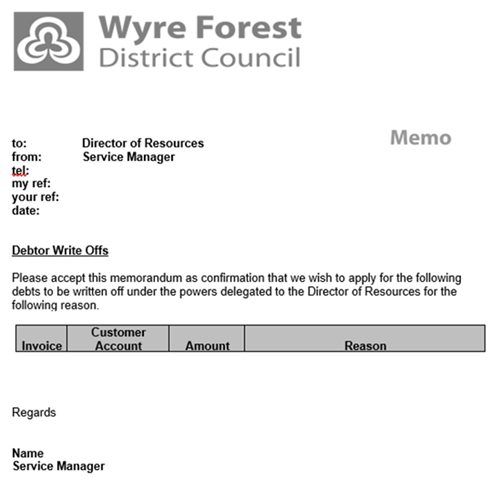
Debtors Write-off sample proforma