Draft for consultation
Shared Homelessness Review 2025
Last updated March 2026
DRAFT VERSION
- Bromsgrove District Council
- Malvern Hills District Council
- Redditch Borough Council
- Wychavon District Council
- Wyre Forest District Council
Introduction
This homelessness review has been carried out to inform the shared Homelessness and Rough Sleeping Strategy 2026-31 for five of the six Local Housing Authorities (LHAs) in Worcestershire; Bromsgrove District Council, Malvern Hills District Council, Redditch Borough Council, Wychavon District Council and Wyre Forest District Council. Worcester City Council is developing a separate homelessness review and strategy. In the event that Local Government Reorganisation (LGR) sees the creation of one or two unitary councils, the new organisation(s) will look to review the strategy at the earliest opportunity.
In accordance with the Homelessness Act 2002, this comprehensive assessment of the nature and extent of homelessness across the county will enable the five Worcestershire districts who share this strategy to demonstrate the evidence base for the strategic priorities and actions within the strategy, and to develop and deliver services in partnership to prevent and tackle homelessness.
The purpose of the review is to:
- Set out the national and local strategic context affecting homelessness
- Establish the current and future extent of homelessness in the county and identify any trends
- Identify what is currently being done to prevent and tackle homelessness
- Identify any potential gaps in service provision or homelessness prevention activities, and set out the strategic priorities and actions to address those gaps
- Identify what level of resources are available, to prevent and tackle homelessness and deliver on actions identified
This review gives an overview of data available on homelessness in Worcestershire, including details of applications made to the councils by homeless households and those threatened with homelessness under the prevention and relief duties of the homelessness legislation. It draws on additional sources of information to explore the specific risks to households and demands on services related to homelessness.
We also consider the impact of different services and actions taken to prevent or relieve homelessness and rough sleeping, the views of stakeholders and those with lived experience of homelessness.
This review has also utilised data within the Worcestershire Housing Strategy 2023-40.
National and local legislation and policy
National Plan to End Homelessness
In December 2025, the Government published their cross-government homelessness and rough sleeping national strategy to end homelessness: A National Plan to End Homelessness. The plan is a comprehensive strategy to address the root causes of homelessness and to provide long-term solutions. It encompasses long term investment in housing, removing section 21 no fault eviction options for landlords, investment in homelessness prevention, tackling poverty and supporting groups of people more vulnerable to homelessness.
The plan involves departments across government committing to reducing homelessness, rough sleeping and improving the lives of children and families already in the homelessness system. A key element of the strategy is a new duty to collaborate, whereby all relevant bodies (local authorities, hospitals, prisons, probation) must identify and act early to prevent homelessness at transitions, for example a discharge from hospital into homelessness would be unacceptable. The aim is for homelessness to become rare and brief, that people can access support quickly and that no-one experiences homelessness more than once in their life.
The voluntary and community sector is identified as a key partner in tackling and preventing homelessness, as their trusted relationships with individuals enables them to design and deliver innovative, trauma-informed, and person-centred interventions that complement council services. In this plan the Government sees a clear opportunity for the voluntary and community sector to broaden its contribution to tackling homelessness, for example, supporting long-term recovery and prevention, helping people to sustain a life away from homelessness - including those in temporary accommodation, at risk of eviction, or facing hidden homelessness.
The plan acknowledges both the human cost and financial cost to the taxpayer, noting spending on temporary accommodation has increased 5-fold in 15 years to £2.8 billion. The impact of living in temporary accommodation on families and specifically on the life chances of children is a key focus of the plan.
The headline objectives for the plan are:
- Long-term sustainable change to address the root causes of homelessness: building more homes, reforming renters’ rights, and tackling poverty
- Medium- term changes to support councils and public services to move from crisis to prevention: new national targets, new duties on services, and focusing on investment in prevention, where possible. Funding for a new National Workforce Programme to provide essential training, expert housing and homelessness advice, and skills for the homelessness and rough sleeping workforce aims to support this objective.
- Short-term change to tackle the worst forms of homelessness: eliminating the use of B&Bs for families and tackling unacceptable temporary accommodation by increasing supply, improving quality and experience and supporting local models, halving the number of people with complex needs who spend years on the street, through new programmes and targeted funding
Our shared Homelessness and Rough Sleeping Strategy 2026-31 and the action plan will align closely with national strategy.
Local Government Outcomes Framework
Oversight of government spending is moving to an outcome focused model of accountability for councils in England through a new Local Government Outcomes Framework. The framework clarifies the key outcomes central government wants to work with local government to deliver.
Headline priorities for central government are:
- Homelessness and rough sleeping - prevent and reduce homelessness and rough sleeping
- Housing - everyone has access to a decent, safe, secure, and affordable home
- Multiple disadvantage - improve the lives of adults experiencing multiple disadvantages
The National Plan to End Homelessness sets a new requirement for local authorities to include targets in their local homelessness action plan, aligned with the metrics in the new Outcomes Framework for local government. Councils will be required to publish and regularly update their action plans as a condition of funding. At a national level, the plan implementation will be overseen by an interministerial group and will be monitored by a group of people with lived experience. The plan notes that we will work with councils to ensure they are also shaping their local plans with people with lived experience.
Our shared Homelessness and Rough Sleeping Strategy Action Plan will align with the metrics in the Outcomes Framework. Implementation will be overseen by the countywide Homelessness and Rough Sleeping Strategy Group and monitored by those with lived experience.
Social and Affordable Homes Programme (2026-2036)
The Social and Affordable Homes Programme (2026 – 2036) commits £39 billion to deliver an expansion in housebuilding, with 60% for social rent. The first grants from April 2026 aim to boost council housebuilding and supported housing. £3.5 billion is dedicated over three years for homelessness and rough sleeping.
See section below on the Worcestershire Housing Strategy 2023-30 regarding local actions on housing growth and delivery relevant to the homelessness strategy.
Homelessness legislation
The Homelessness Reduction Act 2017 extended the duties on Local Housing Authorities (LHAs) to prevent homelessness within 56 days and for those already homeless, to try to relieve homelessness for 56 days regardless of whether the household is in Priority Need or not. There has also been a widening of the Priority Need definitions including survivors of Domestic Abuse.
Homelessness and housing advice services across England are legally framed by the Housing Act 1996, later updated by the Homelessness Reduction Act 2017. Prevention of homelessness is a core principle, placing a duty on all LHAs to prevent homelessness for those eligible and to provide relief for those who are already homeless. To proactively prevent homelessness, LHAs will identify people at risk of homelessness and intervene before a crisis occurs. This will include developing targeted support for vulnerable people, working with partners, and providing housing advice to help people sustain their current accommodation.
Equalities Act 2010
Local authorities, when exercising homelessness functions under the Housing Act 1996 and Homelessness Reduction Act 2017, are required to apply the Public Sector Equality Duty. Local authorities must have due regard to eliminate unlawful discrimination, advance equality, and foster good relations across protected characteristics. Protected characteristics are defined as, age, disability, gender reassignment, marriage and civil partnership, pregnancy and maternity, race, religion and belief, sex and sexual orientation. The Homelessness Code of Guidance requires authorities to integrate equality considerations into policy frameworks, homelessness reviews, prevention strategies, decision-making, advice, temporary accommodation and final offers.
Cost of living crisis
Various factors continue to impact people’s incomes and disproportionately affect low-income households in the UK. Household incomes fell across the income distribution in 2023/24. Median household income before housing costs was £650 a week in 2023/24, a real fall of £13 a week (2%) since 2022/23. Income for households with the lowest 10% of incomes fell the most, by £18 a week (7%) from 2022/23 to £235 a week in 2023/24 (source: Income inequality in the UK). The lowest income households remain 4.9% below 2020 levels. Food price inflation rose sharply to 20% in March 2023, the highest in 45 years. Food price inflation continues to run at 4.9%. Energy prices increased from late 2021. Typical household energy bills increased by 54% in April 2022 and 27% in October 2022. Lower wholesale prices have led to falls in prices, but current bills are still 43% above their winter 2021/22 levels. Consequently, households are spending a growing share of their income on essentials, energy, food and rent, intensifying financial pressure, especially on lower-income groups.
Financial inclusion and support
The creation of Universal Credit (UC) under the Welfare Reform Act 2012 introduced significant changes to welfare benefits. The act introduced a housing under-occupancy penalty, a reduction in housing benefit for social housing tenants of working age who are deemed to have more bedrooms than their household requires. The reduction continues to be 14% for one spare bedroom and 25% for two or more. UC limits the total amount of benefits a household can receive overall, including housing costs. Current weekly caps are £283.71 for single adults and £423.46 for couples or single parents.
In the Autumn Budget (2025) it was announced that the two-child benefit cap is to be removed from April 2026. Families will receive the child element of UC for every child, no longer limited to just two per household. The Office for Budget Responsibility estimates the cap’s removal will lift 450,000 children out of relative poverty by 2029/30. The monthly work allowance, £411 for claimants receiving housing support and £684 (25/26) for those without housing support, aims to help mitigate some of the impact of a reduction in benefits under UC.
The Spending Review in 2021 introduced an adjustment to the taper rate of UC, from 63p to 55p enabling people to retain more of the money they earn. In relation to those people living in supported housing, the Autumn Budget 2025 outlined how the Government will introduce new earned income disregards in Housing Benefit for individuals residing in supported housing or temporary accommodation. Changes are expected to be introduced in autumn 2026.
To support vulnerable households, the Household Support Fund (HSF) continues to be allocated nationally to help vulnerable households with essentials such as food, utilities and emergency housing. The fund has been extended to 31 March 2026. The Department for Work and Pensions (DWP) provide £742m (25/26) to councils using a formula that considers local population and levels of deprivation. Homelessness Prevention Grant also supports councils to prevent homelessness among private renters and others at risk by positively supporting housing stability, health, income maximisation and employment for those unable to work or facing other pressures.
From April 2026, a combined Crisis and Resilience Fund will replace Household Support Fund and Discretionary Housing Payments (in a staged approach). The Crisis and Resilience Fund will be maintained at £842 million. The multi-year settlement for locally delivered crisis support will enable councils to provide preventative support to communities, working with the voluntary and community sector. The Fund will provide immediate support to people in crisis, including those at risk of homelessness. Councils will also be able to use funding to invest in local financial resilience to enable communities to better deal with crises in the long-term, reducing dependence and repeat need. This includes helping people to reduce or manage priority debts such as rent, council tax and utilities arrears.
In the short term, in 2025/26, those who need additional support with their housing costs can approach their council and apply for Discretionary Housing Payments. The housing element of the Crisis and Resilience Fund will be maintained at £100 million per annum. The aim is to streamline emergency support and preventative approaches with the aim of building greater financial resilience for households and communities.
Free debt advice and income maximisation is funded through the Debt Advice Modernisation Fund (2025–26). The fund, £1.5 million for 2025/26, offers grant funding to not-for-profit organisations certified to provide financial advice by the Financial Conduct Authority. The Government’s National Financial Inclusion Strategy (Nov 2025) focuses on reaching vulnerable populations, including those with mental health issues, experiencing digital exclusion, homelessness, or economic abuse through funding specialist outreach and partners. Food banks continue to provide support to people in need. The Trussell Trust distributed parcels from 1,711 locations across the UK in the financial year 2024/25.
Continuing to provide welfare support and financial inclusion is a priority for the shared Homelessness and Rough Sleeping Strategy 2026-31.
Renters’ Rights Act 2025
The Renters’ Rights Act introduces a range of changes that are likely to impact levels of homelessness in different ways. The key changes brought about by the introduction of new legislation are:
- Abolition of section 21, no fault evictions
- Mandatory duty for local authorities to enforce existing legislation relating to housing standards and protection from eviction
- Introduction of a national private sector rental database
- Extension of the Decent Homes Standard to the private rental sector
- Extension of the housing ombudsman service to the private rental sector
As 19% of all households in England live in the private rented sector; where assured shorthold tenancy agreements are predominantly used, the removal of the section 21 route will see the number of people presenting for this reason reduce and stop as the legislation is implemented. Landlords will need to provide cause for evicting tenants in the future and causes are limited by the law. As the turnover of tenancies slows, the hope is that local authorities can increase focus on prevention of homelessness.
Given the increased level of oversight and legal requirements, there may be an initial spike of private sector landlords exiting the sector which may lead to increased homelessness in the short term.
As well as a potential reduction in available supply of rental properties, there may be a knock-on effect of increasing rents, leading to greater affordability pressures on tenants.
The mandatory duty to enforce will put greater responsibility on local authorities to identify and take action where landlords do not maintain standards, keep tenants safe or illegally evict them. Homelessness and housing advice teams will need to update their training to identify where enforcement support would alleviate homelessness. LHAs expect additional funding to implement the changes.
The impact of the Renters Rights Act on rental markets and mitigating the risk of homelessness is a key strategic priority for the Homelessness and Rough Sleeping Strategy 2026-31.
Domestic Abuse Act 2021
The Domestic Abuse Act 2021 amends homelessness legislation so that all eligible survivors of domestic abuse are automatically classed as having “priority need” when making a homelessness application. This removes the prior requirement for a vulnerability assessment, broadening access to accommodation duties, and has resulted in greater numbers of domestic abuse survivors accessing services.
When carrying out their homeless duty the LHAs provide suitable accommodation under Part 7 of the Housing Act 1996, taking into account the victim’s safety and household circumstances. This is achieved by conducting risk assessments and engaging in multi-agency working (such as with Multi-Agency Risk Assessment Conferences, MARAC) to ensure ongoing safety.
Continuing to support domestic abuse survivors is a key priority for the Homelessness and Rough Sleeping Strategy 2026-31.
Supported Housing (Regulatory Oversight) Act 2023
The Supported Housing (Regulatory Oversight) Act allows a new regulatory framework, aimed at improving the quality and accountability of supported housing in England, to be introduced. The Government is developing new national quality standards and consulting with stakeholders. Supported housing provides accommodation with care, support, or supervision for vulnerable groups, including those experiencing homelessness, domestic abuse survivors, and individuals with complex needs. The Act was introduced following widespread concerns about poor-quality accommodation, where some providers prioritised profit over resident welfare. The Act also addresses intentional homelessness rules, ensuring individuals leaving unsafe and sub-standard accommodation are not penalised.
The Act strengthens the link between supported housing and homelessness prevention. Local authorities must integrate supported housing provision into homelessness strategies and planning frameworks, ensuring sufficient supply for vulnerable groups.
The Act encourages closer working between housing, social care, and health services. This integrated approach supports the government’s ambition to reduce homelessness by addressing underlying support needs rather than relying solely on accommodation solutions. Implementation will involve secondary legislation and detailed guidance, and full rollout is expected by 2027.
Local authorities will be required to:
- Introduce and operate a licensing regime based on compliance with National Supported Housing Standards
- Develop and implement a supported housing strategy
- Monitor providers to ensure adherence to licensing conditions and national standards
Clear links between the Supported Housing Strategy and the Homelessness and Rough Sleeping Strategy will be established.
Criminal justice system
The Independent Sentencing Review 24/25 aims to ensure the country is never again in the position where it has more prisoners than prison places and relies on emergency releases. To control the prison population, FTR48 is a new rule introduced in 2025 under the Criminal Justice Act 2003 that changes how prisoners are recalled to custody when they break license conditions after release. Instead of being kept in prison until the end of their sentence (or until the Parole Board decides), most people on short sentences will now be recalled for a fixed period of 28 days and then automatically released back into the community. FTR48 releases will be phased over six tranches, allowing for improved pre-release planning and reducing the volume of individuals released on any single day.
Though a relatively small number of people are recorded as homeless because of leaving prison, data indicates homelessness has a significant impact on repeat offending. In 2024 the Ministry of Justice reported that homelessness is a key driver of reoffending, stating 62% of people who are homeless after prison go on to reoffend, compared to 32% of people who are in settled accommodation. People are more than twice as likely to reoffend if they are rough sleeping after leaving prison.
LHAs will need to:
- Participate in multi-agency prison release panels to ensure homelessness assessments are carried out pre-release, wherever possible, and those with a priority need are identified early
- Ensure timely homelessness assessments for individuals in CAS3 to facilitate appropriate move-on opportunities and maintain capacity within the Community Accommodation Service estate for those being released
- Engage proactively with regional leads, Strategic Housing Specialists and other HM Prison and Probation Service leads, to stay informed of the latest guidance, developments, and opportunities for collaboration
These are now in place in Worcestershire following the implementation of the Prison Leavers Protocol and will continue to be a strategic priority for the homelessness strategy.
Police, Crime, Sentencing and Courts Act 2022
The Police, Crime, Sentencing and Courts Act 2022, was enacted on the 28th April 2022 and includes duties to collaborate and plan to prevent and reduce serious violence (Part 2, Prevention, Investigation and Prosecution of Crime, Clauses 7-12) that will require more resources from agencies. It strengthens police powers to tackle unauthorised encampments (Part 4) which may adversely impact on rough sleepers and Gypsies and Travellers and proposes to ensure children are only remanded to custody where this is genuinely the only option in respect of youth remand (Part 8, Clause 132). This approach necessitates more innovative solutions to meet the housing needs of this cohort.
Vagrancy Act 1824
In the summer of 2025, the government announced the Vagrancy Act would be repealed, decriminalising rough sleeping. The aim is for this to be completed by the spring of 2026.
Care Act 2014
This act introduced the duty to provide care assessments and care plans. The care assessment should include a ‘plan of action’ which shows what services are going to be provided, who is going to provide them, and when.
Local authority and health care bodies/other agencies (such as housing) must work together to deliver services and in addition, local authorities must also provide information and advice to people about accessing support services, even where those needs are not going to be directly met by the local authority.
The National Plan to End Homelessness states the Government’s intentions to take action to strengthen the way that housing, social care and safeguarding services work together to prevent homelessness, particularly for people with complex needs. They will review and update the relevant areas of the Care Act 2014 statutory guidance, particularly in relation to councils’ safeguarding responsibilities and how they should act on these to support people at risk of homelessness and rough sleeping.
The strategy action plan will respond to these updates when provided by government.
Children’s Wellbeing and Schools Bill
Care leavers often move to independence much earlier than their peers, and without family safety nets. Without housing and wraparound support, they are at high risk of poor life chances related to homelessness, poor mental health and social exclusion.
This Bill is expected to become law in 2026, with implementation phased in by September 2026. It reinforces housing’s role as a key partner in child welfare, strengthening corporate parenting responsibilities for housing and increased joint working with children’s services.
The Bill requires housing and homelessness services to more actively participate in statutory safeguarding arrangements, including sharing relevant housing information to protect children at risk and attending child protection meetings. Family Group Decision Making (FGDM) before care proceedings may lead to more relatives taking on kinship care roles. This requirement will impact allocations policies as housing and homelessness services will have a duty to provide solutions, for example, priority transfers, adaptations, or larger properties, to keep children within family networks. There may also be a need for temporary accommodation options during transition periods. A new duty requires each local authority to publish the arrangements it has in place to support and assist care leavers in their transition into adulthood and independent living.
The Bill covers the standard of emergency and temporary accommodation to ensure it meets child-friendly standards, for example it is safe, accessible and near to schools and housing is a suitable size for families. The Bill prohibits care leavers from being classed as intentionally homeless leading to a need to revise homelessness decision-making processes and ensure pathways for secure, suitable accommodation. Housing and support for care leavers will need to be considered, including supported housing and tenancy sustainment services.
The suitability and standard of emergency and temporary accommodation for families and young people, including care leavers, is a key strategic priority for the homelessness strategy.
Armed Forces and veterans
In Worcestershire, the LHAs duty towards veterans is governed by the Armed Forces Act 2021, which enshrines the Armed Forces Covenant into law.
This legislation imposes a statutory "Duty to Have Due Regard" to the principles of the Covenant, ensuring that veterans and their families are not disadvantaged when accessing public services, particularly in housing and healthcare.
-
The Armed Forces Covenant in Worcestershire
Worcestershire County Council and the six District Councils (Worcester City, Malvern Hills, Wychavon, Wyre Forest, Bromsgrove, and Redditch) operate under the Worcestershire Armed Forces Covenant Partnership.
No Disadvantage: The primary duty is to ensure that veterans face no disadvantage compared to other citizens.
Special Consideration: In cases where veterans have been injured or bereaved, local authorities may provide "special consideration," which provides additional priority for social housing.
Armed Forces Champions: Each district council appoints a dedicated "Champion" to advocate for the military community and ensure local policies align with the Covenant
-
Homelessness strategy and housing priority
The Worcestershire Homelessness and Rough Sleeping Strategy 2022-2025 integrated veteran support into its core prevention and relief duties. Under the Housing Act 1996 and the Homelessness Reduction Act 2017, Worcestershire authorities apply specific exemptions for veterans. Unlike most applicants, veterans do not need a "local connection" to apply for social housing.
Prevention and Relief: Local authorities have a duty to work with veterans 56 days before they become homeless (Prevention Duty) and for 56 days after they become homeless (Relief Duty).
Integrated Support Pathways: Worcestershire utilises a multi-agency approach to prevent veteran homelessness by working with specialist Partners: SSAFA Worcestershire, The Royal British Legion, and Stepway to provide holistic support that addresses the root causes of housing instability, such as debt or mental health issues. Housing Associations: Registered Providers like the Rooftop Housing Group offer "Homes for Veterans" schemes, specifically tailored to help former service personnel transition into civilian tenancies.
-
Priority Need status
Armed forces veterans are automatically considered to have “priority need” as part of the homelessness assessment, if they are vulnerable due to military service. Vulnerability may stem from length of service, combat exposure, medical issues (including PTSD), or welfare assessments by the Ministry of Defence. Serving members of the armed forces and anyone who has ever served in the armed forces are able to apply to all LHAs for housing, regardless of local connection.
Veterans Strategy 2025
The aim of the Veterans Strategy 2025 is to ensure veterans get the support they need through dedicated pathways and specialist services where appropriate. This includes, where veterans are experiencing or at risk of homelessness, that they have access to the advice and support they need.
At the time of writing this review the LHAs are reviewing the Worcestershire Armed Forces Covenant Action Plan in relation to housing and homelessness.
Local Policy, Strategy and Projects
Worcestershire Housing Strategy
The Worcestershire Housing Strategy focuses on 4 key themes; Economic Growth and Jobs, Quality and Standards, Health, Wellbeing and Inclusion and Net-zero carbon and sustainability. There is a list of priority actions for the first five years but also longer-term priorities to achieve up until 2040. This has been developed in conjunction with partners including from health, county council and the Local Enterprise Partnership. Two delivery groups have been set up to implement actions, chaired by Integrated Care Board and Worcestershire One Public Estate Partnership representatives.
Boosting affordable housing delivery and providing suitable and supported accommodation - linking the work of the Housing and Homelessness Strategy features strongly throughout the homelessness strategy and associated action plan.
Rough Sleeping
Rough Sleeper Prevention and Recovery Grant funding (RSPRG)
The Worcestershire councils successfully obtained several years of Rough Sleeper Initiative funding during 2022-25. This was replaced in 2025-26 by the Rough Sleeper Prevention and Recovery Grant. The intention of the funding remained broadly the same and is used by the councils to support rough sleeper outreach support, housing first and housing led projects, emergency accommodation, personalisation budgets and support to access the private rented sector to help get rough sleepers off the street.
Emergency provision for rough sleepers
The provision of RSPRG funding has enabled some councils within the county to switch emergency temporary accommodation provision to No First Night Out. All other authorities provide No Second Night Out accommodation for Rough Sleepers to provide them with an opportunity to access accommodation and support needs and look for longer term solutions.
Severe Weather Emergency Protocol
Between November and March all the Local Authorities in Worcestershire provide Severe Winter Emergency Provision for rough sleepers whenever the temperature hits 0 or below. This is a mixture of self-contained and communal accommodation located across the county.
Brightpath
The Brightpath service provides a mental health support worker to work with a small caseload of the most complex entrenched rough sleepers in the County. The service also offers a bespoke training course for outreach teams and those working with rough sleepers. The post is also supported by a clinical psychologist funded by the Integrated Care Board to work with entrenched rough sleepers.
At the time of writing this review, the government announced a multi-year settlement for homelessness funding, including rough sleeping funding. A key priority within the strategy will be to review all rough sleeper support and accommodation pathways in light of provisional 3 year funding arrangements.
Health
The development of Primary Care Networks (PCN) has led to closer working relationships between GPs and District Councils, including through the formation of District Collaboratives across the County. The Health and Wellbeing Board acts as a forum in which key leaders from the local health and care system work together to improve the health and wellbeing of their local population. In Worcestershire the Health and Wellbeing Board also has representations from District Council members and the Chief Executive of Malvern Hills and Wychavon District Councils (in his role as Chair of the Worcestershire Housing Board).
Health and Wellbeing Strategy
The Health and Wellbeing Strategy “Being Well in Worcestershire” has a particular focus on good mental health and wellbeing. Under this main priority are three sub-priorities of healthy living at all ages and stages of life; safe, thriving and healthy homes; communities and places and quality local jobs and opportunities. The second of these three sub-priorities is particularly relevant to this Homelessness and Rough Sleeping Strategy, with its focus on tackling health inequalities.
Joint Strategic Needs Assessment
The link between housing and health in Worcestershire is a critical focus for the local Joint Strategic Needs Assessment (JSNA).
Key local statistics
- Mental Health: Approximately 82% of the local homeless population has a mental health diagnosis, compared to 12% in the general public.
- Physical Multimorbidity: Most individuals suffer from two or more long-term conditions, particularly respiratory issues (due to exposure) and poor oral health.
- Premature Aging: Physical frailty in the homeless community often appears 20–30 years earlier than in housed populations.
- Barriers to Access: Over-reliance on A&E (3x higher than average) due to difficulties with GP registration and "discharge to street" cycles.
- The population of Worcestershire is ageing, with 23% over 65 compared to 6% in England and Wales and this does put additional pressure on health services.
- Average life expectancy in Worcestershire for males is9 years and 83.9 for females. These levels are above England’s worst life expectancy areas but not as good as its best areas.
Joint working across housing and health
There are a range of ways that housing and health work together locally to assist homeless households with their health needs. For example, the Hospital Discharge Homeless Pathway Worker project is now in its 10th year and provides specialist support to inpatients within acute and community hospitals across the county as well as offering training to staff and students. The role currently sits within Worcester City Council and is funded via NHS funding. District housing teams also fund Mental Health Link Workers to assist households who approach for homelessness assistance who also have mental health needs. The Basement Project Floating Support for Young People offers emotional and physical wellbeing support, including hypnotherapy and counselling, as well as housing related support. District councils also operate Housing First/Housing Led models which prioritise stable accommodation as a foundation for medical and psychiatric treatment.
In developing this review, a number of key stakeholders within the health sector locally were consulted and the following areas were identified as a priority to address in terms of health and homelessness:
- Understanding the health needs of homeless households and how services might be able to respond more flexibly to those with complex needs
- Reducing health inequalities for rough sleepers and improve life expectancy levels
- Improving joint working to prevent unnecessary hospital admissions for those who are homeless/at risk of homelessness
- Removing barriers to hospital discharge for those who cannot return to their home, or who are homeless
- Developing more accessible permanent and temporary housing
Many people accessing homelessness services have unmet mental or physical health needs for a range of reasons, therefore health and homelessness will be a key feature of the homelessness strategy and action plan.
Young people
The councils in Worcestershire have a joint protocol detailing how they will respond to the needs of 16/17 year olds and care leavers. These are regularly reviewed through working groups to ensure they are kept up to date with changing policies and legislation, including aiming to make intentionally homeless decisions for care leavers exceptional and upcoming amendments in the Children’s Wellbeing and Schools Bill which will remove intentionality for care leavers.
Over the course of the last homelessness strategy there has been a reduction in the number of districts able to provide Young Person's Pathway Workers though this specialism remains in some districts.
There are regular young person panel meetings to discuss current care leavers at the earliest opportunity to try and find accommodation before leaving care as well as looking at barriers to housing and building up tenancy sustainment activity.
There are difficulties for young people in supported accommodation who are unable to work as supported accommodation becomes unaffordable. There are also difficulties for those not in work as options in the private rented sector for young people are unaffordable due to households being entitled to the shared room rate. Many young people have an aspiration for self-contained properties which are currently not attainable for many young people whose primary income is benefits.
Key aims of the homelessness strategy will be to increase options for young people through employability, review the care leavers protocol, work to increase homelessness prevention amongst young people and reduce the need for temporary accommodation usage.
Families with children
Since the previous homelessness review, the districts have successfully reduced the use of bed and breakfast accommodation for families with children. This reflects a continued commitment to minimising the use of unsuitable temporary accommodation for this cohort.
Despite this progress, overall demand for other forms of temporary accommodation for families has increased. This trend is driven by a combination of factors, including the ongoing economic downturn, changes to taxation affecting private rented sector landlords, and the anticipated impact of the Renters Rights Act. Collectively, these factors have contributed to a contraction in the private rented market, increased landlord caution, and reduced access to suitable move-on accommodation. Pressures are expected to intensify in advance of the Act’s implementation in May 2026.
District councils provide a range of support services to families, delivered either through floating support or within temporary accommodation settings. However, the availability and consistency of support varies across districts. Families with larger bedroom requirements face particular challenges due to limited housing supply, alongside households experiencing multiple exclusions linked to previous tenancy issues e.g. rent arrears and anti-social behaviour. Districts utilise targeted funding to mitigate these barriers, working proactively with households and landlords.
This includes tenancy sustainment and training initiatives designed to address landlord concerns and facilitate successful move-on from temporary accommodation.
The strategic priorities for families with children arising from this review are to strengthen prevention activity to reduce reliance on temporary accommodation; maximise opportunities presented by the Renters’ Rights Act to improve access to the private rented sector; establish clearer, more consistent support pathways for families in temporary accommodation; and accelerate move-on into settled housing to minimise the length of stay in temporary accommodation.
Prison Leavers
The National Plan to End Homelessness identifies prison release as a key risk point for homelessness and re-offending, recognising that being released without stable accommodation or support networks in place is a major driver of repeat homelessness and re-offending.
The government aims to ensure no one leaves a public institution into homelessness, with a commitment to reduce by 50% the number of people homeless on their first night out of prison by the end of this Parliament.
Key national measures
- Duty to Collaborate: Prison and probation services must work with councils and homelessness teams to identify housing risks early.
- Pre-release planning: Housing support arranged before release, using digital systems for faster referrals.
- Community Accommodation Service (CAS): Investment in temporary housing and support post-release.
- Sentencing reforms: Reduce short prison stays that disrupt housing and expand community sentences.
- Targeted programmes: For individuals with complex needs to secure and sustain accommodation.
Worcestershire approach
- Criminal Justice Housing & Support Protocol: Agencies work together to identify anyone at risk of rough sleeping well before release.
- Prison Release Meetings: Multi-agency meetings (prison, probation, housing, support services) to plan housing weeks or months in advance.
- Emergency Options: No First/Second Night Out units, Approved Premises, CAS3, and supported housing.
- Support Services: Help with benefits, health access, substance misuse referrals, ID, budgeting, and tenancy sustainment.
- Monitoring: Probation tracks accommodation stability; new Targeting Interventions for People on Probation Group ensures housing remains a shared responsibility.
The development of a Criminal Justice Housing and Support Protocol has supported a more collaborative approach from across statutory partners and this, combined with increased awareness raising and training in the Duty to Refer, has directly resulted in an increase of 115% from 2022/23 to 2023/24 and a further 27% from 2023/24 to 2024/25 in the number of Duty to Refers being received. An increase in the number of individuals referred to our Prison Release meetings means that an assessment of priority need is made at an earlier stage and there are fewer people leaving custody and approaching the local authorities as homeless on the day of release. The number of Duty to Refers received by Worcestershire LHAs is shown in the table below.
213B Specified Public Body with a duty to refer
|
BDC |
RBC |
MHDC |
WDC |
WFDC |
Total |
|
|
2022-23 |
8 |
30 |
5 |
25 |
21 |
89 |
|
2023/24 |
8 |
67 |
17 |
9 |
80 |
181 |
|
2024/25 |
20 |
75 |
15 |
57 |
64 |
230 |
Source: Data Extracted from Internal Homelessness Systems
The increase in the availability of CAS 3 accommodation has provided much-needed short-term housing solutions and the majority of those being released from prison with no fixed abode are being placed in Approved Premises or CAS3 accommodation.
Key objectives of the CAS3 service are:
- To ensure that all prison leavers who would otherwise be homeless have access to temporary accommodation for up to 84 days on release or when moving on from CAS1 (Approved Premises) and CAS2.
- To support prison leavers to move-on to settled accommodation at three months.
- To provide a critical stabilising environment for people on release from prison from which they can address other aspects of their behaviour linked to their risk of re-offending.
Support:
- Basic Floating Support - Weekly contact with a support worker to assist in maintaining the accommodation and fortnightly home visits.
- To sustain the temporary accommodation and support move on to settled accommodation, working with probation.
- Community Probation Practitioner (CPP) has overall responsibility for resettlement planning and oversight.
The shared five authorities (excluding Worcester) have 16 CAS3 beds spaces. Many of these placements fail due to the individual being recalled and understanding and tackling recalls will be a priority for partners.
A Criminal Justice Housing and Support Protocol Review Group has been established to review the effectiveness of the protocol and identify any gaps in services. The group comprises representatives from the local authorities, DWP, support agencies, police, prison and probation. Providing a holistic approach that not only provides accommodation but includes the right support and positive activities including work, education and training will be vital to achieve more pathways into settled and sustainable accommodation.
Priorities for the homelessness strategy are to review supported and transitional accommodation capacity and accommodation pathways, and to strengthen partnerships and use of data to ensure proactive prevention, reducing crisis costs and improving outcomes.
Domestic Abuse
The Domestic Abuse Partnership Board originally developed a Domestic Abuse Strategy and Action Plan, covering issues in relation to the Part IV duties in the legislation and wider to include community domestic abuse services and have during 2024/25 carried out a needs assessment to inform future commissioning and delivery of services. The Councils continue to jointly fund a County Domestic Abuse Co-ordinator to ensure consistency and best practice across the councils and lead on work around lived experience and a specialist County Research and Intelligence Officer to support with data gathering to report on outcomes to central government.
The Councils, with assistance of funding from the County Council employ six Domestic Abuse Housing Officers (DAHOs) to support survivors in safe accommodation and other accommodation settings.
In 2023/24 the DAHOs saw a total of 422 households fleeing domestic abuse and in 2024/25 this had grown to 547.
Below is a table showing approaches for each council over the two years by prevention and relief stages.
|
BDC 23/24 |
BDC 24/25 |
MHDC 23/24 |
MHDC 24/25 |
RBC 23/24 |
RBC24/25 |
WDC 23/24 |
WDC 24/25 |
WFDC 23/24 |
WFDC 24/25 |
|
|
Prevention Duty |
40 |
21 |
7 |
19 |
5 |
92 |
12 |
11 |
13 |
9 |
|
Relief Duty |
29 |
65 |
36 |
35 |
56 |
30 |
57 |
84 |
46 |
59 |
|
Total Duties Owed^: |
69 |
86 |
43 |
54 |
61 |
122 |
69 |
95 |
59 |
68 |
This shows the majority of approaches happen at relief stage when the household is already homeless and the councils are keen to better understand the reasons for this to try and increase the level of prevention for this client group.
Continuing to support domestic abuse survivors – and particularly at an earlier stage - is a key priority for the Homelessness and Rough Sleeping Strategy 2026-31.
Refugees and migrant homelessness
Worcestershire has provided a sanctuary to refugees from Ukraine, Syria and Afghanistan through the government’s resettlement schemes, including Homes for Ukraine, the Afghan Citizens Resettlement Scheme (ACRS) and Afghan Relocations and Assistance Policy (ARAP), as well as a small number of arrivals through the Community Sponsorship Scheme. Accommodation has been provided by a combination of private hosts, the private rented sector and, where appropriate, social housing.
The Home Office is responsible for providing accommodation for asylum seekers, whilst their asylum claims are being processed. Home Office accommodation is provided in Worcestershire in both contingency hotels and dispersal accommodation (usually self-contained family accommodation or houses of multiple occupation). However, asylum seeker numbers in Worcestershire are currently relatively low in comparison to other areas of the UK.
Once asylum has been granted, a refugee is required to leave their Home Office accommodation, with notice to quit currently at 56 days. A process is in place for information to be shared with the local housing authority of notice to quit local Home Office accommodation, to ensure housing advice can be provided.
Homelessness amongst this cohort is relatively low locally due to fewer asylum seeker numbers than other areas of the country and the fact that those placed in Worcestershire often look to relocate to areas where cultural or religious needs are better met or nearer to family members once asylum has been granted. However, it still remains a challenge to be able to respond to the needs of refugees and migrants. In particular, we are seeing an increase in approaches for those with No Recourse To Public Funds, where options for support are extremely limited, and LHAs need to work closely with our partner VCSE organisations to respond to this.
To collaborate with community, voluntary, and faith organisations to develop tailored, culturally appropriate information and guidance for asylum seekers, refugees and those with No Recourse to Public Funds is a key action for this strategy.
Worcestershire Armed Forces Covenant Partnership
Worcestershire partners signed the Armed Forces Covenant in 2012 and are committed to ensuring that those who serve or who have served in the Armed Forces, and their families, are treated fairly. The Worcestershire Armed Forces Covenant Partnership works collaboratively to strengthen local delivery of the Covenant, and in particular, to support Worcestershire veterans who are experiencing problems either in transition or future years. Worcestershire housing allocations policies recognise the contribution of ex forces personnel and are framed to ensure that they are not disadvantaged by not having a local connection and that they receive some additional preference within their housing band by the award of extra waiting time on the housing register. Post traumatic stress disorder is also recognised under the definition of medical need for accommodation.
Employment and financial assistance
The most significant element of financial assistance available to Worcestershire residents comes from the Household Support Fund paid to the County Council and with a smaller amount passported down to the LHAs. This funding is primarily used for emergency support targeted at utilities and food provision. Other sources of financial support are available through housing associations and small local charitable organisations. Food banks have been established in all areas by a number of charitable organisations.
Work is ongoing by County and District Councils to prepare for the roll out of the Crisis & Resilience Fund, which will replace the Household Support Fund from 2026/27.
The Work Health Coach Service has been established to support individuals with long-term health conditions to stay in or return to work, providing personalised coaching and liaison with employers around reasonable adjustments.
The Connect to Work service is a free programme designed to help people in Worcestershire who are finding it hard to start or stay in work due to health conditions, disabilities, or other barriers. This is funded by the DWP and accessed via Worcestershire County Council.
Continuing to provide welfare support and financial inclusion is a priority for the shared Homelessness and Rough Sleeping Strategy 2026-31.
Housing Register and Allocation Policies
The Housing Act 1996 (as amended by the 2002 Homelessness Act and the Localism Act 2011) requires local authorities to make all allocations and nominations in accordance with an Allocations Scheme.
The Housing Act 1996, (as amended) requires local authorities to give Reasonable Preference in their allocations policies to people with high levels of assessed housing need. This includes homeless people, those who need to move on welfare or medical grounds, people living in unsatisfactory housing and those who would face hardship unless they moved to a particular locality within the local authority area. There are four housing register and allocations systems in place across the County
- Wyre Forest Home Choice is a choice-based lettings scheme which operates in Wyre Forest.
- Bromsgrove Home Choice is a choice-based lettings scheme which operates in Bromsgrove
- Redditch Homes is a choice-based lettings scheme for Redditch Borough area
- Housing for You is a choice-based lettings scheme operating across the south Worcestershire authorities of Malvern Hills, Worcester and Wychavon
Safeguarding
Children
Section 11 of the Children Act 2004 places a statutory obligation on district councils to ensure they have in place, suitable arrangements to safeguarding and promoting the welfare of children (either directly or via their families) who may access or use council services.
The Act requires the Council to ensure that:
- its functions are discharged with due regard to the need to safeguard and promote the welfare of children; and
- through working with others, arrangements are put in place to safeguard and promote the welfare of
The Worcestershire Children Safeguarding and Child Protection Procedures issued by the WLCSB (now known as WSCP) sets out how authorities will work together. Further information and the guidelines can be accessed here.
The Worcestershire Local Safeguarding Children’s Board created a guidance document for everyone who works with children and their families in Worcestershire. ‘Multi-Agency Levels of Need: Guidance to help support children, young people and families in Worcestershire.
The focus is on four levels of need which aim is to put the child and their family at the centre of discussion, providing effective support to help them solve problems and find solutions at an early stage.
Adults
The Adult Safeguarding Board is a multi-agency partnership including Local Housing Authority representation. The Board oversee the serious case reviews and the Rough Sleeper Thematic Review action plan, which was developed following the death of a number of rough sleepers in Worcestershire. The Board has a number of sub-groups including one around self-neglect that has established a self-neglect policy and a hoarding protocol.
Local authorities have a duty under Section 42 of the Care Act 2014, to make enquiries relating to anybody aged 18 or over where it has reasonable cause to suspect that the adult in its area (whether or not ordinarily resident there):
- had needs for care and support (whether or not the authority is meeting any of those needs)
- is experiencing, or is at risk of, abuse or neglect, and
- as a result of those needs is unable to protect him or herself against the abuse or neglect or the risk of
Safeguarding responsibilities are integral to all local authority service provision but are particularly important where individuals and families are experiencing homelessness or are threatened with homelessness.
Self Neglect Policy
Self-neglect covers a wide range of behaviour including neglecting to care for one’s personal hygiene, health or surroundings and includes behaviour such as hoarding. A new self-neglect policy was developed and launched in 2022.
Complex Adults Risk Management (CARM) framework
This guidance seeks to provide front line practitioners with a framework to facilitate effective working with adults who are at risk of significant harm due to their complex needs, and where the risks cannot effectively be managed via other processes or interventions, such as section 9 care and support assessment or section 42 safeguarding enquiry under the Care Act 2014. The Complex Adults Risk Management (CARM) framework should be used when the adult’s engagement with support is intermittent or where it has proved difficult to engage with the adult, the risk is significant and an individual agency procedures have not been able to resolve the problem(s).
Current and future levels of homelessness
Overall levels of homelessness
There have been no significant changes in the level of homelessness throughout the districts between 2022/23 to 2024/25. The figures have remained relatively stable. Overall, from 2022/23 to 2024/25 there has been a 5% decrease in the total number of households approaching from 2218 to 2190 and a 2.7% reduction in households assessed from 2150 to 2092. During this time on average 95% of households assessed throughout the districts are owed a duty. Of these, 38% are assessed as being owed a prevention duty. This is a reduction of cases from the last homeless review indicating a higher proportion of households approaching at later stages of their homeless journey. 57% are owed a relief duty, with 5% determined to have no statutory duty owed.
Households assessed and owed a duty
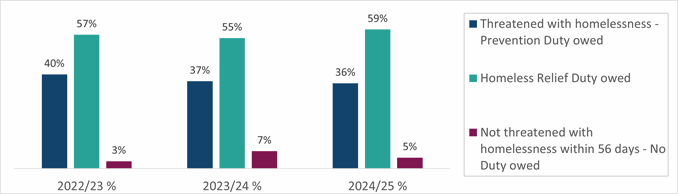
|
Year |
Threatened with homelessness – Prevention Duty owed |
Homeless Relief Duty owed |
Not threatened within 56 days – No Duty owed |
|---|---|---|---|
|
2022/23 |
40% |
57% |
3% |
|
2023/24 |
37% |
55% |
7% |
|
2024/25 |
36% |
59% |
5% |
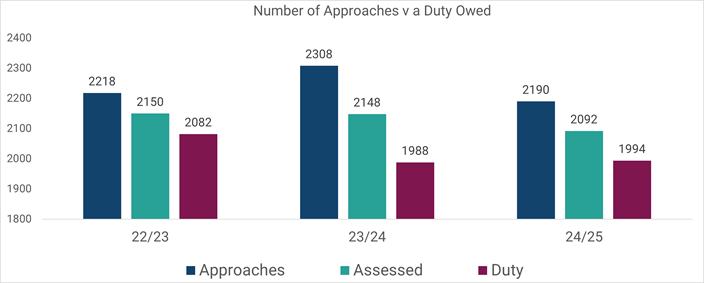
|
Number of Approaches v A Duty Owed |
Approaches |
Assessed |
Duty |
|---|---|---|---|
|
22/23 |
2218 |
2150 |
2082 |
|
23/24 |
2308 |
2148 |
1988 |
|
24/25 |
2190 |
2092 |
1994 |
Reasons for homelessness approaches
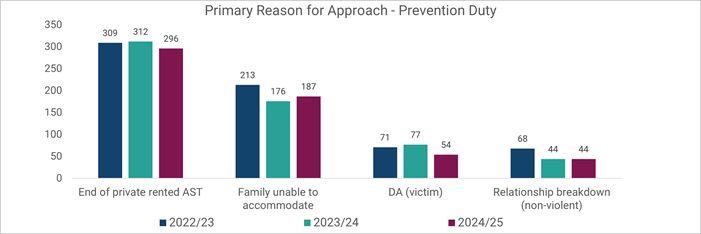
The top four reasons for households seeking assistance are consistent across both the prevention and relief duties. In 2024/25 the ending of a private rented Assured Shorthold Tenancy (AST) is the most common reason for prevention of duty cases accounting for 39% of all households owed a prevention duty. This reflects an increase since the last homelessness review and highlights growing pressures within the private rented sector, driven by tax changes and the impact of the Renters Rights Act on landlord behaviour and market supply.
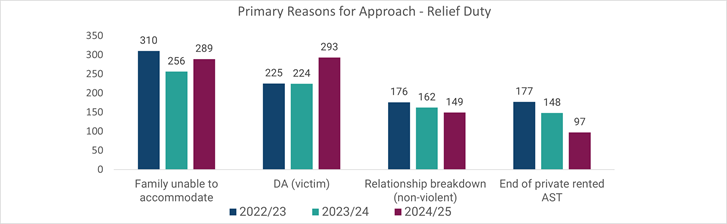
At the relief duty stage, the end of an AST is cited far less frequently, representing only 8% of relief cases. The table below illustrates the data for the leading reasons, including:
- Family no longer willing or able to accommodate
- Non-violent relationship breakdown
- Domestic abuse
- Other reasons
Since the previous review period, relief duty approaches associated with domestic abuse have increased by 10%. This rise indicates an escalation in the number of households requiring urgent housing assistance due to unsafe living conditions, placing additional demand on temporary accommodation and specialist support services.
During the reporting period, the primary reasons for households approaching the service under the prevention duty were predominantly linked to the private rented sector. The most common trigger was the threat of homelessness arising from the ending of assured shorthold tenancies, including notices served under Section 21, alongside rent affordability pressures.
Family and relationship breakdowns also accounted for a significant proportion of prevention duty approaches, particularly where applicants were no longer able to remain with family or friends. Financial hardship, including rent arrears and the impact of rising living costs, continued to contribute to housing instability and early engagement with the service.
Domestic abuse remains a key factor within prevention cases. Increased awareness of domestic abuse and available support pathways has led to earlier disclosures, enabling households to seek assistance before homelessness occurs.
These trends demonstrate the importance of early intervention, targeted prevention activity, and effective partnership working to help households sustain their accommodation or secure alternative housing before homelessness becomes imminent.
|
Primary Reasons for Approach - Prevention Duty |
2022/23 |
2023/24 |
2024/25 |
|---|---|---|---|
|
End of private rented AST |
309 |
312 |
296 |
|
Family unable to accommodate |
213 |
176 |
187 |
|
DA (victim) |
71 |
77 |
54 |
|
Relationship breakdown (non-violent) |
68 |
44 |
44 |
During the reporting period, households approaching the service under the relief duty most commonly cited circumstances where they were already homeless or at immediate risk of homelessness. A significant proportion of cases involved the breakdown of family or friend support networks, where applicants could no longer remain in their existing accommodation.
Domestic abuse continues to be a key factor, with a notable increase in relief duty approaches linked to abuse. This rise may reflect both greater awareness of domestic abuse and increased confidence among individuals to seek urgent assistance.
Other common reasons include eviction from the private rented sector due to tenancy termination, rent arrears, or unsustainable housing costs, as well as loss of social housing accommodation. These factors highlight the urgent need for accessible, short-term accommodation solutions and rapid intervention to prevent further housing instability.
|
Primary Reasons for Approach - Relief Duty |
2022/23 |
2023/24 |
2024/25 |
|---|---|---|---|
|
Family unable to accommodate |
310 |
256 |
289 |
|
DA (victim) |
225 |
224 |
293 |
|
Relationship breakdown (non-violent) |
176 |
162 |
149 |
|
End of private rented AST |
177 |
148 |
97 |
The data shows that the threat of homelessness due to the end of an AST is the leading cause for prevention duty approaches, accounting for 39% of cases, whereas it is less prominent for relief duty (8%). Conversely, domestic abuse is the most common reason for relief duty approaches, representing 24% of cases, compared with 7% under prevention duty. Family no longer willing or able to accommodate remains a significant factor across both duties, while non-violent relationship breakdowns account for a higher proportion of relief duty cases than prevention duty cases.
These trends underscore the different nature of households seeking support under prevention versus relief duties and highlight the need for targeted interventions based on the specific circumstances of each approach.
Household composition of those owed a prevention / relief duty
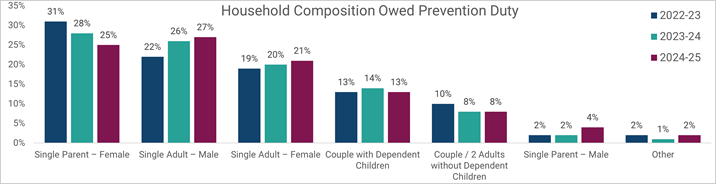
Household composition data demonstrates a clear change in the profile of households owed a prevention duty, with single-adult households now accounting for the largest and fastest-growing proportion of demand, particularly single adult males. This reflects increasing housing insecurity among working-age single adults and presents a significant challenge for homelessness prevention services. While single parent households (female) remain a key cohort within prevention activity, their proportional reduction over the period may indicate the effectiveness of existing early intervention and family-focused prevention measures. Notwithstanding this improvement, continued targeted support for households with dependent children remains essential to prevent repeat or escalated homelessness. Couple households, both with and without dependent children, continue to represent a smaller and relatively stable share of prevention cases, suggesting comparatively lower levels of housing instability within these groups.
|
Year |
Single Parent – Female |
Single Adult – Male |
Single Adult – Female |
Couple with Dependent Children |
Couple / 2 Adults without Dependent Children |
Single Parent – Male |
Other |
|---|---|---|---|---|---|---|---|
|
2022-23 |
31% |
22% |
19% |
13% |
10% |
2% |
2% |
|
2023-24 |
28% |
26% |
20% |
14% |
8% |
2% |
1% |
|
2024-25 |
25% |
27% |
21% |
13% |
8% |
4% |
2% |
Household composition of those owed a Relief Duty
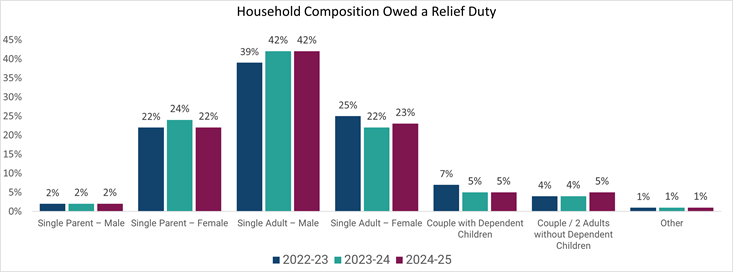
Household composition data for the relief duty highlights a significant concentration of demand among single-adult households, particularly single adult males, who account for over 40% of all relief cases. This profile has remained consistent over the period, indicating structural challenges in preventing homelessness for this group and a higher likelihood of cases progressing beyond prevention.
The contrast between prevention and relief profiles suggests that single adults are more likely to experience prevention failure or present at a later stage, increasing reliance on relief activity and temporary accommodation. This cohort is therefore a key driver of ongoing service pressure and longer case durations.
Family households, including single parents and couples with dependent children, represent a comparatively small proportion of relief cases. This indicates that early intervention and prioritisation for families is generally effective, though a residual level of demand remains and requires continued focus.
|
Year |
Single Parent – Male |
Single Parent – Female |
Single Adult – Male |
Single Adult – Female |
Couple with Dependent Children |
Couple / 2 Adults without Dependent Children |
Other |
|---|---|---|---|---|---|---|---|
|
2022-23 |
2% |
22% |
39% |
25% |
7% |
4% |
1% |
|
2023-24 |
2% |
24% |
42% |
22% |
5% |
4% |
1% |
|
2024-25 |
2% |
22% |
42% |
23% |
5% |
5% |
1% |
Priority need and support data
Priority Need at Main Duty Stage
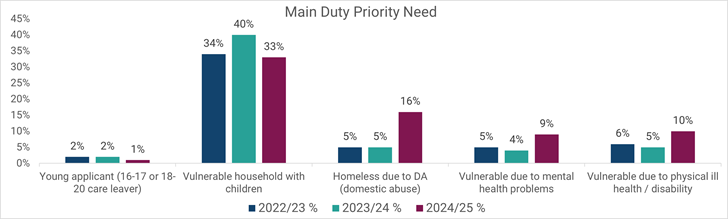
The majority of households that are owed a main rehousing duty are those with dependent children. Those owed a main duty who are victims of domestic abuse have been steadily increasing over the last few years which may be down to greater awareness of issue leading to more appropriate recording by the Housing Advice Teams.
|
Year/Category |
Young applicant (16-17 or 18-20 care leaver) |
Vulnerable household with children |
Homeless due to DA (domestic abuse) |
Vulnerable due to mental health problems |
Vulnerable due to physical ill health / disability |
|---|---|---|---|---|---|
|
2022/23 % |
2% |
34% |
5% |
5% |
6% |
|
2023/24 % |
2% |
40% |
5% |
4% |
5% |
|
2024/25 % |
1% |
33% |
16% |
9% |
10% |
Domestic abuse (DA) continues to represent a large proportion of homelessness approaches to LHAs. In 2024/25, of the households owed a homelessness duty by the 5 districts in Worcestershire (excluding Worcester), 30.8 % were survivors of domestic abuse. The Domestic Abuse Act 2021 significantly strengthened LHA’s duties in relation to victims of domestic abuse, especially those at risk of or experiencing homelessness.
The LHAs work in close partnership with Worcestershire County Council to assess the need for “safe accommodation” (such as refuges, specialist safe housing, or dispersed units) for those fleeing domestic abuse and ensure that temporary accommodation complies with the definition of what is safe. Safe accommodation consists of self-contained, supported accommodation or refuge accommodation and therefore, Bed and Breakfast is not considered to be safe accommodation. Support relating to this accommodation is commissioned by the County Council and includes community-based DA support, floating support and a specialist Domestic Abuse Housing Officer (DAHO) in all local housing authority housing options/solutions teams to provide specialist support for those experiencing homelessness.
Joint working between the six Worcestershire LHAs and the County Council, to meet the requirements of the Domestic Abuse Act is well established and feedback from people with lived experience shows the role of the domestic abuse housing officers (DAHOs), based in each LHA, is valued. Focus on training, skills development and networking is leading to continual improvement in practice and communication across agencies in support of victim / survivors of domestic abuse.
|
Area |
Prevention Duty |
Relief Duty |
||||||||||
|---|---|---|---|---|---|---|---|---|---|---|---|---|
|
22/23 |
23/24 |
24/25 |
22/23 |
23/24 |
24/25 |
|||||||
|
No. |
% |
No. |
% |
No. |
% |
No. |
% |
No. |
% |
No. |
% |
|
|
Bromsgrove DC |
47 |
5.5% |
40 |
5.0% |
22 |
2.9% |
30 |
2.5% |
29 |
2.4% |
57 |
4.6% |
|
Malvern Hills DC |
2 |
0.2% |
7 |
0.9% |
6 |
0.8% |
32 |
2.6% |
36 |
3.0% |
43 |
3.5% |
|
Redditch BC |
10 |
1.2% |
5 |
0.6% |
7 |
0.9% |
35 |
2.9% |
56 |
4.7% |
58 |
4.7% |
|
Wychavon DC |
4 |
0.5% |
12 |
1.5% |
6 |
0.8% |
74 |
6.1% |
57 |
4.8% |
76 |
6.1% |
|
Wyre Forest DC |
8 |
0.9% |
13 |
1.6% |
13 |
1.7% |
54 |
4.4% |
46 |
3.9% |
59 |
4.8% |
|
Total |
71 |
8.3% |
77 |
9.7% |
54 |
7.1% |
225 |
18.4% |
224 |
18.8% |
293 |
23.7% |
|
West Midlands |
3,750 |
34.8% |
1,040 |
8.4% |
880 |
7.5% |
3,220 |
17.9% |
3,250 |
16.5% |
3,270 |
16.5% |
|
England |
9,950 |
7.0% |
10,270 |
7.0% |
10,610 |
7.2% |
26,750 |
16.8% |
27,920 |
15.5% |
28,800 |
15.8% |
LHAs support the County Council in their strategic duty to publish a strategy based on a needs assessment, monitor delivery, and report annually on how they are meeting demand for safe accommodation.
Domestic Abuse continues to be one of the primary drivers of homelessness across Worcestershire, with a profound and lasting impact on victim/survivors, families, and communities. Since the introduction of the Domestic Abuse Act 2021, LHAs and Worcestershire County Council have worked collaboratively to strengthen housing pathways, deliver on new statutory duties, and create a coordinated, trauma-informed response using a whole family approach for those fleeing abuse.
The establishment of the Worcestershire Domestic Abuse Partnership Board, a domestic abuse and housing coordinator, specialised domestic abuse housing officers and the provision of safe accommodation has led to more consistent standards of support across the county. Housing teams, alongside commissioned domestic abuse providers, now play a critical role in early identification, prevention, and sustaining safe accommodation for survivors.
Data and Trends
Data highlights that domestic abuse remains a significant cause of homelessness presentations across Worcestershire over the last three years. Of those owed a homelessness duty in 2024/25, 30.8% of households presented due to domestic abuse.
| Year | Prevention | Relief | Total |
|---|---|---|---|
| 2022/23 | 8.3% | 18.4% | 26.7% |
| 2023/24 | 9.7% | 18.8% | 28.5% |
| 2024/25 | 7.1% | 23.7% | 30.8% |
In the financial year 2024/25 (ending March 2025), over 10,000 domestic abuse–related incidents and crimes were recorded by police in Worcestershire. This total includes both crimes and non-crime incidents. According to Worcestershire County Council’s Operation Encompass page, which summarises West Mercia Police’s Q4 2024/25 Performance Monitoring Report, around 25% of all recorded crimes in the county were classified as domestic abuse related.
While West Mercia Police data for the same period indicates a statistical decrease in domestic abuse incidents across the force area, the figures for Worcestershire demonstrate that domestic abuse remains a significant issue locally. Over 10,000 incidents and crimes were reported in the year, highlighting the continuing scale of the problem in the county.
At the time of writing this review, some work undertaken by Safe Lives and commissioned by Public Health suggests a much higher number of people experience domestic abuse. This review will be updated when the final statistics are made available.
Despite improved reporting, local insight suggests that many survivors still do not disclose abuse, indicating ongoing unmet need. Across the county, domestic abuse-related approaches accounted for a significant proportion of homelessness applications. The majority were women with dependent children, though a growing number of single survivors, male victims, and individuals with complex needs have been identified.
Sanctuary Schemes and Safe Accommodation
Local housing authorities across Worcestershire, work in partnership to deliver safe accommodation, including, refuge spaces, dispersed units, and sanctuary schemes which provide security measures to enable survivors to remain safely in their homes where appropriate.
Sanctuary Scheme Referrals (September 2024 – August 2025):
Worcestershire Public Health, in partnership with the Police and LHAs, commission a Sanctuary Scheme to provide safety and security measures in a victim/survivor’s own home, so that they can remain there. Between 2024-2025 a total of 105 referrals were made to sanctuary schemes across all 5 local authorities.
|
District |
2024/25 |
|
Bromsgrove |
3 |
|
Malvern Hills |
15 |
|
Redditch |
8 |
|
Wychavon |
32 |
|
Wyre Forest |
47 |
Overall referrals have decreased across most districts, with some localised increases, highlighting variation in demand and referral pathways.
Progress
- Implementation of the Domestic Abuse Act 2021 statutory duty across LHAs.
- Expansion of the Domestic Abuse Community Champions network through Worcester Community Trust.
- Delivery of trauma-informed housing training to frontline staff. Specialist Domestic Abuse Housing officers implemented in each of the 5 local housing authorities. Positive feedback from service users provided regarding the implementation of Domestic Abuse Housing officers.
- Strengthened partnership working between housing, police, and support providers through regular MARAC coordination.
- Housing teams across all districts work in partnership with Sanctuary Schemes to help victim-survivors of domestic abuse stay safely in their homes by providing tailored security measures, reducing the need to move.
- Introduction of a Domestic Abuse & Housing Coordinator role to work closely with Domestic Abuse Housing Officers, ensuring training and knowledge remain up to date.
- Established engagement of Domestic Abuse Housing Officers with MARAC and DRIVE, working closely with West Mercia Women’s Aid.
LHA priorities for 2026–2031 to tackle domestic abuse will be to sustain and expand safe accommodation options and community-based support. Improve early identification and response within housing and homelessness services. Develop dedicated housing pathways for survivors with multiple needs or No Recourse to Public Funds (NRPF). Strengthen communication and engagement with schools to support early identification and safeguarding and ensure children affected by domestic abuse are linked to appropriate support services to prevent future victimisation or perpetration.
Support needs
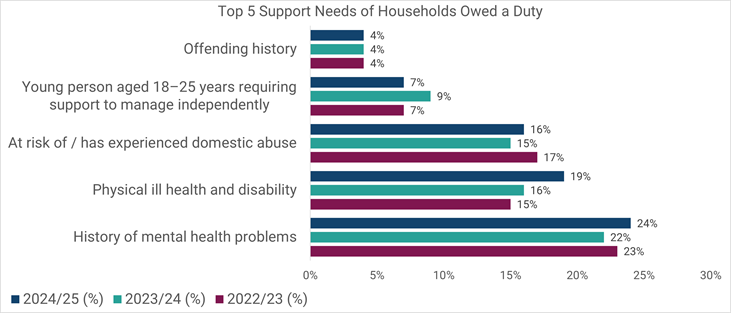
Households having a history of mental health needs consistently ranks as the highest identified support need (accounting for 23% on average over the three-year period), indicating a persistent challenge among households requiring support. There is also a notable rise in households with physical ill health and disability (17% average, and a 35% increase from 2022/23 to 2024/25), which may suggest worsening health inequalities and aging populations. Domestic abuse remains a significant, stable support need (16%). All of the identified support needs highlight the importance of strengthening cross-agency collaboration and early intervention to provide integrated support to some of the county’s most vulnerable populations.
Our data review has also highlighted a notable increase in the number of those approaching for homelessness assistance who also have support needs due to the household including care leavers aged 18-20 (18 in 2022/23 to 52 in 2024/25 – a 189% increase). The LHAs and Worcestershire Children’s Services work together via a joint Care Leavers Protocol but it is clear that more needs to be done to address this issue and the homelessness strategy will reflect this.
|
Support Need |
2022/23 (%) |
2023/24 (%) |
2024/25 (%) |
|---|---|---|---|
|
Young person aged 18–25 years requiring support to manage independently |
7% |
9% |
7% |
|
Physical ill health and disability |
15% |
16% |
19% |
|
Offending history |
4% |
4% |
4% |
|
History of mental health problems |
23% |
22% |
24% |
|
At risk of / has experienced domestic abuse |
17% |
15% |
16% |
Homeless approaches made to LHAs due to leaving custody
The table below shows that those leaving custody mainly approach LHAs when they are already homeless. There are low numbers of approaches from those who are threatened with homelessness, and a higher proportion of people approaching who are already homeless from custody. This highlights the need to improve to improve joint working between the criminal justice system and housing to ensure that assessment and referral processes happen at an earlier stage so that people are not homeless upon release.
| District |
22/23 Number |
22/23 % of all cases owed the prevention duty |
22/23 Number |
22/23 % of all cases owed the prevention duty |
22/23 Number |
22/23 % of all cases owed the prevention duty |
|---|---|---|---|---|---|---|
|
Bromsgrove |
1 |
0% |
0 |
0% |
2 |
1% |
|
Malvern |
0 |
0% |
0 |
0% |
0 |
0% |
|
Redditch |
0 |
0% |
0 |
0% |
1 |
1% |
|
Wychavon |
1 |
1% |
1 |
1% |
3 |
2% |
|
Wyre Forest |
0 |
0% |
0 |
0% |
0 |
0% |
|
Total |
2 |
0% |
1 |
0% |
6 |
1% |
Homelessness Applications due to Departure from institution: Custody (already homeless - relief duty owed) – source HCLIC
| District |
22/23 Number |
22/23 % of all cases owed the relief duty |
23/24 Number |
23/24 % of all cases owed the relief duty |
24/25 Number |
24/25 % of all cases owed the relief duty |
|---|---|---|---|---|---|---|
|
Bromsgrove |
3 |
2% |
1 |
1% |
4 |
2% |
|
Malvern |
3 |
2% |
3 |
2% |
8 |
4% |
|
Redditch |
0 |
0% |
16 |
4% |
8 |
3% |
|
Wychavon |
12 |
3% |
10 |
3% |
14 |
4% |
|
Wyre Forest |
1 |
1% |
2 |
1% |
4 |
2% |
|
Total |
19 |
2% |
32 |
3% |
38 |
3% |
Across 5 Worcestershire LHAs (excluding Worcester City Council)
Rough sleeping data
Rough sleeping figures fell steadily between 2018 and 2021, showing a 40% reduction and demonstrating the impact of targeted interventions and the “Everyone In” funding. However, since 2022 numbers have risen again, with annual counts fluctuating between 21 and 37, and the most recent figure in 2025 standing at 34. This increase highlights the ongoing pressures that continue to drive people into street homelessness, despite earlier progress.
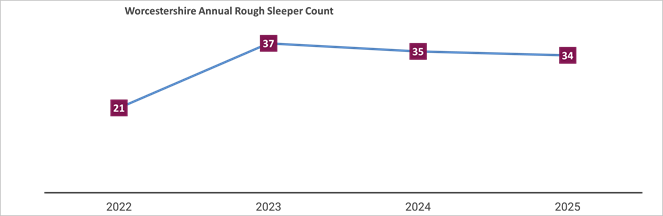
Alongside the annual count, Worcestershire also completes four bi‑monthly street counts each year. These provide valuable insight into local patterns and trends, helping to track changes more closely and inform responsive action. Together, the data shows that while interventions have reduced rough sleeping in the past, sustained effort is needed to ensure any future occurrence is rare, brief, and non‑recurring.
The bi monthly count data below highlight regular fluctuations throughout the year, and also shows are high proportion of male rough sleepers as compared to female.
|
LHA |
Men |
Women |
Total |
|---|---|---|---|
|
Bromsgrove |
2 |
0 |
2 |
|
Redditch |
5 |
2 |
7 |
|
Malvern |
1 |
0 |
1 |
|
Wychavon |
4 |
1 |
5 |
|
Wyre Forest |
4 |
0 |
4 |
|
Total |
16 |
3 |
19 |
|
LHA |
Men |
Women |
Total |
|---|---|---|---|
|
Bromsgrove |
2 |
0 |
2 |
|
Redditch |
7 |
2 |
9 |
|
Malvern |
4 |
0 |
4 |
|
Wychavon |
7 |
1 |
8 |
|
Wyre Forest |
5 |
0 |
5 |
|
Total |
25 |
3 |
28 |
|
LHA |
Men |
Women |
Total |
|---|---|---|---|
|
Bromsgrove |
0 |
0 |
0 |
|
Redditch |
4 |
1 |
5 |
|
Malvern |
1 |
0 |
1 |
|
Wychavon |
5 |
0 |
5 |
|
Wyre Forest |
5 |
0 |
5 |
|
Total |
15 |
1 |
16 |
Housing register and allocation of social housing
All councils maintain a housing register through which eligible applicants may apply for social housing. Applicants are assessed and placed into priority bandings in accordance with council allocation policies. Properties owned by Local Authorities or Registered Providers are advertised through a Choice Based Lettings (CBL) system, where applicants may place bids for available homes.
Current demand profile
As of June 2025, there were 11,490 applicants recorded as being in housing need on the councils’ housing registers.
The applicant profile is as follows:
- 4,955 families
- 2,968 single or couple households aged 35–65
- 2,110 single applicants under the age of 35
- 1,457 single or couple households aged 65 and over
This data highlights sustained demand across all household types
Access and waiting times
The length of time required for an applicant to make a successful bid varies depending on their priority banding and the geographical areas for which they are bidding. Demand significantly exceeds supply in many areas, resulting in extended waiting times for most applicants.
Households at risk of homelessness frequently face barriers to securing accommodation through the Choice Based Lettings system. In many cases, applicants do not have sufficient priority banding or waiting time to make a successful bid within 56 days, increasing the risk of homelessness and placing additional pressure on homelessness prevention and temporary accommodation services.
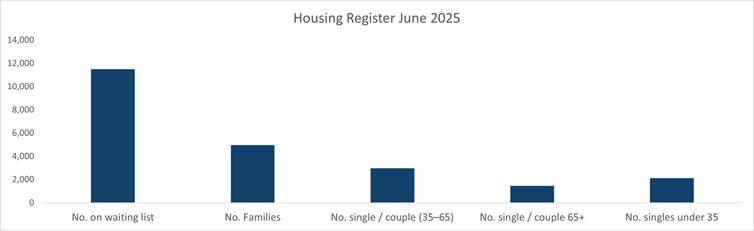
|
Category |
No. on waiting list |
No. Families |
No. single / couple (35–65) |
No. single / couple 65+ |
No. singles under 35 |
|---|---|---|---|---|---|
|
Number of applications |
11,490 |
4,955 |
2,968 |
1,457 |
2,110 |
|
Description |
Percentage |
|---|---|
|
Families |
43% |
|
Single/Couples (Aged 35 – 65) |
26% |
|
Single/Couples (Aged Under 35) |
18% |
|
Single/Couples (Aged 65+) |
13% |
The LHAs continue to work to maximise affordable housing delivery through the implementation of the Worcestershire Housing Strategy and the work of the housing strategy delivery groups.
Employment and welfare benefits
Worcestershire's working age population is around 350,700 people, which equates to 59.6% of the overall population. Around 80.3% are in some form of employment, albeit that 3.1% of those are claiming benefits of some kind. Alongside this Worcestershire has an economic inactivity rate of 18.8% compared to West Midlands at 22.5% and England at 21.1%. In Worcestershire, an estimated 6% of the working-age population have no qualifications, which equates to approximately 22,224 people.
For residents, Worcestershire's median gross weekly earnings (£622.80 in 2022) are very close to the West Midlands average (£613.30) and slightly below the Great Britain average (£642.20) for full-time workers, showing relatively similar earning levels within the region but trailing the national average.
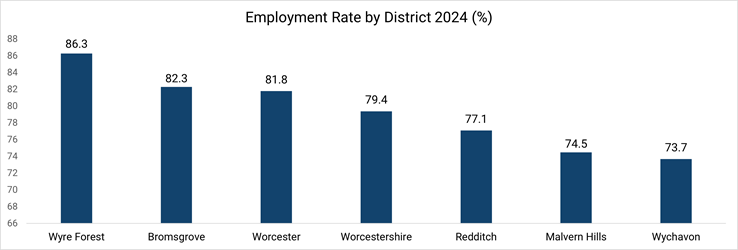
Source: Annual Population Service
| District | Wyre Forest | Bromsgrove | Worcester | Worcestershire | Redditch | Malvern Hills | Wychavon |
|---|---|---|---|---|---|---|---|
| Rate | 86.3% | 82.3% | 81.8% | 79.4% | 77.1% | 74.5% | 73.7% |
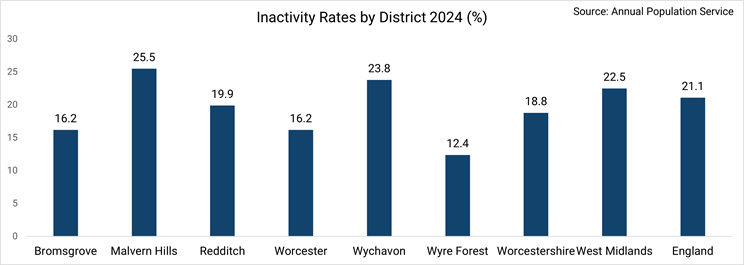
|
Bromsgrove |
Malvern Hills |
Redditch |
Worcester |
Wychavon |
Wyre Forest |
Worcestershire |
West Midlands |
England |
|
|---|---|---|---|---|---|---|---|---|---|
|
Inactivity Rate (%) |
16.2% |
25.5% |
19.9% |
16.2% |
23.8% |
12.4% |
18.8% |
22.5% |
21.1% |
The Get Worcestershire Working Strategy states that “while Worcestershire's overall economic inactivity may appear less challenging compared to other regions, a closer look reveals a more complex picture. One of the most significant contributing factors is long-term sickness, defined as health conditions lasting more than six months, which accounts for 34% of all economic inactivity. This equates to approximately 22,600 residents and highlights a key challenge that Worcestershire must address to improve employment outcomes.”
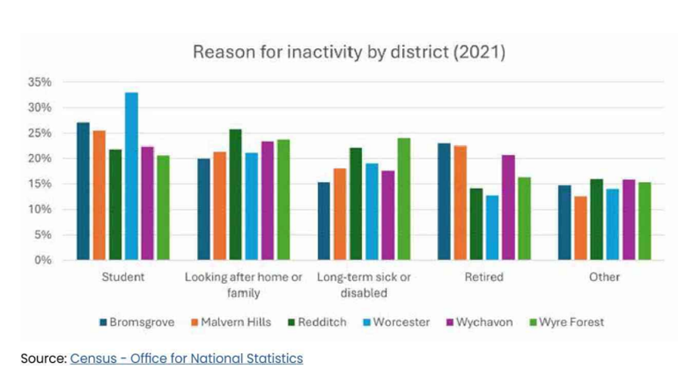
Reasons for economic inactivity vary across Worcestershire's districts. Wyre Forest has a notably high proportion of residents facing health-related barriers to employment. Retirement is a common reason in Malvern Hills and Wychavon, reflecting their more affluent and older populations. Meanwhile, caring responsibilities-such as looking after children or family members-are more prevalent in Redditch and Wyre Forest.
Health data
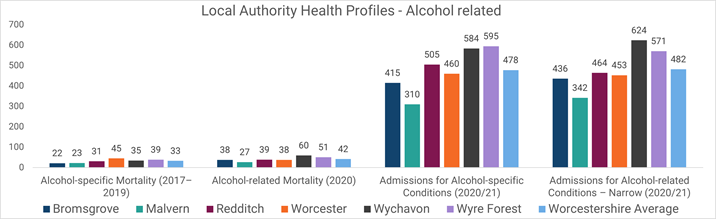
|
Bromsgrove |
Malvern |
Redditch |
Worcester |
Wychavon |
Wyre Forest |
Worcestershire Average |
|
|---|---|---|---|---|---|---|---|
|
Alcohol‑specific Mortality (2017–2019) |
22 |
23 |
31 |
45 |
35 |
39 |
33 |
|
Alcohol‑related Mortality (2020) |
38 |
27 |
39 |
38 |
60 |
51 |
42 |
|
Admissions for Alcohol‑specific Conditions (2020/21) |
415 |
310 |
505 |
460 |
584 |
595 |
478 |
|
Admissions for Alcohol‑related Conditions – Narrow (2020/21) |
436 |
342 |
464 |
453 |
624 |
571 |
482 |
Alcohol related deaths remain above the county average in Wyre Forest and Worcester. Admissions to hospital for alcohol-specific and alcohol related conditions are highest in Wyre Forest and Wychavon.
|
District |
Count |
Value per 100,000 |
|---|---|---|
|
Wyre Forest |
20 |
7.00 |
|
Wychavon |
10 |
1.40 |
|
Redditch |
10 |
4.00 |
|
Malvern Hills |
6 |
N/A |
|
Bromsgrove |
5 |
N/A |
Wyre Forest had the highest number of drug related deaths per 100,000 during the period 2018-2020 and is higher that its CIPFA near neighbours, the West Midlands region and England averages.
Dementia
Dementia will be a significant issue in future years as the population in the oldest age groups grows. The number of people with dementia in Worcestershire is forecast to increase by 56% between 2019 and 2035 from 9,560 to 14,905.
Fuel Poverty
Fuel poverty is a material issue in Worcestershire, affecting around 14.4% of households compared with 13.4% of households in England as a whole. A household is said to be fuel poor if it needs to spend more than 10% of its income on fuel to maintain an adequate standard of warmth. Following significant increases in energy costs in the past 12 months, fuel poverty is expected to affect more people, and as a result, might further accelerate investment in energy efficiency. The health effects of fuel poverty are far-reaching and disproportionately affect older people as there are links between cold homes and respiratory conditions. The five-year average for excess winter mortality index in the County is higher than England’s five-year average
Use of temporary accommodation
LHAs have a duty to provide temporary accommodation (TA) to homeless households in certain circumstances. They can also utilise a discretionary duty to accommodate others, where no duty is owed but they are accommodated under wider policy initiatives such as No First Night Out to support rough sleepers coming off the streets.
For all the councils the most used type of temporary accommodation is Bed and Breakfast (B&B) but the amount this is used varies from 46% of all placements in Redditch to 59% in Wyre Forest in 24/25.
Total TA placements ending
|
Use of temporary accommodation |
2022/23 |
2023/24 |
2024/25 |
|
|
Total TA placements ended |
1121 |
973 |
734 |
|
|
Use of temporary accommodation |
2022/23 |
2023/24 |
2024/25 |
|
|
TA within RP Stock |
89 |
88 |
72 |
|
|
TA within LA own stock |
113 |
115 |
98 |
|
|
Any other type of TA |
27 |
28 |
76 |
|
|
Made own arrangements for TA |
36 |
13 |
3 |
|
|
Other nightly paid, privately managed accommodation |
165 |
92 |
69 |
|
|
Private sector TA leased by LA or leased/managed by a registered provider |
29 |
43 |
12 |
|
|
Bed & Breakfast |
633 |
578 |
395 |
|
|
Temporarily remains in property |
5 |
3 |
3 |
|
|
Other: e.g refuge |
24 |
13 |
6 |
|
|
Average duration of placement (in days) |
50 |
62 |
71 |
|
Between 2022 and 2025, 2828 temporary accommodation placements came to an end. Of these 925 were families with dependent children representing around 33% of all placements, this percentage is static from the 2018-22 period.
Total TA placements ending for households with dependent children
|
Use of temporary accommodation HOUSEHOLDS WITH CHILDREN |
2022/23 |
2023/24 |
2024/25 |
|
Total TA placements ended |
339 |
351 |
235 |
|
Use of temporary accommodation HOUSEHOLDS WITH CHILDREN Placements into: |
2022/23 |
2023/24 |
2024/25 |
|
TA within RP Stock |
36 |
47 |
45 |
|
TA within LA stock |
49 |
73 |
59 |
|
Any other type of TA |
11 |
15 |
16 |
|
Made own arrangements for temporary accommodation |
23 |
7 |
3 |
|
Other nightly paid, privately managed accommodation, shared facilities |
31 |
38 |
21 |
|
Private sector accommodation leased by LA or leased or managed by a registered provider |
11 |
0 |
7 |
|
Bed & Breakfast |
167 |
162 |
81 |
|
Temporarily remains in property |
3 |
2 |
2 |
|
Other: e.g. refuge |
4 |
7 |
1 |
|
Average Duration (DAYS) |
56 |
60 |
68 |
Over the previous three years the number of placements ending has steadily declined from 1121 to 734 and the same for placements with children from 339 to 235. This is likely to indicate increasing pressure on housing availability and the ability to house people into permanent accommodation and we can see a corresponding increase in the length of stay.
Both tables show that the length of stay in days has been increasing over the three years, reflecting the issues with finding homeless households suitable move-on and permanent accommodation. The five districts length of stay in temporary accommodation over 12 weeks has risen from 18% in 2022/23 to 26% in 2024/25. For very short lengths of stay Wyre Forest District Council is an outlier with 35% of placements in TA ending before 7 days (although this is also declining). This is likely to reflect policies around accommodating homeless households under discretionary duties like No First Night Out (NFNO) but should be investigated further to confirm.
Temporary Accommodation numbers and types
|
District |
Number of rooms in B&B / Hotel |
Self-contained LA stock |
Self contained RP stock |
Shared – LA stock (HMO type) |
Shared – RP stock (HMO type) |
Private sector leased numbers |
|---|---|---|---|---|---|---|
|
BDC |
Ad hoc |
0 |
54 |
0 |
0 |
0 |
|
MHDC |
Ad hoc |
0 |
4 |
0 |
0 |
0 |
|
RBC |
2 Contract |
43 |
0 |
0 |
0 |
0 |
|
WDC |
Ad hoc |
2 |
22 |
0 |
0 |
3 PSL properties and 2 HMO’s with 6 rooms 6 self contained 11 bedspaces plus 4 standalone flats. |
|
WFDC |
Unlimited - Contract |
6 |
9 houses and flats |
31 |
4 x 3 bedroom houses |
1 PSL property of 5 one bed flats |
|
Total |
Variable |
51 |
89 |
31 |
4 |
6 |
There has been a decrease in use of Bed and Breakfast between 2023/24 and 2024/25 in all of the councils except Bromsgrove where the % of placements in B&B have increased from 42% to 48%. This shows positive work undertaken by many councils to bring other forms of temporary accommodation into use. All of the councils have looked to increase their supply of self-contained and/or council owned temporary accommodation and this is illustrated in the table above showing only two councils now have contracts with B&B providers and the number of rooms used has fallen from 24 to 4 whilst the number of self-contained units owned by the council has increased to 51 in January 2025 (up from 45 previously). Similarly, the number of self-contained units provided by a Registered Provider has increased from 77 to 89. Overall, the number of temporary units excluding B&B have risen from 158 in January 2025 to 181 in November 2025.
When considering the use of temporary accommodation for households with dependent children, Wyre Forest District Council and Malvern Hills District Council still mainly use Bed and Breakfast (53% and 72% respectively). However, both Wychavon District Council and Bromsgrove District Council use more temporary accommodation provided by Registered Providers than B&B (39% and 56% respectively) and Redditch Borough Council mainly use their own housing stock (61%).
Homeless households with dependent children in Bed and Breakfast for more than six weeks
The Councils have been able to keep the number of families in Bed and Breakfast for longer periods of time to an absolute minimum with Redditch and Bromsgrove having none, Wyre Forest one, Malvern Hills seven and Wychavon nine (2024-5). None of the Councils have reached the threshold for having to write an action plan for the Ministry of Housing, Communities and Local Government.
Other issues and responses around temporary accommodation
Infants in temporary accommodation
All of the councils’ support families in obtaining cots for infants when they are staying in TA and ensuring there is sufficient space in the unit for the cot to be used. More work can be done about sharing information with parents of young children on co-sleeping utilising available resources.
Temporary accommodation and employment
One council reported concerns around residents of temporary accommodation being stigmatised and will consider whether they can convert units of dispersed TA into permanent homes after a period of time and then using voids to replace the dispersed unit. Generally speaking, units of temporary accommodation are more expensive as they are often covering additional costs including staffing related expenses and increased void costs. This can make it difficult for people to gain or maintain employment if that takes them outside of the housing benefit regime.
Temporary accommodation demand and costs
The demand for temporary accommodation has risen considerably in the last few years and this is true across much of the country as well as Worcestershire. Within Worcestershire the length of stay has increased over time in addition to the numbers being placed and in some parts of the county the type of household has changed with an increase in single people (as a consequence of the HRA 2017) and larger families including those evicted for non-payment of rent which may be a consequence of the bedroom tax introduced in 2015. In addition, the cost of emergency temporary accommodation such as Bed and Breakfast and Hotels has risen. In a recent report looking at costs in 2023/24 the five councils spent £1.39m on Bed and Breakfast and Hotels.
Financial pressures on social and private landlords means there is a risk aversion to taking on clients that might abandon their properties or have rent arrears which increases the length of stay in temporary accommodation for the more complex and vulnerable households in our society.
The wider problems within the housing market of reduced supply of housing and affordability issues means that those households previously able to purchase a property are now looking for accommodation in the private and social rented sectors. Changes to the taxation regime and more recently, the Renters Rights Act have led to some private sector landlords exiting from the market, reducing the availability of properties. Anecdotally officers are aware from landlords of multiple households chasing one property and can see similar high numbers of bids placed on social housing properties especially on new build estates or desirable areas.
Temporary accommodation and health impacts
In recent years the growth of households and children in temporary accommodation has led to more research including A Better Vision for Temporary Accommodation (May 2025) published by JustLife and work by the Lullaby Trust on infant mortality in temporary accommodation. The Councils have agreed that any young parents with a baby will be given access to an appropriate cot/moses basket in temporary accommodation if required. At the stakeholder event attendees highlighted the need for accessible temporary accommodation and accommodation that was able to take dogs. Issues around accessing supported housing for those with drug and alcohol addiction was also highlighted. These issues will feed into the development of the Supported Housing Strategy which is a requirement under the Supported Housing (Regulatory Oversight) Act 2023.
Housing supply
The tables below show the number of homes expected to be built per year to meet housing need, the number of affordable homes being built and the number of affordable homes being let. There are variances across the districts but it is clear that the number of affordable homes being built is decreasing whilst the number of lettings remains at similar levels. The decline in the number of affordable homes being built will directly affect homelessness levels and the number of households in temporary accommodation. The work of the Worcestershire Housing Strategy Delivery Groups in boosting affordable housing will be essential.
Total number of units expected to be built per annum (all tenures)
|
Council |
Number of units pa as per local plan |
Number of units pa as per new government methodology |
|---|---|---|
|
Bromsgrove |
383 |
714 |
|
Malvern Hills |
363 |
646 |
|
Redditch |
337 |
475 |
|
Wychavon |
460 |
976 |
|
Wyre Forest |
276 |
584 |
|
Total |
1911 |
3341 |
Number of affordable housing units completed 22/23- 24/25
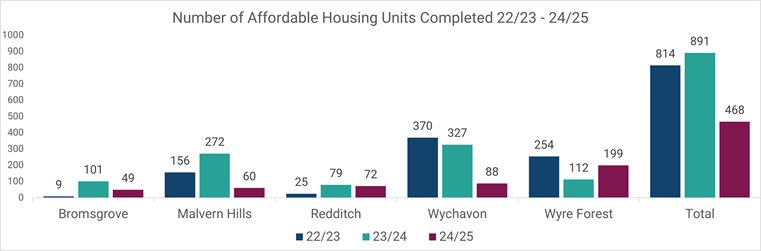
|
Council |
22/23 |
23/24 |
24/25 |
|---|---|---|---|
|
Bromsgrove |
9 | 101 | 49 |
|
Malvern Hills |
156 | 272 | 60 |
|
Redditch |
25 | 79 | 72 |
|
Wychavon |
370 | 327 | 88 |
|
Wyre Forest |
254 | 112 | 199 |
|
Total |
814 | 891 | 468 |
Number of social housing lets 22/23- 24/25
|
Council |
22/23 |
23/24 |
24/25 |
|---|---|---|---|
|
Bromsgrove |
284 |
278 |
281 |
|
Malvern Hills |
206 |
252 |
189 |
|
Redditch |
313 |
366 |
497 |
|
Wychavon |
522 |
398 |
428 |
|
Wyre Forest |
327 |
332 |
354 |
|
Total |
1652 |
1626 |
1749 |
Private rented sector
The private rented sector (PRS) continues to play a critical role in preventing and relieving homelessness across the districts. District councils actively utilise a range of PRS access mechanisms, including private sector leasing (PSL), rent bonds and other forms of financial assistance.
Number of private sector leasing and rent bond units 2024/25
|
Council |
Private Sector Leasing (PSL) units |
Rent bond / deposit units or other forms of financial assistance |
|---|---|---|
|
Bromsgrove |
Scheme not available |
4 |
|
Redditch |
Scheme not available |
Scheme not available |
|
Malvern Hills and Wychavon DC combined |
4 |
6 |
|
Wyre Forest |
5 |
41 |
|
Total |
9 |
51 |
In 2024/25, provision across the county comprises a total of 9 private sector leasing units and 51 rent bond or deposit-supported placements. Uptake and delivery models vary by district, reflecting local market conditions, capacity, and commissioning priorities. While PSL schemes are not currently available in all districts, where they are in place they provide a more attractive offer to landlords by delivering guaranteed income and reduced management risk.
Historically, Worcestershire councils secured a countywide grant from the Department for Levelling Up, Housing and Communities in 2018 through the Private Rented Sector Access Fund. This funding enabled the development of private sector leasing and social letting schemes in several districts, strengthening access to the PRS for households who are homeless or at risk of homelessness. Over time, reliance on traditional rent bond schemes has declined, while the use of Discretionary Housing Payments and PSL arrangements has increased in some districts, reflecting changing market dynamics and landlord preferences.
At the time of writing this review, the councils were in the process of finalising a Private Sector Stock Condition Survey which will inform the housing tenure split across housing stock in each of the council areas. This section will be updated during the consultation period.
Strategically, the continued development of PRS access pathways will remain central to Worcestershire’s approach to homelessness prevention and relief. Key priorities include strengthening landlord engagement, maximising the use of leasing and financial incentive models, and ensuring PRS interventions are aligned with support services to sustain tenancies and improve long-term housing outcomes.
Stakeholder feedback
Feedback from the stakeholder event
The Homelessness Strategy Stakeholder Event held in September 2025 at Wyre Forest District Council was well attended with over 50 representatives from the statutory, community and voluntary sectors. The event focused on four main areas; domestic abuse, homelessness and health, young people and rough sleepers and looked at what is currently working well, what could be improved / gaps and what actions should be incorporated into the new strategy and action plan.
This section captures the feedback collected through this event, including suggestions made for actions. Further work on these suggestions has been undertaken to establish whether or not they should be taken through to the draft strategy and action plan.
Rough sleeping
What’s working well
- Collaboration: Strong emphasis on multi-agency approaches, shared client work and inter-agency knowledge sharing
- Visibility: Acknowledgment that rough sleeping is a recognised problem even in rural areas.
- Effective service models: Successful implementation of drop-ins and dedicated outreach services.
Areas identified for change and improvement
- Systemic gaps: Challenges in prevention for single homeless people, some examples of poor linkages between services and issues with cross-boundary transient populations.
- Specific client needs: Difficulty in providing targeted services for entrenched rough sleepers, individuals with complex needs (dogs, arson convictions, rent arrears, substance use), and those exiting institutions (prisons, hospitals, mental health settings).
- Process issues: Need for refinement of the way in which all agencies manage adults with complex needs and risky behaviours, issues around non-priority need and intentionality classifications, and standardising outreach approaches.
Suggested actions
The proposed actions aim to scale up existing successful collaborations and address the identified gaps:
- Enhance integration: Expand multi-agency team meetings, link up with key health and social care teams (AFD, TAST, HATs), and improve transition protocols from institutions.
- Resource management: Renew community services directories, promote the "Duty to Refer and ensure it is working effectively and in line with legislation, develop more supported accommodation options, and seek to establish a flexible, county-wide budget for non-priority cases.
- Develop specific models: Implement a "Drop-in Hub model," standardise outreach practices, and create specialist officer/champion roles for specific client types.
- Embed the Complex Adults Risk Management (CARM) process to manage adults with complex needs and risky behaviours
Domestic Abuse
What's working well
- Effective partnerships & communication: Strong collaboration, information sharing, and multi-agency working are increasing safety.
- Specific services praised: The Domestic Abuse Housing Alliance (DAHA) service, the Multi-Agency Risk Assessment Conference (MARAC), and the "Drive" and "Men and Masculinity" courses were all highlighted as successful initiatives.
- Beneficial schemes: The Sanctuary Scheme is effective in helping people remain safely in their own homes.
- Gateway services: Signposting to organisations like Women's Aid provides a crucial entry point for accessing a wide range of support services.
Areas for improvement & identified needs
Funding and resources
- Static funding vs. increased demand: Waiting lists are growing due to static funding levels and an increase in people requiring support.
- Short-term funding: Short-term funding cycles hinder the effective and sustainable delivery of services.
Information sharing & housing
- Trauma-informed approach: Survivors are forced to repeatedly retell their stories. Housing providers (RPs) need access to more information to offer suitable permanent housing with a trauma-informed approach.
- Housing concerns: Families sometimes accept unsuitable properties or are too scared to leave due to concerns about "intentionality" (how their housing need is assessed).
Service gaps and accessibility
- Lack of awareness: Many people do not understand coercive control or where to access services.
- Need for support workers: Many individuals cannot follow through on advice without a dedicated support worker.
- MARAC gaps: While MARAC works well for high-risk cases, there is a lack of structured planning for lower-risk households.
- Fear of social care support: People are worried about involvement with social care and view it negatively; reassurance efforts are needed.
- Partner knowledge gaps: Not all partners are aware of the full range of available services.
- Managed moves within Registered Provider housing: is there a better way to facilitate moves within existing housing stock to prevent homelessness approaches and temporary accommodation?
Training and policy
- Training needs: More training is required for partners on general domestic abuse issues, suicide prevention, and children's specific needs.
- Policy review: The Domestic Abuse strategy needs to be reviewed and refreshed.
Suggested actions:
- Develop a protocol for RPs to access relevant survivor information (with consent) to deliver trauma-informed housing offers and minimise re-traumatisation.
- Implement trauma-informed training for professionals and voluntary sectors, including specific modules on coercive control and the impact on children/babies.
- Ensure the right people, specifically Housing Providers, are consistently present at DA panel meetings to facilitate suitable housing solutions.
- Promote the adoption of Domestic Abuse Housing Alliance (DAHA) accreditation practices across all relevant agencies.
Young people and families with children in temporary accommodation
Key themes addressed
- Complexity of needs: The challenges of supporting young people with neurodiversity in shared accommodation models, and the need for more specialised "training flats/houses"- increasing complex needs amongst young people
- Early intervention: The need for "upstream" projects, better family mediation, and earlier identification of risk factors e.g., the Centrepoint pilot model.
- Landlord engagement: landlord support plan to offer assurances young people can manage a tenancy and support in place. If there is not enough support what is needed?
- Children in temporary accommodation - issues with the location, suitability, and stigma of temporary accommodation impacting children's education and well-being. There is not enough suitable temporary accommodation.
- Working and affordability of accommodation is an issue for young people – private v supported. Need to look at/learn from the Sandwell Living work model. Nb recent budget announcements highlight this as an area for consideration to change and so this may be addressed at a national level.
- Non engagement with support: how can this be overcome? Opportunity to improve upscale outreach support?
- Renters Rights Act may reduce private rented properties available although it does bring in the abolition of s21 notices. Ensuring sufficient legal advice / support for tenants for the new renter’s rights act will be key. This would either include reviewing current funding for CAB and utilisation of new burdens funding to increase 3rd party support. Or exploring in house training to upskills officers to be able to provide representation for evictions ourselves in a legally compliant manner with rights of audience at court.
- Increased advocacy - in house advocacy/new specialism/additional funding for partner agencies
- Landlord engagement re changes and education
- Better joint working with GPs and schools – e.g. workshops in schools, notify schools and GPs about temporary accommodation placements for families with children (with consent).
- Early notification: Promote duty to refer and commitment to refer.
- Localised hubs – family support officer role in housing?
Suggested actions:
- Increase awareness of homelessness issues and trends through education in schools – workshops to have a longer-term effect
- Increase the use of Duty To Refer and Commitment To Refer to intervene at the earliest stage
- Temporary accommodation placements should consider the wider impact of Children in TA, suitability, health, social, support needs, schooling and transport
- Ensure feedback from families who have lived experience of homelessness and TA to understand the issues and tackle the cycle
- Support services are needed for face-to-face interaction – families in TA could be isolated in a new environment
- Adapt services to collocate to be nearer to customers in TA and create family hubs
- Look into changing TA model for families with Children. Direct match into properties
- Can Local Authorities make use of the voluntary sector to support families and children in TA
- More bespoke funding for families to move out of TA more quickly, furnishing costs are a barrier.
- Increase the supply of social rented housing across the County that is affordable
- Review of housing and care leavers protocol required
- Move on meetings with third sector support?
- Look at Sandwell Living work model and also options to work more closely with private sector landlords
Health and homelessness
Data, information sharing, and system-wide collaboration
- Data linkage: Can we learn by linking data sets across different advice services (e.g., CAB)?
- Service registries: A service registry is needed, but all partners must register and keep information up to date to facilitate signposting and referrals across districts that may operate differently.
- Widen the Duty to Refer (DTR): consider widening the DTR to non-traditional partners like housing providers. Primary care (GPs) currently don’t have DTR responsibilities, which may be a gap.
- Joined-up working: "Housing & Health Meetings" and existing "hubs" (e.g., The Tulip Centre) are identified as effective models for co-location and collaboration.
Housing provision and adaptations
- Adapted properties register: There is a strong consensus on the need for a centralised, up-to-date register of adapted properties to help both providers and individuals find suitable housing, which is currently difficult.
- Temporary accommodation: The need to provide accessible and appropriate temporary accommodation continues. Issues include a lack of pet-friendly options and accommodations sometimes being unsuitable for the client's needs (e.g. not wheelchair accessible).
- Lack of stepdown/recovery housing: There is a critical shortage of stepdown, recovery, and supported housing, particularly for people with drug and alcohol addictions who are often excluded from existing supported living facilities.
- Hospital discharge: Hospital discharges are delayed due to the lack of suitable onward accommodation.
Supporting vulnerable populations & specific issues
- Mental health issues: There is a prevalence of mental health issues across the population, with concerns raised about male mental health support (not meeting criteria until a crisis point) and the impact of social isolation (linked to suicide).
- Hoarding: Hoarding is a "massive issue." Ideas include earlier intervention (deep cleans) and specific support sessions (e.g., Kidderminster Foodbank hosts a session).
- Substance use: People exiting treatment/rehab often need immediate housing. A lack of supported housing options for those with drug/alcohol addictions means they may lose their home rather than attend rehab (£1000/week, no facility in county).
- Prison leavers: Registering with a GP after a short sentence is challenging (Friday releases, difficulty with documentation/de-registering from the prison GP).
Service delivery and process improvements
- Holistic approach: The need for specialist support from other agencies to provide a holistic, wrap-around service was consistently mentioned.
- Assessments: Questions were raised about whether current initial assessments capture all needs due to their brevity.
- GP Engagement: GPs are increasingly aware of past trauma (trauma-informed care). Using GP surgeries as a temporary address might be possible. However, some GP lists are closing, making registration challenging for support services.
- Early Intervention: Earlier intervention is preferred across issues (e.g., mental health, hoarding) rather than waiting for a crisis point.
Suggested actions:
- Consider the feasibility of an adapted property register
- Consider ways to tackle hoarding in partnership across statutory and voluntary sector
- Increase the number of accessible temporary accommodation placements
Feedback from those with lived experience
Families
Feedback from 19 residents placed in B&B accommodation by local authorities highlights a mixed and inconsistent experience, with significant implications for the use of B&Bs as temporary accommodation for people experiencing homelessness.
While some residents reported positive, supportive relationships with staff and managers, describing them as welcoming, respectful, and emotionally supportive during difficult periods, this was offset by notable concerns around accommodation standards. Around one-fifth of respondents rated their overall experience as very poor, with similar proportions expressing strong dissatisfaction with cleanliness and room comfort.
The survey identified inconsistent cleaning arrangements, limited or absent bedding changes, and concerns about hygiene—issues that were particularly problematic given the length of stays, with over half of respondents remaining in B&B accommodation for more than four weeks. For many residents, the accommodation did not fully meet basic needs, including access to adequate food provision, cooking facilities, laundry facilities, and regular housekeeping. Several respondents highlighted a mismatch between the accommodation being advertised as a B&B and the services actually provided.
Although the majority of residents felt safe, a minority reported feeling unsafe, underlining the importance of maintaining appropriate standards to support resident wellbeing. Overall, the findings indicate that while staff support is a key strength, the quality, consistency, and suitability of B&B accommodation require improvement. This reinforces the need to reduce reliance on B&Bs, strengthen quality assurance arrangements, and ensure alternative temporary accommodation better meets the needs of people experiencing homelessness.
Rough sleepers
During 2025 a lived experience survey was conducted with rough sleepers. The rough sleepers who were interviewed represented a diverse mix of individuals, including both those currently living on the streets and those who had recently experienced homelessness within the past three to twelve months. Participants were asked to reflect on their personal experiences of rough sleeping, their housing histories, and their preferences for long-term housing solutions. The interviews also explored their medical needs, and the types of agency support they were accessing on a regular basis, such as health services, outreach teams, and community organisations, to reduce health inequalities. Together, these insights provided a fuller understanding of the complex realities faced by people who have experienced homelessness and the support they consider most vital for rebuilding stability in their lives.
Reason for homelessness
The interviews revealed that most participants had been staying with family and friends or sofa surfing before sleeping rough, highlighting the reliance on informal and often unstable arrangements and potential missed opportunities to prevent rough sleeping.
Smaller numbers reported coming from private rented accommodation, prison, or supported housing such as HMOs. Overall, the data suggests that many individuals transitioned into rough sleeping after exhausting temporary or precarious living situations, with only limited access to structured housing support.
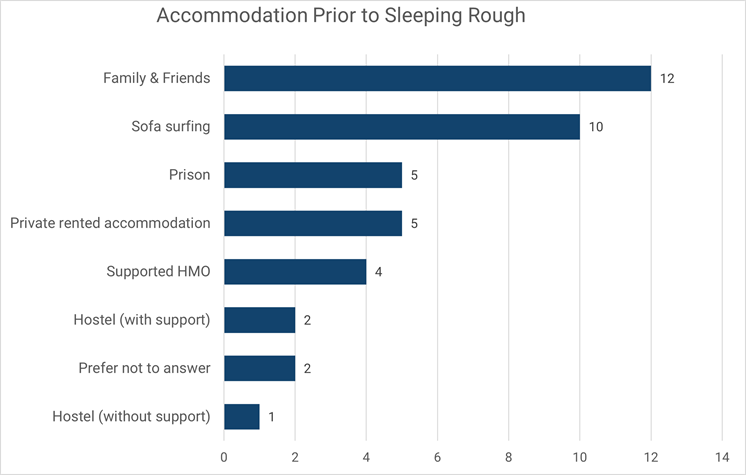
|
Accommodation Type |
Count |
|---|---|
|
Hostel (without support) |
1 |
|
Prefer not to answer |
2 |
|
Hostel (with support) |
2 |
|
Supported HMO |
4 |
|
Private rented accommodation |
5 |
|
Prison |
5 |
|
Sofa surfing |
10 |
|
Family & Friends |
12 |
The interviews showed that many people lost their last settled accommodation due to being asked to leave or evicted, often linked to behavioural issues. Relationships and family breakdowns were another common factor, alongside experiences of domestic violence and time spent in prison.
A smaller group mentioned financial pressures or other personal circumstances. Overall, the findings highlight how conflict, instability, and vulnerability frequently contributed to housing loss and the move into rough sleeping.
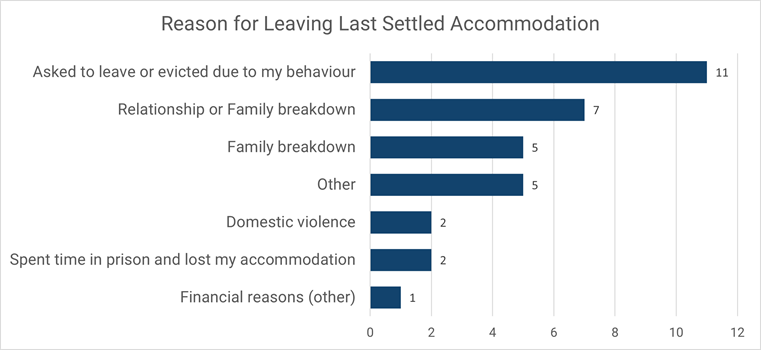
|
Reason for Leaving |
Count |
|---|---|
|
Financial reasons (other) |
1 |
|
Spent time in prison and lost my accommodation |
2 |
|
Domestic violence |
2 |
|
Other |
5 |
|
Family breakdown |
5 |
|
Relationship or Family breakdown |
7 |
|
Asked to leave or evicted due to my behaviour |
11 |
Clients described varied experiences of homelessness, often moving between insecure housing and rough sleeping. Many had sofa surfed or used council emergency accommodation, while others stayed in hostels, squats, or refuges.
Rough sleeping was common, with people reporting time in tents, vehicles, or outdoors either alone or with others. These findings highlight the instability and range of precarious living situations faced.
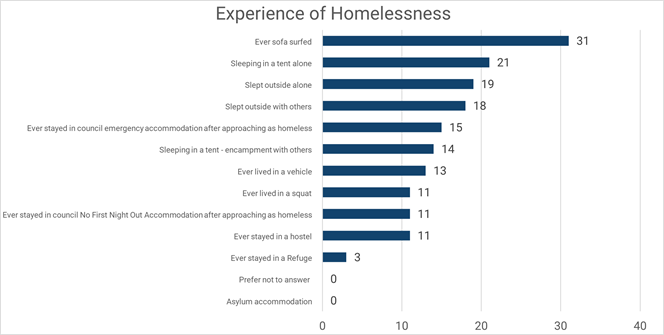
|
Experience Category |
Count |
|---|---|
|
Ever sofa surfed |
31 |
|
Sleeping in a tent alone |
21 |
|
Slept outside alone |
19 |
|
Slept outside with others |
18 |
|
Council emergency |
15 |
|
Sleeping in a tent |
14 |
|
Lived in a vehicle |
13 |
|
Ever stayed in a hostel |
11 |
|
Ever stayed in NO First Night |
11 |
|
Ever lived in a squat |
11 |
|
Ever stayed in a Refuge |
3 |
Health issues
The main health issues reported within this cohort included joint and muscle pain, dental problems and chest or breathing difficulties, alongside circulation issues, skin conditions, stomach or bowel problems, and foot ulcerations.
While these concerns highlight significant health inequalities, the data also shows a positive shift compared to three years ago: clients are now accessing medical support more regularly, with many engaging with GPs and some using specialist services such as the health bus and homeless vulnerable nurse. This increased contact with healthcare agencies marks an important change, suggesting improved pathways to support that were not previously in place.
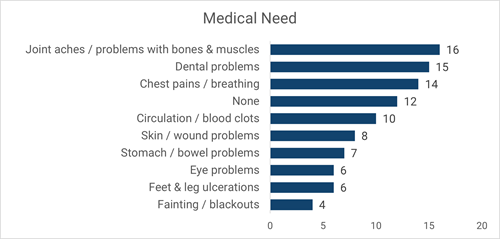
|
Medical Need |
Value |
|---|---|
|
Joint aches / problems with bones |
16 |
|
Dental problems |
15 |
|
Chest pains / breathing |
14 |
|
None |
12 |
|
Circulation / blood clots |
10 |
|
Skin / wound problems |
8 |
|
Stomach / bowel problems |
7 |
|
Feet & leg ulcerations |
6 |
|
Eye problems |
6 |
|
Fainting / blackouts |
4 |
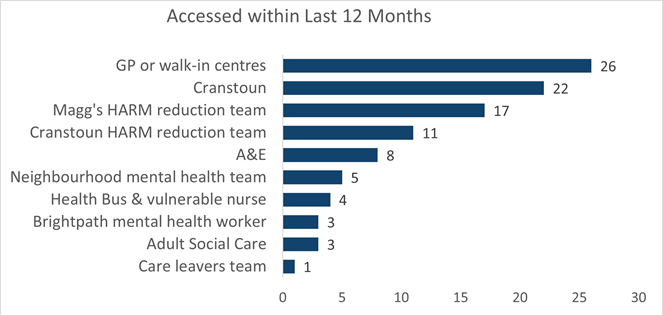
|
Service Accessed |
Value |
|---|---|
|
GP or walk‑in centres |
26 |
|
Cranstoun |
22 |
|
Magg's HARM reduction team |
17 |
|
Cranstoun HARM reduction team |
11 |
|
A&E |
8 |
|
Neighbourhood mental health team |
5 |
|
Health Bus & vulnerable nurse |
4 |
|
Adult Social Care |
3 |
|
Bright path mental health worker |
3 |
|
Care leavers team |
1 |
Support
Rough sleepers reported high levels of engagement with housing-related services, particularly local authority homeless and outreach teams, which were accessed by many. Charities, voluntary organisations, and food banks also played a significant role in providing support.
Alongside these, clients engaged with health services such as GPs, community resources like soup kitchens and cafes, and a large number were accessing countywide drug and alcohol services, including the new harm reduction teams.
Overall, the findings show strong connections with housing and outreach services, complemented by wider support from voluntary, health, and specialist agencies.
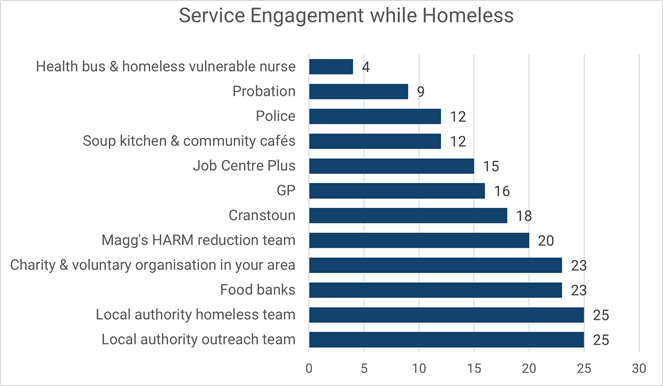
|
Service |
Value |
|---|---|
|
Local authority outreach team |
25 |
|
Local authority homeless team |
25 |
|
Food banks |
23 |
|
Charity & voluntary organisation in your area |
23 |
|
Magg's HARM reduction team |
20 |
|
Cranstoun |
18 |
|
GP |
16 |
|
Job Centre Plus |
15 |
|
Soup kitchen & community cafés |
12 |
|
Police |
12 |
|
Probation |
9 |
|
Health bus & homeless vulnerable nurse |
4 |
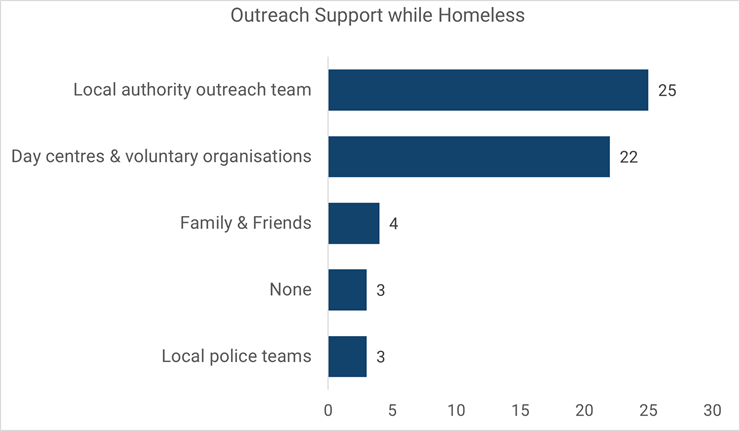
|
Support Type |
Value |
|---|---|
|
Local authority outreach team |
25 |
|
Day centres & voluntary organisations |
22 |
|
Family & Friends |
4 |
|
Local police teams |
3 |
|
None |
3 |
Future accommodation
Most clients currently rough sleeping expressed a clear preference for self‑contained flats or supported accommodation within their district. The findings highlight that tenancy support is essential, as people want stable housing but also need ongoing help to sustain it.
Importantly, clients also stressed the need to remain in their local area so they can continue engaging with familiar support services and agencies, which are vital for maintaining stability and reducing the risk of repeat homelessness. These findings will feed into the development of a Supported Housing Strategy which is required to be developed by the Supported Housing (Regulatory Oversight) Act 2023.
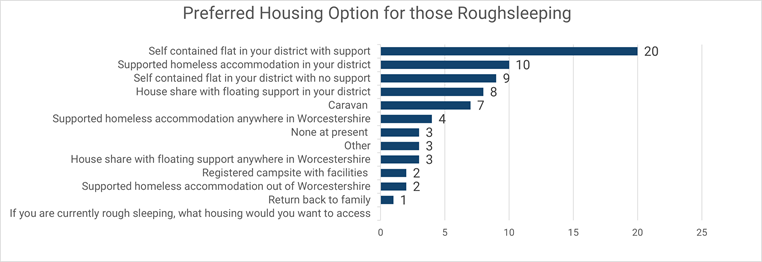
|
Housing Option Preferred |
Count |
|---|---|
|
Self-contained flat in your district with support |
20 |
|
Supported homeless accommodation in your district |
10 |
|
Self-contained flat in your district with no support |
9 |
|
House share with floating support in your district |
8 |
|
Caravan |
7 |
|
Supported homeless accommodation anywhere in Worcestershire |
4 |
|
House share with floating support anywhere in Worcestershire |
3 |
|
Other |
3 |
|
None at present |
3 |
|
Supported homeless accommodation out of Worcestershire |
2 |
|
Registered campsite with facilities |
2 |
|
Return back to family |
1 |
Former rough sleepers without secure housing mainly wanted self‑contained flats with support in their local area. A few preferred supported accommodations, while some had no clear preference. The results underline the need for stable housing with tenancy support close to existing services.
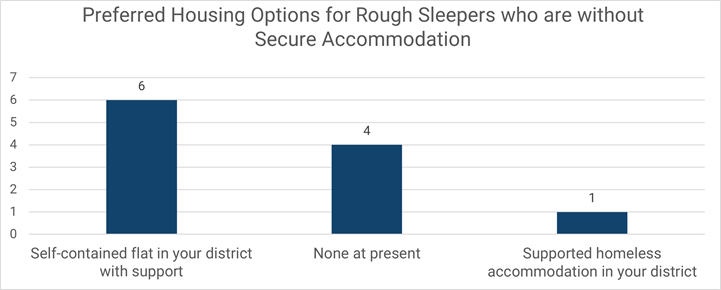
|
Housing Option |
Value |
|---|---|
|
Self‑contained flat in your district with support |
6 |
|
None at present |
4 |
|
Supported homeless accommodation in your district |
1 |
Findings show that people experiencing homelessness often moved between insecure housing and rough sleeping, with many preferring self‑contained flats or supported accommodation in their local area.
Health needs were widespread, and there has been a clear increase in engagement with local support networks, including access to health and recovery services. This highlights the importance of tenancy support and staying connected within their community to maintain stability and reduce repeat homelessness.
Domestic abuse
The Countywide Lived Experience Advisory Network was established in response to duties under the Domestic Abuse Act 2021 by Worcestershire and Herefordshire County Councils. There are 29 members from Worcestershire (as at 2025) and the network facilitates engagement at three levels. This allows all survivors to participate, choosing how and when to engage depending on their personal circumstances whilst still enabling them to have their voices heard. There are many complexities to recovery from domestic abuse – often as lone parents and in new surroundings, with ongoing legal processes and financial challenges. The model recognises that survivors have busy lives in which it is sometimes difficult to accommodate additional commitments. In addition all the LHAs conducted their own lived experience survey in Spring 2024 completed by 39 survivors. This identified the importance of the Domestic Abuse Housing Officer role in providing support and making services accessible, ensuring Housing Staff were well trained around DA and the difficulties in moving into temporary accommodation for some survivors due to it being away from support networks.
Young people
Feedback from young people supported by Wyre Forest and South Worcestershire Nightstop.
In December 2025 WFDC met with three young people who had been supported by Wyre Forest and South Worcestershire Nightstop. Below is a summary of their views on homelessness and their experiences.
What worked well
- Nightstop
- Tenancy training
- Foodbanks
- CAB positive
- Basement Project
- Household Support Fund
- Housing advice teams in some councils
What had they struggled with?
- Lacking financial acumen including knowledge of service charges, council tax, managing universal credit, costs of travel (to college), dealing with utility companies
- Length of time they were in supported housing before being rehoused despite being tenancy ready
- Shared housing and being with mixed households types in temporary accommodation
- Responses from some staff in schemes in certain situations, feeling judged or lack of support
- Having to tell their story multiple times
- Feeling brushed off or rushed and not listened to as part of the homelessness process
Feedback from young people supported by The Basement Project
Feedback from young people with lived experience of homelessness provides insight into what support and intervention supported young people, how it felt and the impact on the young person’s life. Young people were asked what could have helped them prevent or reduce the impact of homelessness.
Young people told us:
- Early intervention is critical, but it was inconsistent
- They experienced emotional barriers to accessing help and support, they felt like failures and were fearful of judgement
- Services are not designed for young people, because young people lack self-confidence, they are inexperienced and have difficulty navigating systems
- They lacked knowledge about where to turn to first and how to navigate the council. Some sought help from social services, police or schools but received no early intervention
- When they did get help and support, from family, friends and support workers, it made a significant difference, building their confidence with paperwork and navigating organisations. Help with paperwork, emotional support, navigating bureaucracy and advocacy made a big difference
- Neurodiversity and mental ill health were barriers to dealing with councils
- The reason for their homelessness was mainly due to decisions / circumstances of their parents, and they did not feel they could influence / prevent their homelessness. Some believed that support services designed to support people with mental ill health and neurodiverse people, may have helped relationships
- They wished that people around them would have checked if things weren’t going well at home and that services were more person centred, understanding the impact of poor mental health and neurodiversity
- Homelessness has a significant impact on mental health, one young person explained how they were paralysed by every task and were struggling to do the most basic things to exist.
- Periods of homelessness leave a legacy, a lasting trauma. People need help with the long-term effects, that is emotional, social and mental health support.
The homelessness strategy seeks to increase oversight and engagement with PWLE to inform service delivery and track progress against the strategy.
Mapping data
Rough sleeping and the prevention of rough sleeping
“No First Night Out” provision is available in all 5 local housing authority areas. The initiative provides short term accommodation to people who are not in priority need and at risk of, or actually, rough sleeping. Support is aimed at moving people on to secure, stable accommodation, preventing the highly damaging experience of rough sleeping or developing an entrenched rough sleeping lifestyle.
Housing Led/Housing First intensive housing and support is provided across all areas and gives individuals with a history of rough sleeping and complex needs are housed and provided with a bespoke package of wraparound support.
All areas provide a rough sleeper outreach service, and a Harm Reduction drop-in service which supports those with substance use issues is available in some areas.
County wide substance use and mental health outreach services provide specialist support for people with complex needs and a history of homelessness. A specific rough sleeper mental health service, Bright Path, has been established to provide mental health outreach services.
Nationally, Streetlink provides an on-line platform for members of the public and partners to report those seen rough sleeping. These reports are forwarded to local homelessness services so that individuals can be located and offered support.
Harm reduction services
Two services work across Worcestershire, one providing community-based alcohol, drugs and support services for both adults, young people and families. The other focuses on building trusted relationships with people who may feel excluded from mainstream services, helping them stay as safe and well as possible while reducing the risks associated with drug and alcohol use.
Single people
Countywide accommodation and support is provided for homeless people. Housing options and homelessness prevention advice is provided in all local authority areas. Support to access the private rented sector is provided in all five districts. Citizens Advice services are available in all districts.
Young people
There are funded supported housing and emergency accommodation for young people in all 5 areas. Floating support is available countywide to support young, homeless people. Young people vulnerable to child criminal exploitation are supported countywide as well as programmes to raise young people’s awareness of sexual abuse. Nationwide programmes focus on education, for example supporting young people to understand healthy relationships, delivered in schools and colleges. Wyre Forest also deliver a homelessness education programme in schools through Nightstop.
In Bromsgrove and Redditch support is available for young people with special educational needs and LGBTQ+ young people. Bromsgrove District Council also fund a young person’s floating support and drop-in service. In Bromsgrove, Redditch and Wyre Forest youth club provision/ Nightstop provides support and mediation.
Families
Homelessness prevention is provided by all 5 local housing authorities, working closely with the statutory and community and voluntary sector. In Malvern Hills, Wychavon and Wyre Forest a multi-agency panel approach is used to support prevention. Foodbanks operating across the county often also provide more general support, such as signposting and job search advice as well as the provision of food parcels. Bromsgrove provides a tenancy support service for families at risk of homelessness.
The Starting Well partnership is provided across the county, with family hubs in each district. Worcestershire Parenting Service also offers opportunities for parents to come together to share experiences and gain knowledge and skills.
Prison leavers
Two services work across the county. One works to reduce reoffending by providing support, housing, health and criminal record advice. A second is a multi-agency approach to tackling persistent offenders who commit a lot of crime, causing damage and nuisance to communities. This includes serial domestic abuse perpetrators. The approach recognises that repeat offenders have multiple problems which contribute to their offending which cannot be addressed by a single agency. Accommodation based services for ex-offenders are based in Bromsgrove and Redditch.
Domestic abuse
Services to support people experiencing and recovering from domestic abuse are available through national, county and local providers.
Across Worcestershire
Each Worcestershire housing authority joint funds domestic abuse housing officers (with the County Council) and a county wide coordinator to ensure well-trained, specialist support is offered when victim / survivors of domestic abuse approach local housing options teams. All services are working to a whole family approach. Worcestershire County Council and all six local housing authorities work together, pooling funding, working jointly across statutory and commissioned domestic abuse services and overseeing performance in relation to domestic abuse and delivering the duties within the Domestic Abuse Act 2021.
A Sanctuary scheme, working across Worcestershire, enables victim / survivors to choose to stay in their own home with additional security. A community based domestic abuse service, working across the county, enables victim / survivors to access support with all elements of life close to where they live. West Mercia Women’s Aid provides independent domestic abuse adviser service, accommodation-based refuge provision and face-to-face support. Legal advice and support through the criminal justice system is available, including specialist support for victim / survivors of sexual assault. Child to parent domestic abuse advice is available to professionals supporting people. Support for male and LGBTQ victim survivors is provided and schemes to work with domestic abuse perpetrators.
Within each local housing authority, a variety of services are funded to support individuals, family and young people victim / survivors of domestic abuse. These include domestic abuse advice and support and accommodation-based refuge.
Nationwide
A range of services are available for victim / survivors of domestic abuse as well as other criminal justice help, advice and support.
Domestic abuse support and advice services available to victim / survivors include:
- National helplines for victims / survivors
- Support for professionals
- Support for lesbian, gay, bisexual and transgender people
- Support for child victims / survivors
- Cat and dog fostering
- Legal advice and services
- Forced marriage and honour-based violence
- Asian and Muslim women
- Jehovah’s witnesses
- Deaf people
- Armed forces, current and previously served
- Victim / survivors of economic abuse
- Advocacy after fatal domestic abuse
In addition, victim / survivors also have access to nationally provided support around the criminal justice system and victim support. These services include:
- Outreach support for victims / witnesses in advance of giving evidence in court
- Sexual abuse support line
- Male sexual assault survivors
- National stalking helpline
- Reporting on-line sexual abuse
- How to remove nude images
- Modern slavery support helpline
- Access to legal aid
- Digital and on-line abuse
Veterans
Nationwide services are available for veterans of the armed forces. These include support with addiction, relationship breakdown, debt, homelessness, post-traumatic stress, depression and disability, support and advice with care and independent living, physical and mental wellbeing, financial and employment and community connections. Worcestershire utilises a multi-agency approach to prevent veteran homelessness by working with specialist Partners: SSAFA Worcestershire, The Royal British Legion, and Stepway to provide holistic support that addresses the root causes of housing instability, such as debt or mental health issues. Housing Associations: Registered Providers like the Rooftop Housing Group offer "Homes for Veterans" schemes, specifically tailored to help former service personnel transition into civilian tenancies.
Older people
Age UK provide services across all housing authorities, including, befriending, information & advice, 'At Home' services, foot care, activities (Keep Fit, Tai Chi), Information & advice, social clubs (Connect Club, dancing, creative) and dementia support.
Refugees and migrant homelessness
A number of volunteer led groups are in place across the county, providing a range of support and advice to refugees, migrants and asylum seekers. This includes support with housing, education training and employment, health, language and legal advice.
Cost of living support
Utility companies provide nationwide schemes for people struggling with their energy and water costs. Locally, there are a multitude of local charitable grant giving bodies that support people with reducing arrears and securing accommodation.
Free and impartial advice is available across the county on how to reduce fuel bills and warm homes grants. Practical information and support to end financial insecurity is provided countywide. The Act On Energy website provides a free Benefits Calculator and Grants Search to find out what help people can get.
All local housing authorities provide welfare assistance, including discretionary housing payments. Malvern Hills, Wychavon and Bromsgrove are also served by furniture projects. Foodbanks operate across all authorities, several in some areas. In Bromsgrove and Redditch, and Malvern Hills and Wychavon people can also access an income maximisation and housing service.
Our homelessness review shows a whole range of services across Worcestershire, delivered by the voluntary, community and faith-based and statutory sector. Each of these services plays a part in supporting people when they are homeless or at risk of homelessness. Services for people experiencing and surviving domestic abuse, at both the national and local level, have developed to empower, protect, advise and support people, reducing the impact of domestic abuse on the whole family. Worcestershire County Council continue to review needs and the feedback from victim / survivors about the most useful ways to continue to improve services and address any gaps. Worcestershire local housing authorities work closely with the county council to ensure domestic abuse housing officers provide specialist support, linking people to safe accommodation and a range of other support services.
Over the life of the previous strategy, services to support people sleeping rough or at risk of sleeping rough have developed significantly. Services focus on working closely with individuals through, coordination, networking, keeping in touch with people through outreach, identifying appropriate housing and addressing vulnerabilities and support needs such as poverty, abuse, mental health conditions and substance use. The development of a new strategy and meeting new national priorities to halve long term rough sleeping, is an opportunity to continue to collaborate with people with lived experience and to develop services and networks to make sure root causes are addressed. Mapping of supported housing highlights a lack of accommodation with support across the county. There is some specialised housing with support services in Worcester and an intensive support plus housing model across the county. However, the homelessness review has identified that supported housing models have a key role to play in supporting long term rough sleepers. The implementation of the Supported Housing (Regulatory Oversight) Act and statutory duty to assess current provision and gaps in provision provides further opportunity to better understand and remedy any gaps in supported housing supply.
The mapping of services shows that across the 5 local authority areas there are support services for young people at risk or experiencing homelessness. However, there is not a consistent offer of support for young people across the whole area. Young people have expressed the value of advocacy and advice in helping them navigate through difficult situations, particularly from people they can trust. Young people report they often find dealing the council’s homelessness services difficult. Services supporting young people report that, with advocacy, young people achieve a better outcome with their housing difficulties. Across the life of the new strategy, we will develop services for young people to make sure they are designed to meet needs, prevent homelessness and build resilience to avoid repeat homelessness. Supported housing models for young people are also available in some parts of the 5 areas, the review of supply will enable consideration of where accessible, specialist supported housing for young people can serve to prevent homelessness.
Reviewing existing services and the development of new services and networks, during the new strategy will enable us to achieve the priorities of the national plan to end homelessness. We must, move from expensive crisis responses to prevention, focus on people vulnerable to repeat homelessness, take a holistic approach to meeting people’s support needs as well as housing needs, improve the quality of our emergency responses and address recovery from periods of homelessness and rough sleeping. For all groups of people experiencing periods of homelessness, we will ask how effective our current services are, where are the gaps and what links should we be making to help people with support needs. We will use this feedback from people with lived experience to guide and inform our work.
Partner information
The councils who undertook this review recognise that there is a wealth of data sets available from partner organisations, both in the voluntary and statutory sectors which are not fully represented in this review.
However, there is an action within the strategy itself to make more effective use of data, and the councils are committed to using a range of data to inform homelessness prevention services and track strategy progress.
The information below is from partner organisations with whom the district councils directly commission.
|
People supported in 22-23 |
People supported in 23-24 |
People supported in 24-25 |
|
|---|---|---|---|
|
HoPES Service (Caring for Communities and People) Supporting single people and childless couples who are homeless or at risk of homelessness |
228 |
283 |
292 |
|
SWEP (Caring for Communities and People) Severe Weather Emergency Protocol service – emergency bed spaces for rough sleepers during severe weather |
118 |
111 |
127 |
|
Housing First/Housing Led (St Paul’s Hostel) Intensive housing and support offer for complex rough sleepers Please note that Wyre Forest District Council operate their own Housing Led approach internally and assisted people directly. This Housing First data only includes service users in Bromsgrove, Malvern, Redditch and Wychavon. |
As at November 2022, the service was supporting 28 single homeless people. |
As at November 2023, the service was supporting 21 single homeless people. |
As at November 2024, the service was supporting 24 single homeless people. |
|
Community Mental Health Link Workers (Onside) Bromsgrove Malvern Hills Redditch Wychavon Wyre Forest Specialist service to assist those with mental ill health who approach councils for homelessness assistance. |
Not operational in Worcestershire in 2022/23 |
Only operational in Wyre Forest in 2023/24 72 |
82 35 55 52 45 |
Resources
Homelessness Prevention Grant 2025/6
Homelessness services across the districts are funded through a combination of district council general fund budgets and targeted grant funding from the Ministry of Housing, Communities and Local Government (MHCLG), most notably the Homelessness Prevention Grant (HPG).
The HPG is a ringfenced funding stream and is required to be deployed in line with national policy objectives. Its strategic purpose is to strengthen early intervention and prevention activity, ensuring full and consistent implementation of the Homelessness Reduction Act, while contributing to the ambition of ending rough sleeping through increased prevention of single homelessness.
The HPG is also intended to reduce reliance on temporary accommodation, particularly for families. This includes maximising opportunities for family homelessness prevention, reducing the overall number of families placed in temporary accommodation, and eliminating the use of bed and breakfast accommodation for families beyond the statutory six-week limit.
Strategic deployment of HPG will focus on targeted prevention, effective use of temporary accommodation alternatives, and system-wide approaches that deliver sustainable housing outcomes while reducing financial and operational pressures on local authorities.
The allocations in 2025/26 are as follows;
|
Housing Authority |
Grant (£) |
|---|---|
|
Bromsgrove District Council |
£383,917 |
|
Malvern Hills District Council |
£402,595 |
|
Redditch Borough Council |
£776,429 |
|
Wychavon District Council |
£811,670 |
|
Wyre Forest District Council |
£664,560 |
This funding supports the delivery of a range of coordinated interventions across the county aimed at preventing and reducing rough sleeping. These include No First Night Out and No Second Night Out emergency accommodation, designed to minimise the number of nights individuals spend sleeping rough; housing pathway, intervention and transition worker roles that provide targeted support to secure and sustain accommodation; a countywide Rough Sleeping Coordinator role operating across the districts to ensure strategic oversight of rough sleeping interventions, partnership working and system alignment; and the delivery of Housing-Led and Housing First accommodation to provide settled housing with appropriate wraparound support for individuals with complex needs.
At the time of writing this review, the Government had recently announced the new homelessness funding allocations for 26/27-29/30 via a multi-year provisional settlement. This section will be updated once further government guidance has been provided on the new grant arrangements, however the LHAs welcome a longer-term funding allocation to enable longer-term strategic plans to prevent homelessness.
Domestic Abuse Act Funding for Domestic Abuse Housing Officers 2025/6
|
Housing Authority |
Grant (£) |
|---|---|
|
Bromsgrove District Council |
£33,666 |
|
Malvern Hills District Council |
£33,666 |
|
Redditch Borough Council |
£33,666 |
|
Wychavon District Council |
£33,666 |
|
Wyre Forest District Council |
£33,666 |
Funding for domestic abuse services is essential to ensure the provision of dedicated, specialist officers who can effectively respond to victims and survivors. These officers play a critical role in early intervention, risk assessment, safeguarding, and multi-agency coordination. Sustained investment will allow for improved response times, consistent victim support, enhanced offender management, and better outcomes for families affected by domestic abuse. Funding will support recruitment, specialist training, and retention of officers, ensuring victims receive trauma-informed, timely, and effective protection while reducing repeat incidents and long-term harm within communities.
Domestic Abuse Act funding (to implement the requirements of the Domestic Abuse Act 2021) 2025/6
|
Housing Authority |
Grant (£) |
|---|---|
|
Bromsgrove District Council |
£35,774 |
|
Malvern Hills District Council |
£34,742 |
|
Redditch Borough Council |
£35,697 |
|
Wychavon District Council |
£34,855 |
|
Wyre Forest District Council |
£33,835 |
Household Support Fund (HSF)(2025/26)
HSF 7 Allocation April 25 – March 26
|
District Council 12 month allocation |
General allocation |
Food/warm space allocation |
Total |
|---|---|---|---|
|
Bromsgrove |
£171,321.39 |
£18,000.00 |
£189,321.39 |
|
Malvern Hills |
£235,312.23 |
£18,000.00 |
£253,312.23 |
|
Redditch |
£329,900.14 |
£18,000.00 |
£347,900.14 |
|
Worcester |
£298,995.28 |
£18,000.00 |
£316,995.28 |
|
Wychavon |
£230,918.03 |
£18,000.00 |
£248,918.03 |
|
Wyre Forest |
£328,625.52 |
£18,000.00 |
£346,625.52 |
|
Total |
£1,595,072.59 |
£108,000.00 |
£1,703,072.59 |
The Household Support Fund (HSF) is intended to provide targeted financial assistance to vulnerable households who are struggling to meet the cost of essential living expenses. The fund aims to prevent crisis, reduce hardship, and support households to maintain stability.
Discretionary Housing Payments (2024/25)
|
Housing Authority |
Grant (£) |
|---|---|
|
Bromsgrove District Council |
£62,332 |
|
Malvern Hills District Council |
£75,651 |
|
Redditch Borough Council |
£79,296 |
|
Wychavon District Council |
£112,099 |
|
Wyre Forest District Council |
£110,242 |
Discretionary Housing Payments (DHPs) provide short-term financial assistance to households who require additional help with housing costs and are in receipt of Housing Benefit or the housing element of Universal Credit. The fund aims to prevent homelessness, sustain tenancies, and support households during periods of financial difficulty.